
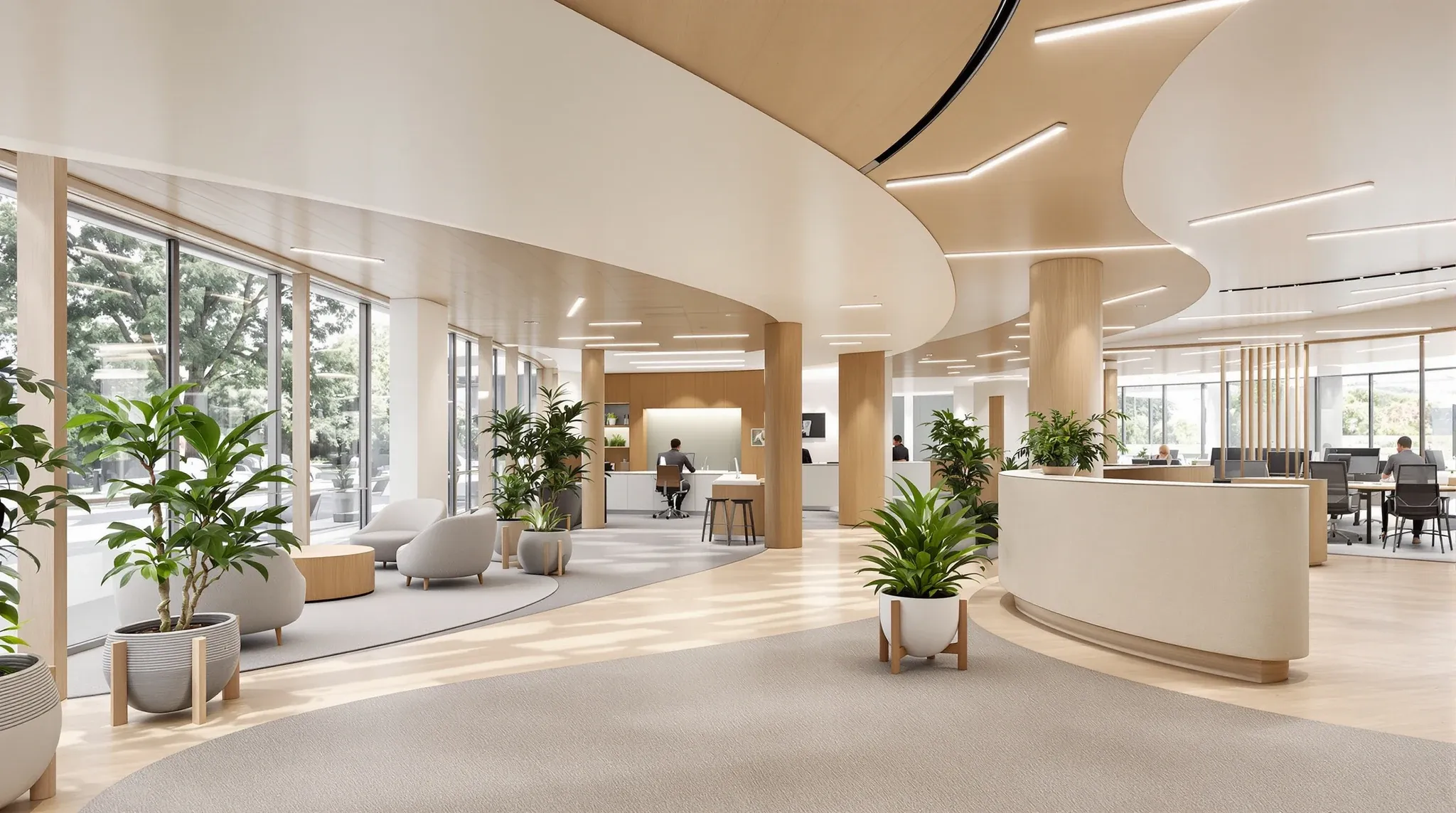
Not-for-profit organisations occupy commercial offices the way every other tenant does, but the brief they bring to a fitout sits differently. The space has to support a small paid team and a larger volunteer base, host board and committee meetings alongside member or donor-facing interactions, and present a credible professional front to stakeholders who are also usually the source of the organisation’s funding. All of this usually needs to happen on a budget that is tighter than a comparable commercial tenancy, and with a stronger obligation to demonstrate that the spend was responsible.
The fitout decisions that suit an NFP are rarely the same as those that would suit a commercial professional services firm of similar headcount. Where the commercial firm can choose premium finishes on the assumption they drive revenue, the NFP has to weigh the same decision against its impact on donor perception. Where the commercial firm can specify the meeting room mix for internal productivity, the NFP usually has a bigger external-meeting load for its size. These differences shape almost every line on the brief.
Commercial Realities Of Not-For-Profit Workspaces
Most NFP offices in Sydney operate with a relatively small full-time staff, a significant volunteer or part-time base, and a high-cadence event and meeting schedule. An organisation with twenty full-time employees may host three hundred board, committee, volunteer, member, and donor visits through the office in a year. The room mix that suits a twenty-person commercial firm, with one or two meeting rooms and a large open-plan area, does not serve an NFP operating at that visit density.
The operational pattern also runs differently through the week. A Tuesday evening board meeting, a Thursday volunteer orientation, a Saturday workshop, and a Monday morning donor briefing are not unusual for a mid-sized NFP. The office needs to support all of these comfortably, which means the meeting and event spaces need to be usable without the paid team present, secure when they are in use out-of-hours, and adaptable between configurations without tradies on call.
The headcount also tends to fluctuate more than in a commercial office. Seasonal campaigns may push the office population up by fifty per cent during a three-month window, typically with volunteers or short-term contractors occupying hot-desk positions rather than dedicated workstations. The fitout needs to absorb these fluctuations without looking under-utilised during quiet periods or overwhelmed during busy ones.
Managing Donor And Public-Facing Aesthetics
The arrival experience of an NFP office matters more than headcount alone would suggest, because the people walking through the door are often also the people whose contributions keep the organisation running. A donor arriving for a small-gift briefing, a major donor arriving for a one-on-one conversation, a board member arriving for a committee meeting, or a media visitor attending a press briefing all form an impression of the organisation within seconds of entering.
The impression that serves an NFP best is almost never “expensive”. A lavish reception signals to donors that their contributions are being spent on overheads rather than mission delivery. Equally, a visibly cheap or neglected reception signals that the organisation is not well-run, which undermines donor confidence in a different way. The working position for most NFP offices is a reception that reads as considered, clean, and functional, without reaching for premium materials.
Specific elements that serve this position well include clear signage of the organisation’s name and brand, a reception desk in a proportionate size rather than a hotel-scale feature, a small waiting area with comfortable but not luxurious seating, and consistent lighting across the arrival zone. Where the organisation’s work is visible through its own storytelling, whether photography, recognition walls, or impact displays, the reception becomes a chance to communicate mission rather than a lobby statement. That is usually the stronger spend. The principles of a high-functioning reception apply, with the adjustment that the budget and the tonal register land differently than in a corporate tenancy.
Optimized Board And Committee Environments
NFPs typically host more formal board and committee meetings than commercial offices of similar size, because governance obligations require regular board meetings, committee meetings, and sub-committee work. A meeting room scaled for a twenty-person commercial office (usually a six to eight-seat room) is often too small for an NFP board of ten to fifteen members plus the executive team.
The practical answer for most NFP tenancies is one larger board-capable room, typically ten to fourteen seats, with proper audio-visual integration for remote board members, and a second smaller room for executive one-on-ones, donor meetings, and paired work. A room that can reconfigure between these uses through a movable wall adds flexibility at some acoustic cost; most NFP offices find a fixed configuration more reliable over time.
Where the organisation hosts evening or weekend meetings, the board room needs to operate independently of the rest of the office. A separate entry path, independent lighting control, and audio-visual equipment that can be set up by the board chair without IT support are all practical requirements that are easy to specify at brief stage and expensive to add later.
Flexible Meeting And Event Solutions
Most NFP offices need at least one space that can host a group of twenty to forty people. Depending on the organisation’s mission, that space hosts workshops, training sessions, volunteer inductions, community briefings, member events, or partnership forums. On a smaller footprint, this space is often the same room that serves as the board room, combined with breakout for seated workshop format.
The fitout decisions that make this space work are not complex but are easy to miss. Flooring that can handle a chair-heavy configuration without wear. Power outlets distributed across the room, not concentrated on one wall. Lighting that can shift between presentation mode (dimmed on screens, bright on participants) and meeting mode (evenly lit). Storage for stacking chairs and folding tables close to the room, not stored two floors down. Tea and coffee provision in the adjacent kitchen or breakout, scaled for event throughput, not just for the paid team.
Acoustic performance in this room carries double duty. It needs to contain sound from events so that the rest of the office can continue to function, and it needs to deliver clear speech within the room for presentations and training. Both are standard requirements but are often under-specified in budget-constrained NFP fitouts, with the result that events work poorly for the attendees and disrupt the paid team simultaneously.
Integrating Volunteer And Hybrid Work Zones
The typical NFP has a larger share of volunteer and part-time workers than a commercial office of similar size. These people occupy desk space when they are on site, which is usually sporadic. Allocating dedicated desks to volunteer staff rarely makes sense; the desks sit empty most of the time. Hot-desk or shared-desk arrangements work better, provided they are set up to allow quick access without administrative overhead.
A workable pattern is a dedicated volunteer zone with four to eight hot desks, basic equipment (screen, docking station, guest network), locker-style storage for personal effects while on site, and proximity to the amenity spaces volunteers use most. The zone should not be the prime real estate of the office, but it should also not be the worst corner. Volunteers who feel like second-class citizens in the space tend to disengage over time; volunteers who have a functional, respected place to work stay connected to the organisation.
Where the organisation’s volunteer base is fully remote with occasional office visits, the desk provision can be lighter. Where the volunteer base is substantial and regular, the zone may need to scale toward small team rooms rather than hot desks. The brief needs to reflect the actual pattern, not an assumed corporate one.
Strategic Budget Discipline And High Impact Investment
The single most useful discipline in an NFP fitout brief is explicit allocation of the budget against visibility and longevity. Money spent on visible elements that also last ten years is money that reads well to donors. Money spent on invisible but essential infrastructure (cabling, power, acoustic treatment) is money that avoids cost later. Money spent on premium finishes that look expensive is the hardest to defend and usually the first to cut.
The spend that usually pays back well for an NFP includes clear wayfinding and signage, good lighting throughout, acoustic performance in the meeting and event rooms, reliable audio-visual in the board room, durable flooring in circulation zones, and quality reception furniture that lasts a decade. The spend that usually does not pay back includes premium finishes in back-of-house zones, decorative lighting in staff areas, and any material upgrade that drives the cost-per-square-metre into the higher band without delivering operational benefit.
For NFPs working to a tight brief, the budget tier guidance in the Sydney office fit-outs under $100k discussion sets out how the trade-offs land at that price point. Larger tenancies operating at higher budgets still benefit from the same underlying discipline: name the elements that matter to visitors, spend on them, and strip cost elsewhere.
Frequent Pitfalls In Not-for-Profit Briefing
Several patterns recur in NFP fitout briefs that do not serve the organisation well. The first is over-scaling the meeting room to corporate standards and under-scaling the event space. A twenty-seat board room in a small NFP looks impressive but is used fortnightly; a larger event space used weekly is a better investment of the same footprint.
The second is under-investing in the volunteer zone. A hot-desk area sketched as an afterthought on the plan, with mismatched furniture and poor lighting, signals to volunteers that they are peripheral to the organisation. For organisations whose mission depends on volunteer engagement, the zone deserves proper design attention even if the square metre allocation is modest.
The third is misreading donor expectations. Some boards assume donors want to see a restrained, almost ascetic office to confirm their money is well-spent. Some assume donors want to see a professional, well-presented space to confirm the organisation is credible. Most donors sit in between: they want to see that the office is well-run and functional, without visible extravagance. Reading the board’s interpretation of donor expectations is often harder than the physical design itself.
The fourth is deferring the audio-visual specification. NFPs host hybrid meetings and events at higher rates than most commercial offices, and the AV equipment in the board and event rooms is used heavily. A fitout that specifies a basic projector and a speaker, with cabling run to a single wall position, usually finds within six months that the rooms cannot host the meetings they need to host. Specifying flexible camera positions, quality microphones, and hybrid-ready videoconferencing from the beginning costs a modest amount more and avoids the later retrofit.
Characteristics Of High-Performing Not-For-Profit Fitouts
The NFP offices that work best over time tend to share a common pattern. They are modest in their finish specification but disciplined in their planning. They have deliberately scaled event and meeting space against the actual operational cadence rather than against corporate convention. They look after their volunteer and part-time spaces as real working zones rather than overflow. They have invested carefully in reception and board room presentation without reaching for premium materials. And they have kept the money spent on invisible infrastructure, where it reduces long-term operating friction, without cutting it to fund visible upgrades.
If you are planning an NFP fitout and the brief is currently weighted toward corporate fitout conventions that may not match your operating pattern, we can walk through the meeting, event, and volunteer-space mix with you and help specify a full office fitout that serves the organisation without compromising the donor perception that funds it.
📞 Call us on 1300 60 93 93