
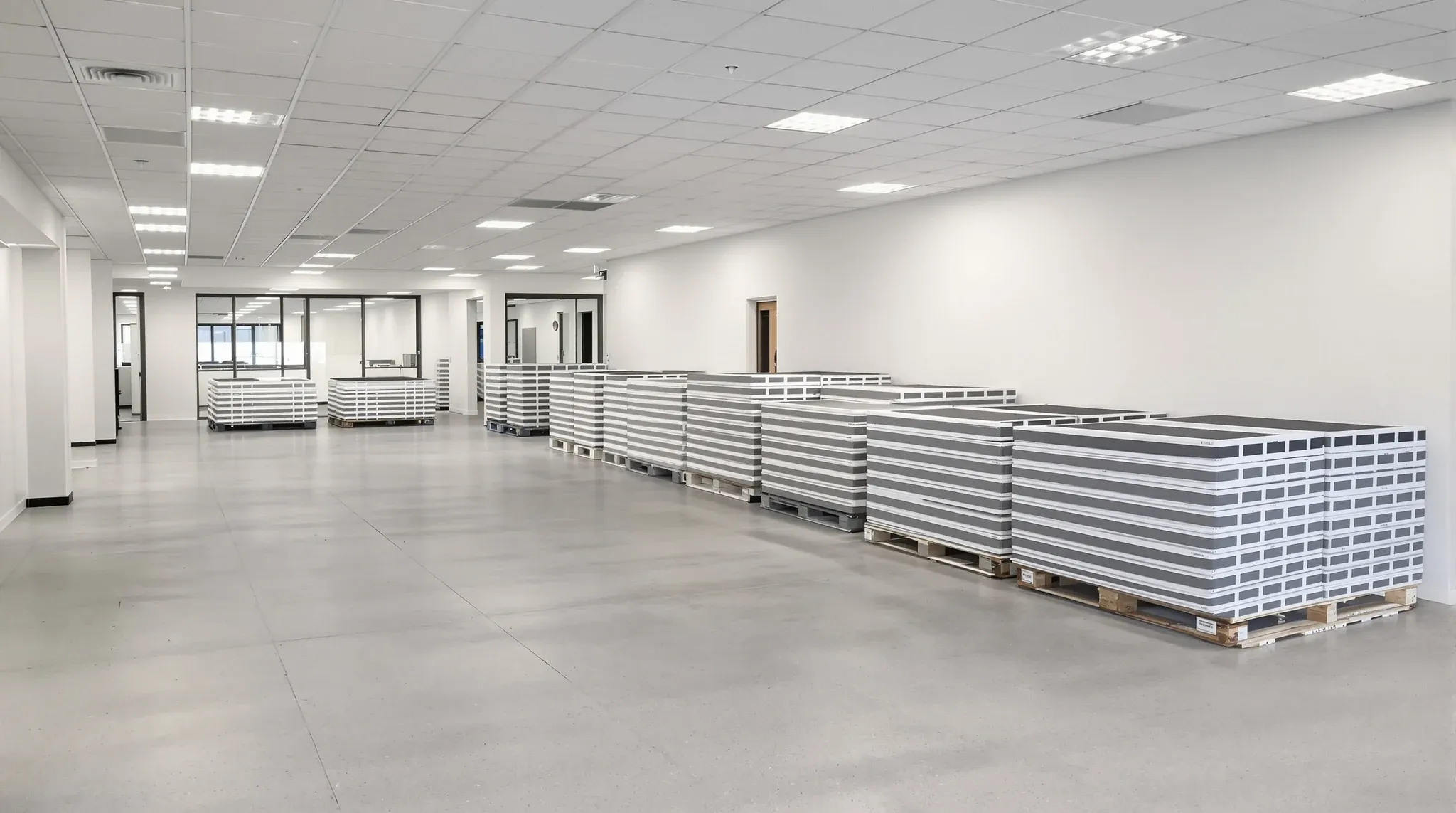
A raised access floor that carried power and data across the tenancy has to come up at lease end if the make good calls for base building condition, and what sits under it is rarely a clean slab. Lifting the panels, stripping the pedestals and getting the concrete back to a finishable level is the part that decides how big the job becomes. The panels themselves come up quickly; everything the floor was hiding is what turns a tidy removal into a real scope of works.
Most make good clauses written for a floor that was handed over flat will treat the access floor as a tenant alteration, which means it leaves with everything else as part of the defit and make good. The useful question at that point is not whether it comes out, but what the slab underneath needs before the floor can be signed back.
What lifting the floor actually puts on the table
Pulling up a raised access floor is three separate jobs that happen in order, and only the first one is quick. The finished panels lift off their pedestals by hand, the pedestals unbolt or grind off the slab, and then the concrete that has been covered for years gets assessed for what it needs to become a finishable surface again.
The pedestals are the catch. They are usually glued and sometimes mechanically fixed, and stripping several hundred of them leaves a grid of adhesive footprints and minor spalls across the slab. None of that is visible until the panels are gone, so the scope you can see at inspection and the scope you actually have are different numbers.
It helps to know how the floor went in to predict how it comes out. A system that was set out and installed cleanly as part of the original raised access floor fitout tends to lift in a predictable way, where pedestals release without taking chunks of the surface with them. A floor that was patched and re-cut over multiple churn events fights back at every fixing.
What the slab condition controls
The slab under an access floor is a working surface, not a finished one. It was never meant to be seen, so it can carry adhesive residue, levelling compound from the original install, core holes for old cabling risers, and the occasional saw cut. Each of those is a small remediation, and together they set the size of the make good.
Adhesive removal is the usual driver. Pedestal glue does not simply scrape off; it needs grinding back, and grinding a full floor plate is a measured, dusty operation that takes longer than the panel lift it follows. The finish the slab needs depends on what the make good clause asks for, which is often a clean, sealed, broom-finished surface rather than a polished one.
Old penetrations are the other variable. Cores cut for floor boxes or cabling drops have to be filled and made flush, and the cabling that ran through the void usually has to be removed in the same window. Coordinating that with the cabling removal the lease end requires keeps the void clear so the slab work is not interrupted halfway through.
Flatness is the quiet factor underneath all of this. A raised floor hides a slab that may dip, fall to old drainage points or carry a level change the access floor simply bridged with longer pedestals. Once the panels are gone, those variations are exposed, and bringing the slab to an even, finishable plane can mean a levelling screed across part of the floor rather than spot patching. How flat the slab needs to be depends on what the handback specifies and what, if anything, is going back on top of it.
The order the work has to run in
The sequence matters because each stage exposes the next. Lifting the panels gives access to the pedestals; removing the pedestals gives access to the slab; only then can the slab be assessed honestly. Trying to price or program the slab work before the panels are up is guesswork, which is why a staged approach beats a fixed quote on a floor nobody has seen under.
A typical run starts with the panels stacked and removed, usually for disposal or resale depending on their condition. The pedestals come next, ground flush where they will not unbolt. The slab is then cleaned back, with adhesive grinding and any patching of cores and spalls. Finally the surface is sealed or finished to whatever the handback specifies.
The volume of material is easy to underestimate. A floor of access panels and pedestals is heavy and bulky, and it all has to leave the building through the same lifts and dock the rest of the lease end works are using. In a tenancy being handed back, the access to remove that material, and the building’s rules for when it can move, often set the pace as much as the demolition itself, so the program is built around how fast the floor can physically be cleared rather than just how fast it can be lifted.
Where the floor void carried more than cabling, the services in it come out in step with the floor. Air paths, supplementary cooling and any plant that fed the void are part of the same lease end works, and the mechanical reinstatement the make good calls for usually overlaps this window so the floor and the services finish together rather than one waiting on the other.
What drives the cost
The panel lift is the cheap part and the most visible, which is why removal of a raised access floor is often underestimated. The money sits in the slab. Adhesive grinding, core filling and getting a large plate back to an even, finishable level are labour-heavy and time-bound, and the area involved scales every one of them.
Three things move the number most. The first is the fixing method, because glued pedestals cost more to clear than bolted ones. The second is the finish required, since a broom finish is a fraction of the work of a ground and sealed surface. The third is what else is in the void, as cabling, plant and penetrations each add their own line. These sit alongside the broader make good cost drivers across the floor, and the access floor is rarely the only item being reinstated at once.
Where the make good then calls for a new floor finish to be laid over the recovered slab, that becomes its own scope rather than part of the removal. The slab has to be clean and level before any carpet or flooring reinstatement can sit on it properly, so the two stages are priced separately even though they run back to back.
What handing back the floor actually means
The outcome the lease wants is a slab that reads as base building: even, sound, free of tenant fixings and ready for the next occupier to start from. A floor lifted carelessly leaves a slab that technically has no access floor on it but still fails inspection because the adhesive grid, open cores and uneven patches are all visible. The removal and the make good are judged as one result, not two.
That is why the slab assessment is the real deliverable, not the stack of panels. A make good is signed off on the condition of the surface, so the work is only finished when the concrete meets the standard the clause describes. Getting there cleanly the first time avoids a return visit to grind back a patch that was missed or fill a core that was left.
The practical risk of underscoping is a handback that gets knocked back, which costs both the remediation and the holdover while it is fixed. A floor assessed properly once the panels are up, with the slab work priced against what is actually there, is the version that signs off without a second round.
There is also a timing consequence worth planning for. Slab grinding and any levelling screed need time to be done and, where a screed is used, to cure before anything else can touch the floor. Leaving the access floor removal to the last week before handover gives no room for that, so the slab work is best sequenced early enough that the grinding, filling and curing all finish inside the lease rather than running into a holdover the curing time alone could cause.
Getting the scope right before the panels come up
The single most useful step is to treat the panel lift and the slab make good as connected but separately scoped, with the slab priced once it can be seen rather than guessed at inspection. That keeps the surprise out of the job, because the expensive part is committed to with the surface in front of you.
It also helps to read the make good clause for the finish it actually names, since the gap between a broom finish and a sealed surface is most of the slab cost. Knowing that early sets the right expectation and the right program. A raised access floor removal that is planned this way, with the void cleared and the services coordinated in the same window, hands back as a clean plate without a holdover fight at the end.
📞 Call us on 1300 60 93 93