
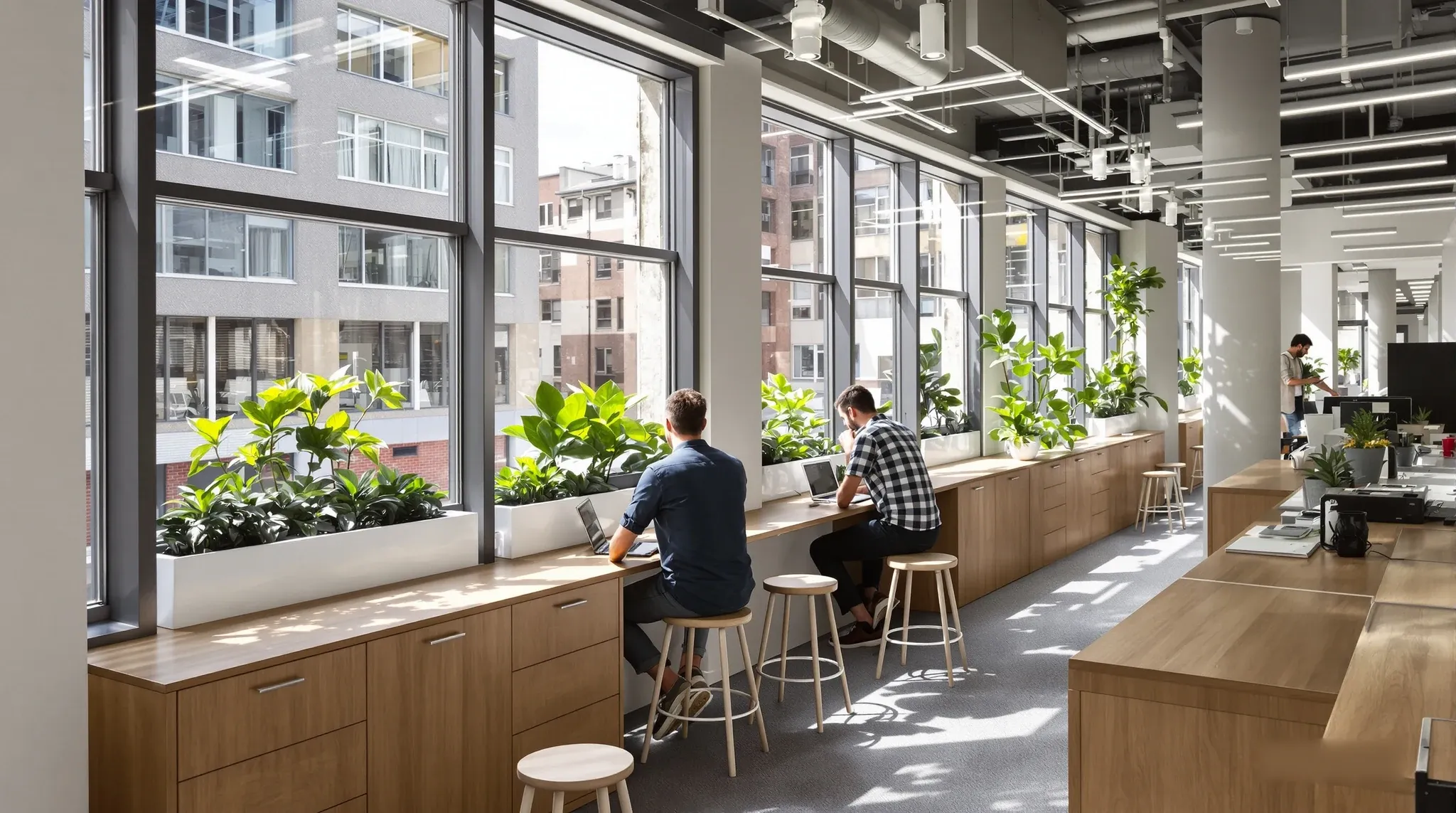
When a growing team starts feeling cramped, the first instinct is to look for more space. But moving to larger premises is expensive, disruptive, and may not be necessary. In many commercial offices, the space itself is not the problem. The layout is. Corridors that serve no purpose, meeting rooms sized for twelve people that regularly host three, enclosed offices that sit empty while the open plan overflows, and storage areas holding equipment that should have been cleared out two years ago all represent space that exists on the lease but does not work for the business.
Redesigning within the existing footprint is not about making the office feel smaller by cramming more desks in. It is about reconfiguring how the available area is used so that the space supports the business as it operates today, not as it operated when the fitout was originally designed.
Why Redesigning Within the Same Footprint Makes Sense
The financial argument for redesign over relocation is compelling. Moving to larger premises involves lease exit costs, fitout costs for the new space, make good costs on the existing space, relocation expenses, and the operational disruption of transitioning an entire team. A redesign within the existing footprint avoids most of these costs and delivers the result faster because the business stays in place.
There is also a lease argument. If the current lease has three or more years remaining, breaking it early to relocate carries a financial penalty that may exceed the cost of a redesign. Even where the landlord allows early termination, the terms are rarely favourable. Redesigning the existing space allows the business to maximise the value of the remaining lease term and defer the relocation decision until it can be made on better terms.
From a team perspective, a redesign is less disruptive than a move. Employees keep their commute, their local routines, and their familiarity with the building. Understanding how teams actually work rather than how they were expected to work when the layout was designed is the starting point for a redesign that delivers real improvement.
Where Most Office Layouts Waste Space
The most common sources of wasted space in commercial offices are oversized meeting rooms, underused private offices, excessive corridor width, and dedicated storage areas that could be consolidated. These are not design errors in the original fitout; they are the result of a layout designed for one set of circumstances being used in another.
Meeting rooms are a frequent target. A business that designed its fitout with two large boardroom-style meeting rooms may now find that it needs four smaller meeting spaces for video calls and two-person discussions. The total area allocated to meetings has not changed, but the way it is configured no longer matches how people actually meet.
Private offices are another common source of recoverable space. A layout designed with six enclosed offices along the window line for senior staff may now have three of those offices underused because the people who originally occupied them now work partly from home or prefer to sit with their teams. Converting those offices to shared meeting rooms, focus pods, or additional team area recovers valuable floor space without adding a single square metre to the lease.
Rethinking Partition Placement for Better Flow
Partitions define the layout, and in many offices the original partition placement creates bottlenecks, dead zones, and circulation paths that waste space. A corridor that runs the full length of the office to provide access to a storeroom at the back might consume 15 to 20 square metres that could be used for workspace. A partition that creates a meeting room in the centre of the floor plate might block natural light from reaching the desks behind it.
Redesigning partition placement does not necessarily mean removing all the walls. It means assessing which partitions serve a genuine purpose and which exist because they were part of the original design rather than because they are needed now. In some cases, shortening a partition, adding a doorway, or relocating a wall by a metre can transform the flow of the space without a major construction exercise.
Smart partition and ceiling design for smaller offices focuses on precisely this kind of reconfiguration: using the available area more effectively by rethinking where the boundaries sit, rather than accepting the original layout as fixed. Glass partitions can replace solid walls in some locations to improve light penetration while maintaining visual separation. Lower partitions or screens can provide enough privacy for focused work without the space cost of full-height walls.
Using Shared Spaces More Effectively
Shared spaces, including breakout areas, kitchens, reception zones, and informal meeting areas, often represent the largest opportunity for redesign. These areas are typically generous in new fitouts because they contribute to the feel and culture of the office. Over time, however, some shared spaces become underused while others are overcrowded.
A kitchen that was designed for a team of 30 but now serves a team of 50 needs more counter space, more seating, and better flow, not a larger room. Often the solution is to reconfigure the furniture and fixtures within the existing kitchen area rather than expanding the boundaries. Similarly, a reception area designed for a business that hosted frequent client visits may be oversized for a business that now meets clients at external locations or online.
Designing for hybrid work patterns means accepting that not every desk is occupied every day, and converting permanently allocated desks into shared or hot-desking zones can recover significant space. A team of 40 with an average in-office attendance of 70 per cent needs 28 workstations, not 40, which frees 12 desks’ worth of floor area for other uses.
How Furniture and Workstation Choices Create Space
Furniture contributes more to perceived and actual space than most people realise. Standard desks of 1,600mm width with fixed pedestals and return units consume significantly more area per person than modern workstations of 1,200mm or 1,400mm width with mobile storage. Replacing outdated furniture with space-efficient alternatives can increase the capacity of the same floor area by 20 to 30 per cent without changing a single wall.
Storage is another furniture category that frequently consumes more space than it should. Large filing cabinets, plan drawers, and free-standing storage units that were essential in a paper-heavy era may be largely redundant in a business that has moved to digital records. Consolidating storage into a single, well-organised area and clearing the floor space that individual storage units occupied is one of the simplest and most impactful changes in a redesign.
The choice of workstation system also affects the flexibility of the layout over time. Modular partition systems and workstation configurations that can be rearranged without trades involvement give the business ongoing ability to adapt the layout as needs change, which extends the useful life of the redesign and reduces the likelihood of needing another major intervention before the lease ends.
When Removing Walls Creates More Usable Area
Removing partitions is the most direct way to create additional usable area within an existing footprint. Each partition removed recovers the floor area beneath it, eliminates the dead space created by the wall’s thickness and the clearance zone around it, and opens up the visual volume of the space. The total area gained from removing a single partition is small, but across multiple partitions the cumulative effect is significant.
The decision to remove a wall should be based on what replaces it. Removing a meeting room wall without providing an alternative meeting space creates a different problem. Removing an office wall to extend the open-plan area only works if the person who used that office can be accommodated elsewhere. The best redesigns remove partitions that are no longer justified and repurpose the recovered space for a use that is currently underserved.
Removing partitions also has a make good dimension. Every partition removed mid-lease is one fewer partition to remove at lease end, and the floor and ceiling restoration can be addressed at the same time as the redesign rather than left for the make good. For tenants who are mid-lease and planning to stay, the redesign can serve double duty as both an improvement and a partial defit that simplifies the eventual exit.
Getting Professional Input Before Making Changes
A redesign that feels intuitive can have unintended consequences. Removing a partition may affect the air conditioning balance in the surrounding area. Relocating a wall may require moving a fire sprinkler head or a smoke detector. Converting a private office to a meeting room may change the occupant load calculation for the floor and trigger a compliance requirement that did not exist with the original layout.
Professional input at the planning stage avoids these issues and typically identifies opportunities that the business would not have seen on its own. An experienced fitout team understands how partitions interact with services, how layout changes affect compliance, and where the most effective interventions sit for a given floor plate and building type.
Effective office layouts are designed, not improvised. A redesign that starts with a clear understanding of how the team works, what the space currently provides, and where the gaps are will deliver a better result than one based on assumptions about what more space would fix.
If your office feels too small but moving is not the right option, we can assess the layout, identify where space is being lost, and propose a redesign that gives you more capacity within the same footprint.
📞 Call us on 1300 60 93 93