
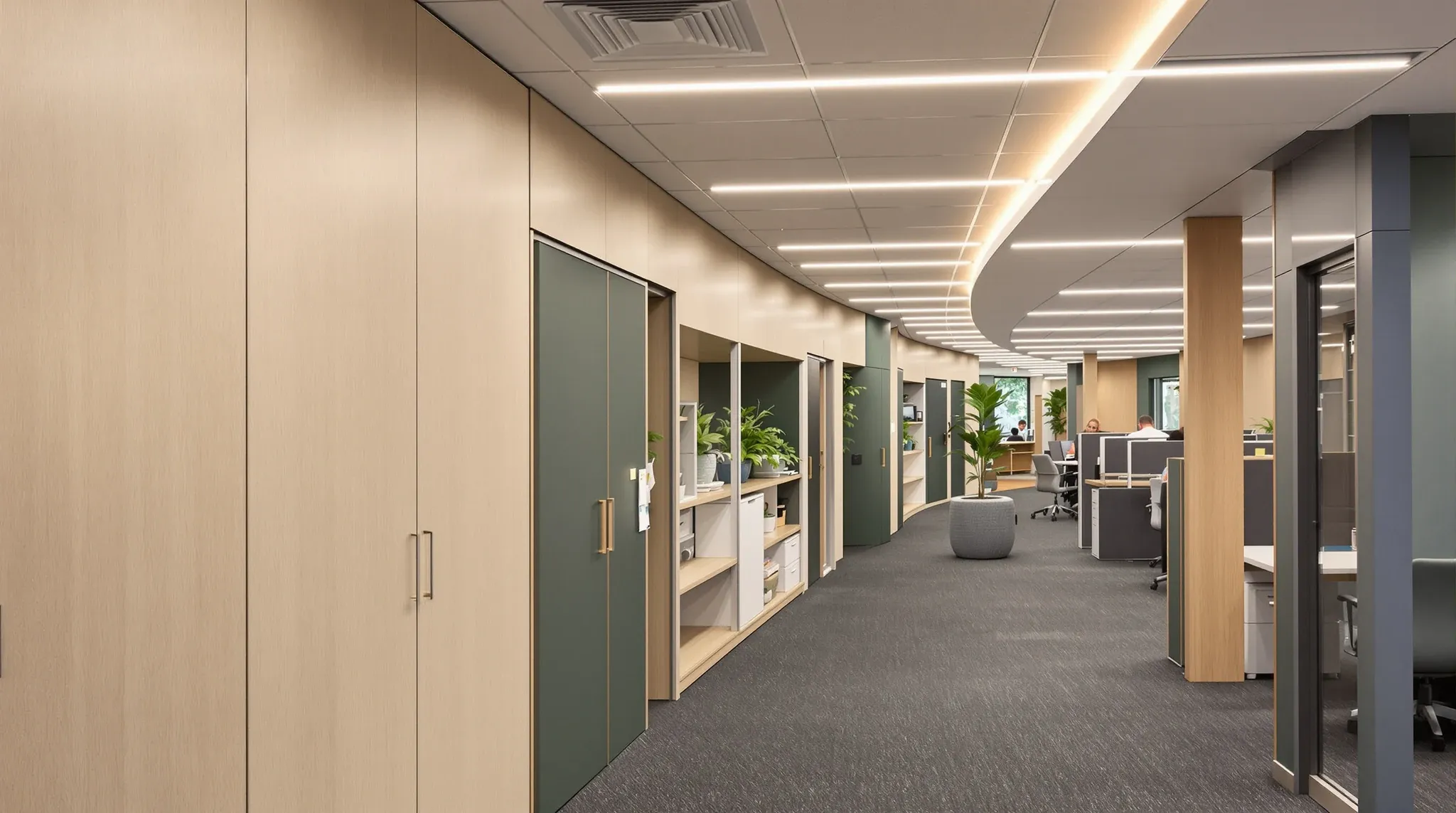
We deliver office fitouts two ways. We run complete, design-to-handover programmes for tenants who need every trade coordinated under one operator, and we deliver individual service packages for tenants who only need one scope done well: office partitions, ceilings, defit and make good, or related standalone work. Both models sit under the same team, and both carry the same delivery discipline.
The reason we built it this way is commercial, not marketing. Some projects genuinely need a full programme because the floor is changing everywhere and trades have to move in the right order. Others need one element done cleanly inside an otherwise stable floor. Forcing either situation into the wrong delivery model costs tenants money, time, and certainty. So we run both.
Two delivery models, one delivery discipline
A complete office fitouts engagement runs from early brief through design, documentation, landlord approvals, construction, commissioning, and handover. It covers partitions, ceilings, joinery, lighting, electrical, data, HVAC variations where needed, finishes, compliance sign-off, and the sequencing between every one of those trades on site.
A standalone service package is a defined slice of that same work delivered as its own project. The scope is smaller, the duration is shorter, and the paperwork is tighter around a single trade family, but the programme logic, documentation standards, site protection, and QC are the same. A tenant who engages us for one scope is getting the same team and the same habits they would get on a full fitout, applied to a narrower brief.
When a complete fitout earns the full programme
A complete programme tends to be right when the floor is changing substantially and the trades cannot sensibly be split. A new lease on a blank or near-blank floor, a move that changes headcount, a repurpose of an existing tenancy, or a significant relayout of an existing floor usually touches partitions, ceilings, services, joinery, lighting, and finishes at the same time. The sequencing between those trades is not optional, and it drives the programme.
When we run a full programme we hold that sequencing end to end. We do not hand off to another coordinator mid-project, we do not rely on trades to self-coordinate with each other, and we do not leave the tenant to carry the risk of a missed dependency. The logic of who goes first, what has to be finished before the next trade can start, and where the commissioning windows sit is set out in writing before site work begins, and it holds through to handover. On a complex floor, getting the correct trade sequence right is the difference between a site that lands on time and one that stalls on a dependency nobody mapped.
If the brief spans that much scope, splitting it into standalone packages usually creates more cost and more risk than it saves. The sensible call is a single complete programme that runs from design through to handover, with every trade coordinated under one operator from day one.
When a standalone scope is the right call
A standalone scope tends to be right when the floor is otherwise stable and one element needs work. A partition refresh on a floor that is mostly fine. A ceiling upgrade tied to better lighting. A reception rework. A defit at lease end without a new fitout on the other side. Mid-lease refurbishment that adjusts the layout without triggering a full rebuild.
In all of these cases, dragging the tenant through a full fitout programme would be wrong. There is no cross-trade sequencing to coordinate across the whole floor. There is no change-of-use approval to manage. The rest of the fitout is staying. What the tenant needs is one package delivered cleanly, with everything around it protected and left untouched. There are common mid-scope situations where it makes sense to only upgrade partitions or ceilings rather than trigger a broader programme.
That is why we run the standalone models as first-class engagements rather than as cut-down versions of something else. Tenants can engage us specifically for office partitions only, for office ceilings only, or for a defit and make good package with no other scope attached.
Why a standalone scope still carries fitout-grade rigour
This is the part tenants sometimes get wrong when they compare us to a trade-only supplier. A standalone partition package from us is not “just partitions”. It comes with the same documentation discipline, the same site protection standards, the same compliance attention, and the same handover protocol we apply inside a full fitout.
That matters because the failure modes inside a small scope are the same as the failure modes inside a large one. Penetrations that break acoustic performance. Ceiling details that do not line up with partition heads. Services that were not mapped before trade sequencing started. A sub-scope that lands on a floor already populated by staff, with no thought for dust, access, or base-building rules. We handle all of that on a standalone job the same way we handle it inside a full programme.
A trade-only supplier looks at a small scope as its own scope and stops there. The sub-contractor delivers the trade, and whatever happens at the interface with the rest of the fitout is someone else’s problem. That is where standalone work quietly goes wrong. The partition arrives, but nobody thought about the ceiling grid it has to meet. The ceiling lands, but nobody checked the existing partition heads it is supposed to tie into. We treat the interface as part of our scope, because on a fitout-delivered standalone job it always is.
The same principle applies at the other end of the lease. A defit and make good is a standalone scope, but it still carries programme-grade rigour: strip-out sequencing, reinstatement standards, landlord liaison, final condition, and the right paper trail at handover. Tenants regularly engage us for defit and make good works with no new fitout attached, and we run it with the same backbone as any other scope.
How the two models share the same coordination backbone
The reason both models work under one team is that the underlying delivery logic is identical. The programme logic for a standalone partition job is the same programme logic that would govern the partition phase inside a complete fitout. Documentation. Trade brief. Site set-up. Sequencing against the rest of the floor. Dust control. Compliance of the new work. Handover checks. The only difference is the scope boundary.
When a tenant moves from a standalone engagement into a complete fitout later, nothing about how we operate changes. Same internal standards, same documentation conventions, same site habits. When a tenant moves in the other direction, from a complete fitout into a later standalone scope in the same building, the site knowledge and the landlord relationship carry across with us. There is no re-onboarding cost. The second engagement starts with context the first one built.
What tenants get from having both options under one team
A tenant who only needs a partition refresh this year and may need a defit in three years does not have to split that work across two unrelated suppliers. The same team that delivered the partition scope already understands the floor, the landlord, the building manager, the base-building rules, and the compliance posture of the existing fitout. When the later scope comes up, the tenant restarts from a running position, not from zero.
That also removes a lot of procurement friction. A single operator relationship covers both complete fitouts and standalone packages, so tenants are not setting up a new supplier every time a scope shifts. It simplifies insurance onboarding, safety documentation, landlord approvals, and the small things that slow a new engagement down. The commercial value of that consistency is quiet but real, and it tends to show up most clearly during the fast-moving phases of a lease.
A simple test for which model fits your situation
If the floor is changing everywhere and every trade has to be coordinated, a complete fitout is the sensible call. If the floor is otherwise stable and one trade family needs work, a standalone scope will usually serve the tenant better and cost less. If the engagement is a lease-end defit, a standalone package is almost always the right answer. If the brief is too broad to price scope-by-scope, a complete programme is the safer structure.
Mixed situations are common. A tenant might start with a ceiling and lighting refresh, then come back later for a partition reconfigure as headcount grows, and eventually engage a complete programme at the next lease. We are set up to handle each of those stages without forcing any of them into the wrong model. The question we ask tenants at the start of an engagement is not how big they want to go; it is what the floor needs right now.
If you are weighing a complete office fitout, a single standalone scope, or a mix of both, we can help you work through which model fits your floor, your lease, and your brief, and then deliver the one that makes sense.
📞 Call us on 1300 60 93 93