
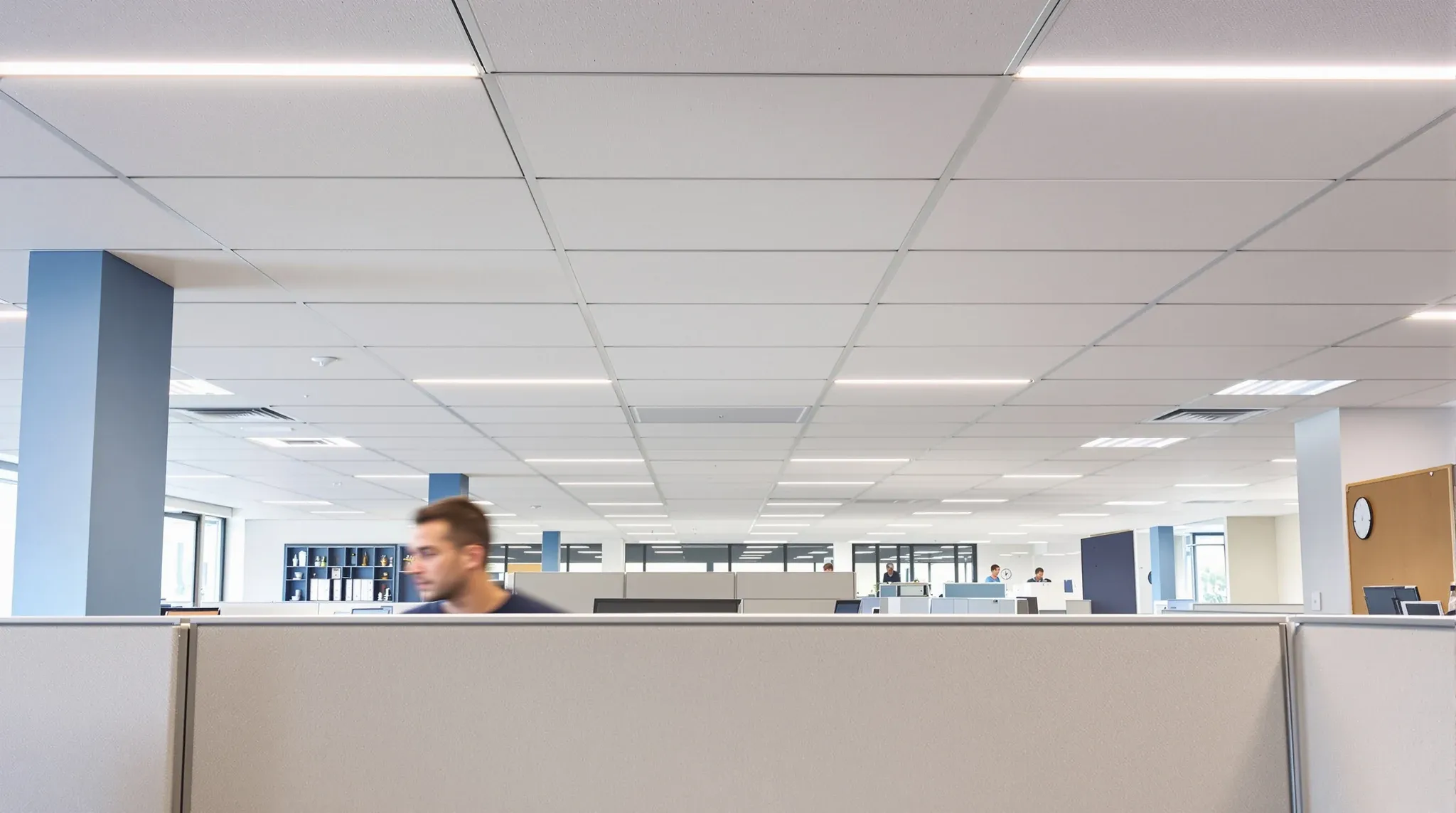
Upgrading only the partitions, or only the ceilings, is the right call in three specific conditions, and a bad call outside them. The three conditions are: the rest of the fitout is holding up well enough to stay, the element you are upgrading has a clear performance problem that will not fix itself, and the lease term has enough runway left to earn back the work. When those three line up, a targeted single-element upgrade is cheaper, faster, and less disruptive than a broader rework. When they do not line up, the partial upgrade usually becomes the first phase of a bigger job the tenant was trying to avoid.
Most tenants who ask us about a partition-only or ceiling-only upgrade are in one of the good conditions. They have a specific problem with a specific element, the rest of the space is fine, and they want the problem fixed without touching the parts that are working. The job of this article is to give you a clean way to check whether your situation genuinely sits inside those three conditions, and to flag the cases where a partial upgrade is likely to backfire.
Read the ceiling plane honestly before you decide
Ceiling-only upgrades live or die on how well the plane is actually performing. A ceiling can look tired and still be structurally fine. A ceiling can look clean and still be acoustically dead or fire-compromised. The visual read almost never matches the performance read. We ask tenants to look at three things before they commit to a ceilings-only scope. How the space sounds on a busy afternoon. How easy it is to get into the ceiling void when a service needs attention. And how the ceiling finishes against the top of the existing partition walls.
If the acoustic problem is real and the grid is in poor shape, a ceilings-only upgrade solves a genuine problem and usually pays for itself within the remaining lease term. If the grid is fine and only the tiles look tired, the scope is smaller than a full ceiling rework and can sometimes be handled as a tile replacement alone. And if the ceiling is performing acoustically but looks dated, think carefully before committing to the scope at all, because the upgrade may cost more than the visual benefit justifies. What counts as a standard office ceiling varies so much between buildings that benchmarking against another tenancy is rarely useful here.
Read the partition layout honestly before you decide
Partition-only upgrades are almost always about matching the walls to how the team has changed. The test is whether the existing partition layout still supports the work the team is doing, or whether the walls are now in the wrong places. If the layout is broadly right but a handful of walls need to move or be added, a partition-only scope works cleanly. If the layout is fundamentally wrong for the current team, a partition-only scope will leave you with a compromise that looks better than the starting point but still does not fit the business.
The other test is whether the existing partitions are going to survive rework without showing their age afterwards. Older partition systems sometimes do not patch cleanly, and a wall that is removed and replaced can leave a visible finishing problem at the head, the base, or the junction against the existing ceiling. That finishing problem usually adds cost to a partition-only scope and is one of the places a tenant can end up spending more than they expected. Looking carefully at the condition of the neighbouring walls before committing to the scope is what we spend real time on during our early walk-throughs.
Check the lease term against the cost of the upgrade
Single-element upgrades earn their cost back through either the productivity they unlock or the lease-end position they improve. Both require enough time to actually land. A ceiling upgrade eighteen months before lease end may still make sense if the acoustic problem is urgent, but a tenant paying for that work then defits the space twelve months later is usually in a worse position than if they had lived with the problem.
The rough rule we work to is that the cost of a single-element upgrade should be comfortably earned back across the remaining lease term, with a margin left for the risk that the work takes longer or costs more than planned. When the remaining term is too short, the honest conversation is usually about whether the problem can be lived with until the next lease event, or whether the decision should become part of a broader renegotiation with the landlord. The distinction between refurbishment and a full fitout often becomes relevant here, because the commercial maths on a short-term partial upgrade can look different from the same work running inside a full refurbishment scope.
Where partial upgrades actually backfire
A partition-only or ceiling-only scope can backfire in three recognisable ways. The upgrade makes the rest of the fitout suddenly look tired by comparison, and the tenant ends up doing the rest of the work anyway within a year. The upgrade touches base-building services in a way the original scope did not anticipate, and the scope creeps into a wider rework. Or the upgrade exposes a problem that was hidden behind the element being replaced, and the tenant has to deal with something they did not expect to find.
None of these are reasons to avoid a partial upgrade. They are reasons to quote one carefully. We usually do a short pre-scope assessment to rule out the obvious surprises, and we price the genuine possibilities into the quote as provisional items rather than pretending they cannot happen. That is how a partial upgrade stays a partial upgrade rather than turning into the opening move of a bigger job.
The sequencing trap: doing them in the wrong order
Tenants who are planning to upgrade both the ceilings and the partitions, but only want to do one now, sometimes pick the wrong order. Doing partitions first and ceilings second usually means the ceiling work damages the new partition heads. Doing ceilings first and partitions second usually means the partition installation damages the new ceiling tiles and grid. The correct order depends on which upgrade is structurally and technically harder to undo once it is done.
As a rough guide, if the partitions are going to change significantly, the ceiling should wait until after the partitions are installed. If the ceiling is going to change significantly, the partitions should wait until after the ceiling is installed. Doing both at once is the cleanest approach of all, and is often cheaper per element than doing them separately, but it is a different conversation from a partial upgrade. How renovation scopes interact with existing fitouts is one of the quieter skills that experience teaches, and it is usually what makes the difference between a clean partial upgrade and a messy one.
Our usual recommendation on the boundary calls
The cleanest partial upgrades are the ones where the tenant has a specific, real problem and a specific, real budget, and the scope needed to fix the problem sits comfortably inside the budget. The messier ones are where the tenant is hoping to fix a vague sense of dissatisfaction with the space through a narrow intervention. Vague dissatisfaction usually does not fix itself with one upgrade. Specific problems usually do.
When we push back on a partial-upgrade scope, it is almost always because the underlying problem is larger than the proposed scope can address. That is a conversation worth having early, not after the work is quoted and the budget is committed. If the scope holds up, the upgrade is usually the most cost-effective way to keep the space working for the rest of the lease term. If it does not, the money is better spent differently, even if that means living with the problem a little longer or widening the brief into a fuller renovation rather than make good conversation as the lease end approaches.
The boundary calls are also where engaging a team that runs both standalone scopes and full projects tends to pay off. A contractor whose business is built around single-trade work has a financial reason to recommend a single-trade job even when the scope is wrong. A team that can deliver either scope cleanly has no reason to push one over the other, and will usually give you a straighter answer about which is actually right for your situation. That is part of the reason we keep a dedicated ceiling practice and a dedicated partition practice alongside our full-fitout work, rather than folding either into the full-project delivery line.
If you are weighing a partitions-only or ceilings-only upgrade and would like a second view on whether the scope genuinely holds together, we can help you walk through the three conditions against your actual space before anything commits. Tell us what the problem is, what the rest of the fitout looks like, and how much lease term is left, and we can give you a realistic view of whether the scope is the right call.
📞 Call us on 1300 60 93 93