
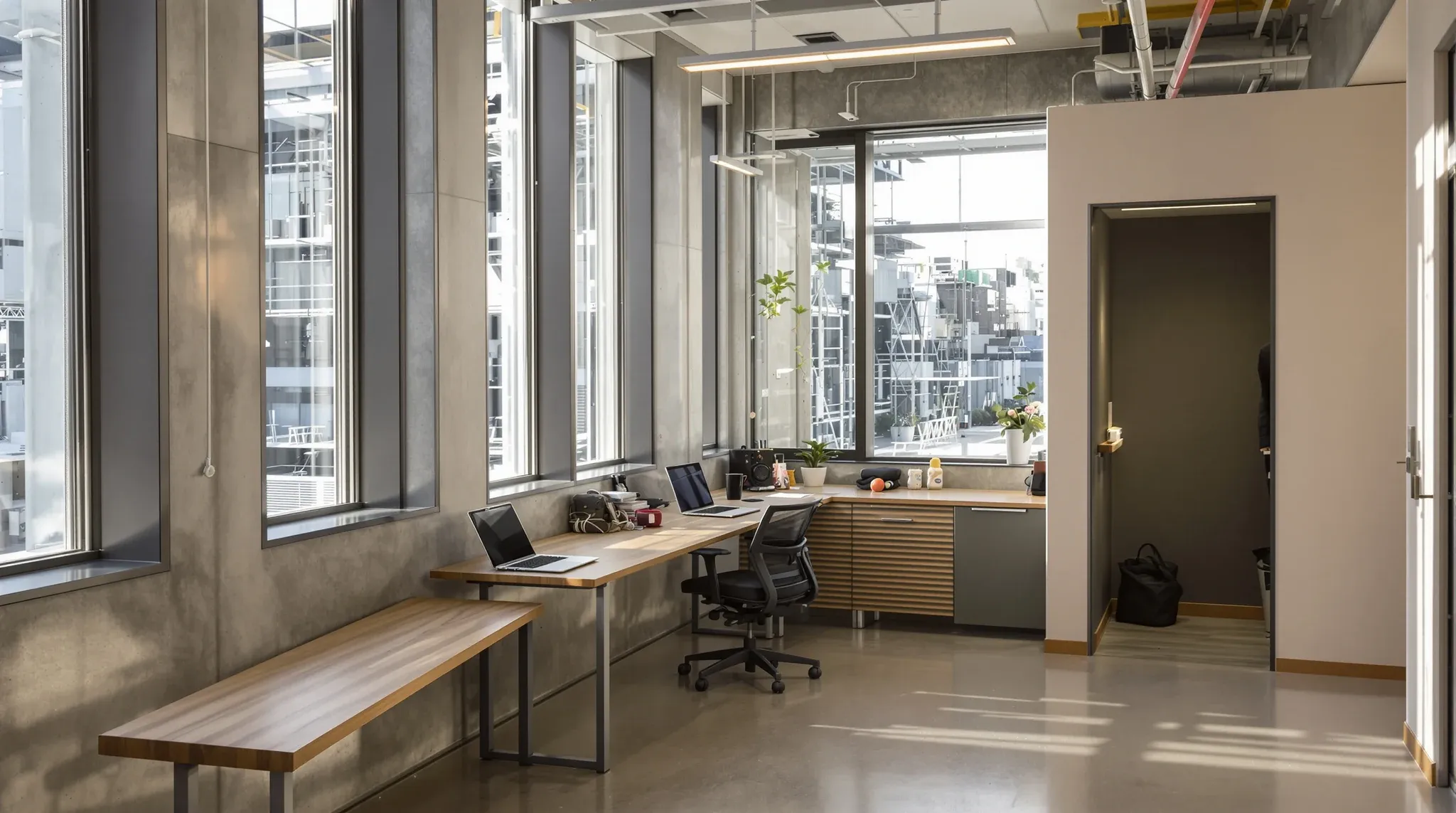
The first private office fitout after years of coworking is a particular commercial decision. The team has grown past the point where a floor of shared hot desks is working, the monthly bill has crept up to the point where a lease looks reasonable, and the question turns from “how many desks do we book?” to “what are we actually building?” The answer is broader than most first-time tenants expect, because coworking was quietly providing a lot of things the new lease will not.
This is written for the founder, operations lead or business manager about to sign their first private commercial lease in Sydney after a long run inside a coworking provider’s space. The move is usually a good one commercially, but the budget, the brief and the handover plan all need to reflect the reality that the business has never fitted out an office before, and the reference point it is working from is a serviced environment it is about to leave behind.
Implicit Services Provided By Coworking Spaces
Coworking feels like a desk, a chair and a password, but the bill covers a long list of things that do not come with a private commercial tenancy. Power, data, cleaning, paper, coffee, internet, printers, meeting-room bookings, reception staff, after-hours access, front-of-house branding, pest control, tea-point consumables and the furniture itself are usually all inside the day-rate or monthly fee. Losing them at the same time as signing a lease is the first surprise.
The practical consequence is that the first private fitout is not just building walls and buying desks. It is commissioning a working office. Services contracts, IT infrastructure, reception function, cleaning, consumables, meeting-room technology, mail handling and everything else the coworking provider handled invisibly all have to be stood up at the same time. Budgeting for the build without budgeting for the commissioning is how growing teams end up in their new lease with painted walls and a Wi-Fi router that cannot carry the team.
We routinely recommend building a running list of every service the coworking space provided, even the ones that feel trivial, and deciding at fitout-planning stage which ones the business will take on itself, which it will outsource, and which it genuinely does not need anymore. The list is longer than most founders remember until they walk a floor with a notebook.
Referencing Coworking For First Time Briefing
Writing a fitout brief is difficult the first time, and writing it from a coworking reference point is harder than writing it from a previous private office. The coworking environment has shaped the team’s mental picture of how work happens (hot desks, booked meeting rooms, a front-of-house someone else runs) and that picture quietly encodes assumptions that may not survive in a private office.
The simplest test is to ask how many meetings the team books through the coworking provider in a typical week, how many private calls staff step out of the main floor for, and how often breakout zones are actually used versus booked. The answers to those three questions usually reshape a brief more than a whiteboard session will. A team that books twenty meeting rooms a week does not want two meeting rooms in the new office. A team whose staff take three private calls a day needs phone booths, not just a “quiet room”.
The brief also needs to say what the business will not own anymore. Coworking-level amenity (barista coffee, event space, rooftop terraces) does not always transfer, and the brief should be honest about which elements the new office will match, which it will adapt, and which it will drop. That honesty saves months of disappointment later.
Translating Day Rates Into Capital Budgets
Coworking costs are monthly. Fitouts are capital. The translation between the two is one of the places first-time tenants most often underestimate the commitment.
A coworking spend of roughly five to fifteen thousand dollars a month for a growing team feels modest line-by-line, but a realistic commercial fitout budget for an equivalent team in a private Sydney tenancy is typically in the hundreds of thousands rather than the tens of thousands once partitions, ceilings, services, furniture, reception and IT are all included. That is not a reason to avoid the move. A three-year lease at owned terms usually beats three years of coworking for a stable team. The capital outlay happens up front, though, and the cashflow conversation is different from the one the business has been having with the coworking provider.
A workable rule of thumb is that the build-and-commission cost sits as a separable line item from the rent. Treating rent as “the equivalent of the old coworking bill” without factoring in the one-time fitout is the pattern that trips first-time tenants. The contingency reserve inside that fitout budget sits alongside other less obvious cost lines, and it needs to be sized to the age of the building, the scope of the fitout and the length of the programme rather than pulled from a rough percentage.
Managing Independent IT And Network Infrastructure
IT is the line item coworking hid most thoroughly. Internet, Wi-Fi, printers, meeting-room booking systems, visitor registration, door access and sometimes even video conferencing hardware were all sitting behind the coworking provider’s infrastructure. The new private office needs its own version of all of them, and it needs them on day one because the business cannot operate without them.
Three things are worth planning early. The first is the commercial internet service, which on most Sydney commercial tenancies is a fibre service with an installation lead time that has to start before handover week. The second is the network cabling itself, with Cat 6A to every workstation, meeting room and phone booth, roughed in while partitions are open. The third is Wi-Fi coverage, which in a private tenancy means planning access point locations rather than assuming the room will be flooded.
Meeting-room technology is the decision that ties back into the brief. Teams that booked meeting rooms with built-in video conferencing inside their coworking provider often assume the new office rooms will come equipped. They do not. Display hardware, cameras, microphones, room-booking tablets and the cabling that supports them all need to be specified, ordered and commissioned as part of the fitout rather than treated as a later purchase.
Strategic Furniture Procurement And Integration
Some coworking providers will sell the team its own chairs and desks on exit, and it can be tempting to carry them over. Sometimes it is the right call. Often it is not, because coworking-scale furniture (lightweight desks sized for hot-desking, chairs chosen for a three-year replacement cycle) under-serves the intensity of an eight-hour working day at a single desk for the same staff member every day for years. A fleet of chairs that held up fine in a shared environment can age much faster under single-occupant use.
A practical approach is to split the furniture list between carry-over items that are still doing their job, new investment in the pieces the team uses most intensively (primary desks, task chairs, meeting-room chairs), and new spend on items that simply did not exist in the coworking environment (reception seating, collaboration-zone soft furniture, storage). That split keeps the furniture budget honest and avoids either over-investing in replacements that are not needed or under-investing in the pieces that define the daily staff experience.
Meeting Room And Phone Booth Acoustic Standards
Teams leaving coworking usually have strong opinions on meeting rooms because they have spent years booking them. They are less used to articulating what “quiet” actually means in a private office, because coworking acoustic management was the provider’s problem. The first private office has to answer that question itself, and the decisions land inside the partitions, ceilings and doors.
Meeting-room count is the first judgement. Booking patterns from the last six months inside coworking are the best guide, and they usually argue for more rooms than the team expects. Phone booths sit next to that decision. Teams running hybrid work have staff on video calls far more often than they used to, and a single private office with a shared desk phone is not the right answer for a team that takes thirty calls a day across its headcount.
Acoustic performance of the rooms is the decision that most separates a good first private fitout from a frustrating one. Wall build-up, ceiling treatment, door seals and glazing specification all shape whether a meeting room actually contains a confidential conversation or merely looks like one. Getting this wrong on a first fitout is something teams tend to notice only once they are inside the space and hearing through the walls.
Protecting Against Day One Lease End Exposure
A coworking exit is usually walking out with your laptop and cancelling the subscription. A commercial lease exit is a make good obligation, and for a first-time tenant it is the part of the commitment that most often gets underweighted at signing.
The make good scope is written into the lease, and the partition system the business chooses, the ceiling modifications it makes and the services penetrations it creates all shape what the end-of-lease cost will look like. Reversible, demountable systems cost slightly more at install and substantially less at make good. Full-depth plasterboard partitions with fixed ceiling transitions cost less up-front and more at exit.
Neither is automatically the right choice. The right choice depends on the expected length of the stay and the likelihood of reconfiguring mid-lease.
The conversation at lease-signing should include a rough view on what the make good scope will eventually cover, because that number is real even if it is five years away. Founders who treat make good as a future problem rather than a present design input usually pay for that decision at exit.
If your team is leaving coworking for its first private office in Sydney and working through the brief, the budget, the IT, the furniture, or the lease-end exposure, we can help. We deliver complete office fitouts from design to handover for teams making this transition, and we also come in on a standalone scope, whether that is partitions, ceilings or make good, when that is what the project calls for.
📞 Call us on 1300 60 93 93