
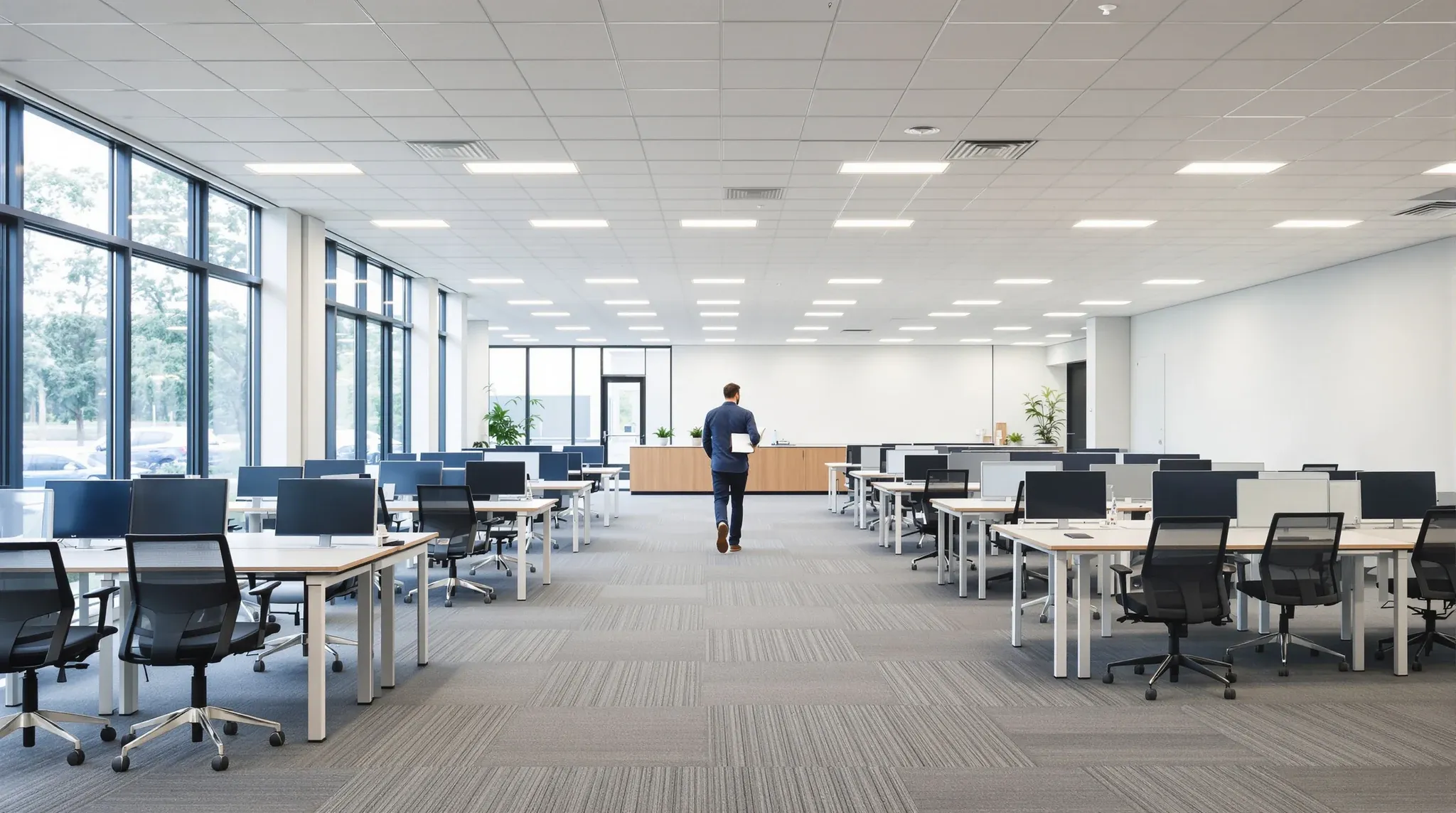
Starting an office fitout without the right information ready is one of the most reliable ways to slow a project down and push costs up. Design teams cannot produce accurate layouts without knowing how many people need to be accommodated. Builders cannot price work without understanding the building’s base conditions. And tenants cannot make sound decisions about materials, finishes, and systems without a clear budget and a realistic timeline.
Before you brief a fitout company, have these settled:
- The executed lease, with the alteration, landlord approval, make good and construction-hours clauses marked up
- The base building condition report, tenancy floor plans and the building’s fitout guide
- Confirmed headcount, growth allowance and desk-sharing ratio
- The list of enclosed rooms you need and their capacities
- An approved total budget, including fees, furniture, IT and a five to ten per cent contingency
- The terms of any landlord contribution, incentive or rent-free period
- Your top functional priorities and a general design direction
- Data, power, AV and wireless requirements from your IT provider
- The approvals the project needs: landlord, certifier and, where relevant, council
- Key dates: lease start, construction access, move-in, and the end of your current lease
- An estimate of the make good exposure at the end of the new lease
Each section below explains what sits behind those items and what tends to go wrong when one is left open.
Lease and Building Documentation
The lease is the foundation document for any fitout project, and a surprising number of tenants enter the fitout process without having read theirs carefully enough. Before the first design meeting, the following should be assembled and reviewed.
The executed lease, including all annexures and schedules, is essential. Key clauses to have identified in advance include permitted alterations, landlord approval requirements, make good obligations, any restrictions on construction hours, and whether the landlord nominates or restricts contractors. The base building condition report, if one was prepared at lease commencement, helps establish the starting point and supports the make good assessment at the end of the term.
Floor plans for the tenancy should be obtained from the building manager or landlord, ideally in a digital format that the design team can work with. If the building has a fitout guide or tenant handbook, this should also be collected early as it typically specifies submission requirements, access procedures, and any building-specific restrictions that affect the fitout scope.
Business Requirements and Headcount
The single most important input for any fitout design is a clear understanding of how the business operates and how many people the space needs to support. This sounds straightforward, but it frequently stalls projects when the information is incomplete or contested.
Before design begins, tenants should have confirmed the total headcount the space needs to accommodate, including current staff and any growth provision for the lease term. The mix of workstation types matters as well. Are all staff full-time in the office, or does the business operate a hybrid model where desks are shared? The answer to this question alone can change the spatial planning by twenty to thirty per cent. Understanding how hybrid work models affect office design helps tenants make better decisions about desk ratios and shared spaces before the layout is drawn.
The number and type of enclosed spaces also needs to be defined. How many meeting rooms, and for what capacities? Is a boardroom needed? Are there quiet rooms, phone booths, focus rooms, or collaboration areas? Does the business need a server room, a print room, a dedicated training space, or a mothers’ room? Each of these has an impact on the floor area consumed and the services required, and leaving them undefined until mid-design creates scope changes that delay the programme and increase costs.
Budget and Financial Approvals
A fitout cannot proceed efficiently without a defined budget, and the budget itself needs to have been through whatever internal approval process the business requires. Design teams that start work without a confirmed budget often produce designs that exceed the available funds, resulting in redesign work that wastes time and money.
The budget should cover not just the construction cost but the full project cost including design fees, consultant fees, council and certification fees, furniture, IT infrastructure, relocation costs, and a contingency provision. Experienced operators build contingency into fitout budgets from the start, typically in the range of five to ten per cent, to cover variations and unforeseen conditions without derailing the project.
If the landlord is providing a fitout contribution, incentive, or rent-free period, the terms and conditions of that arrangement should be understood and documented before design starts. Some landlord contributions come with conditions about the standard of finish, the types of materials used, or the approval of the landlord’s representative during construction. These conditions affect the budget and the design, and discovering them after work has started is disruptive.
Design Preferences and Functional Priorities
Before the first design workshop, the business should have a clear sense of its functional priorities and at least a general direction on aesthetics. This does not mean selecting every finish and fixture in advance, but it does mean being able to articulate what matters most.
Functional priorities might include acoustic privacy for meeting rooms, natural light penetration throughout the floor plate, a prominent reception area for client-facing work, or maximum flexibility for future reconfiguration. These priorities help the design team make trade-off decisions when constraints emerge, which they always do. Without stated priorities, the design process becomes circular as different stakeholders advocate for different outcomes without a framework for resolution.
On aesthetics, the business should be able to describe the general tone it is aiming for. Corporate and restrained, contemporary and open, warm and welcoming, or industrial and raw are all legitimate directions, and each leads to different material palettes, lighting approaches, and spatial configurations. Reference images from other offices, hospitality venues, or even residential interiors can be very helpful in communicating the desired feel to the design team.
Technology and Infrastructure Requirements
Technology requirements are among the most commonly overlooked items on a fitout checklist, and the consequences of leaving them undefined can be significant. Data cabling, wireless access point locations, power distribution, AV systems in meeting rooms, and server or communications room requirements all need to be considered during the design phase because they affect wall construction, ceiling layouts, and floor box placement.
Before design begins, tenants should consult with their IT team or provider to establish the number of data and power points per workstation, the meeting room AV requirements, the wireless coverage expectations, and any specialist technology needs such as videoconferencing systems, digital signage, or security access control. Planning data and electrical infrastructure alongside the fitout rather than after it avoids costly retrofitting and ensures the technology layer is integrated cleanly into the built environment.
If the business is changing phone systems, internet providers, or managed services as part of the move, those transitions need to be planned in parallel with the fitout. The last thing any tenant wants is a beautifully finished office with no working internet on day one because the provider changeover was not coordinated with the construction programme.
Compliance and Approval Requirements
Every commercial fitout in Sydney requires some form of approval, and the specific requirements depend on the building, the scope of work, and the local council area. Before the project begins, tenants should understand what approvals are needed and what documentation each approval requires.
At a minimum, landlord approval will be required. Most commercial buildings have a formal submission process, and the building manager can advise on the specific requirements. For fitouts that involve changes to fire compartmentation, structural elements, or hydraulic services, a construction certificate from a building certifier is typically required. In some cases, a development application to the local council may also be needed, particularly for change-of-use scenarios or work in heritage-listed buildings.
Compliance with the Building Code of Australia, work health and safety regulations, and the building’s own management rules should be understood early so that the design team can address these requirements during the design phase rather than discovering them during construction. Understanding what experienced fitout teams assess before quoting gives tenants a sense of the compliance landscape their project needs to navigate.
Timeline and Coordination Details
The fitout timeline does not exist in isolation. It interacts with the lease commencement date, the existing premises’ end date, the IT transition plan, the furniture procurement timeline, and the staff relocation logistics. Before the fitout starts, these elements need to be mapped out so the programme can accommodate all of them.
Key dates to have confirmed include the lease commencement date for the new premises, the date from which construction access is available, any interim milestones imposed by the landlord or the business, and the required operational date in the new space. If the business is vacating an existing premises, the end date of that lease and the make good requirements create additional programme constraints.
Coordination with furniture suppliers, IT providers, and any specialist consultants should be planned in advance. Long-lead items such as custom furniture, specialist ceiling systems, or imported finishes need to be identified early so that procurement can begin as soon as specifications are confirmed. Waiting until mid-construction to discover that a key item has a six-week lead time is a programme-wrecking scenario that proper advance planning prevents.
End-of-Lease Considerations
The make good clause in the lease should inform fitout decisions from the very beginning, not just at the end of the tenancy. Every partition installed, every ceiling modified, and every service altered during the fitout represents a potential cost at lease end when the space needs to be returned to its base building condition.
Before design starts, tenants should review the make good clause in detail and understand what it requires. Some leases specify a return to base building condition. Others allow the tenant to negotiate with the landlord at the time. The make good exposure should be estimated alongside the fitout budget so the full cost of occupancy is understood from the outset.
Design decisions that reduce make good costs, such as using demountable partition systems where appropriate, minimising modifications to base building services, and avoiding permanent alterations to structural elements, should be considered alongside performance requirements. The cheapest fitout to install is not always the cheapest fitout to occupy when the end-of-lease costs are factored in.
If you are preparing for an office fitout and want to make sure nothing essential is missed before the project begins, we can walk through the checklist with you and identify any gaps before design starts.
📞 Call us on 1300 60 93 93