
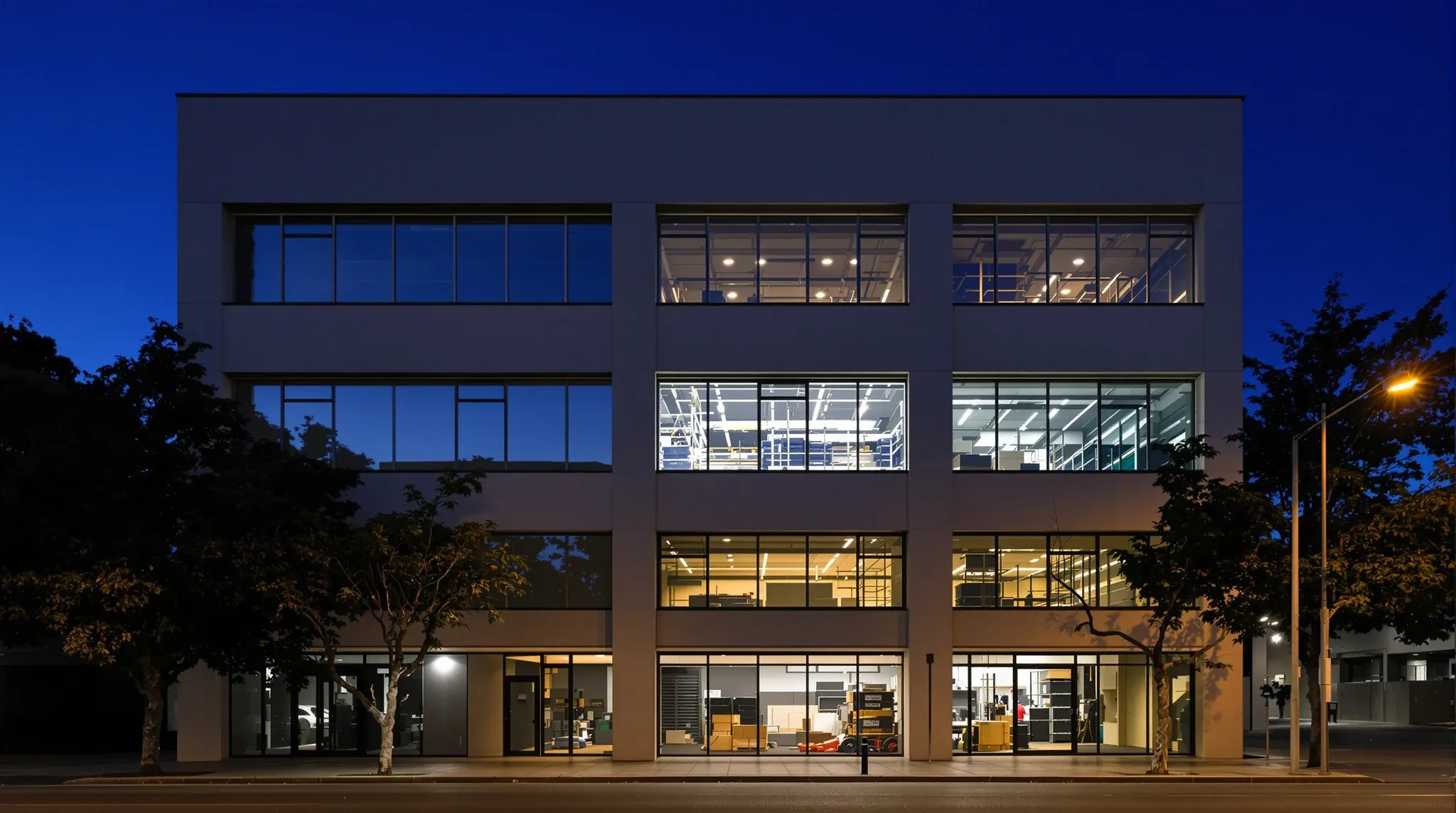
After-hours work in a commercial office tenancy is rarely shaped by abstract NSW law. It is shaped by the landlord’s fit-out rules, the building manager’s access regime, the noise tolerances of the tenants next door, the shutdown windows on the fire and mechanical services, whether the floor is still trading, and the hard commercial maths of running trades outside a normal day.
Tenants often come into the question asking whether they are allowed to work after hours. The more useful question is when after-hours work earns its cost, and when it is a reflex that quietly inflates the budget. Some fit-out scopes cannot run any other way. Others default to evenings and weekends because the programme looked tidier on paper, not because the work needed it.
Building rules set most of the boundaries, not the law
In almost every A, B, and C grade building in the city, the landlord’s fit-out guide defines what after-hours actually means, what you need to submit before you can work in that window, and who has to be on site while the trades are running. That package typically covers an after-hours works application, a nominated authorised person, security access arrangements, a permit for any services isolation, and sometimes a separate acoustic undertaking for mixed-use towers with residential or hotel above.
These are the rules that actually govern what a tenant can and cannot do at night. Legislation sits behind them, but it is the building-side paperwork that sets the practical envelope. A tenant who treats the lease and the landlord’s fit-out manual as loose guidance ends up either rebooking windows, paying for a security callout that was never briefed, or running into a services shutdown the building will not authorise on short notice. The landlord’s fit-out package and the building-management constraints attached to it should be checked against every proposed after-hours window before any of those hours get priced in.
Trades that genuinely need an off-hours window
A small number of trades genuinely cannot run during business hours, and those are the ones where an after-hours booking is paying for something real.
The clearest cases are works that interrupt services the rest of the building depends on. Sprinkler isolations, tie-ins to live electrical or mechanical systems, water shutdowns across a riser, and any fire panel programming that puts detection offline all fall into this bucket. The building will only authorise those activities in a window when other tenants are not affected. This is not about noise at all. It is about shared infrastructure, and the cost of the window is the cost of being allowed to touch it. The fire and compliance considerations that govern any commercial fit-out do not change because the work runs at night; what changes is who the building insists has to be on site to authorise each step, and how many of those people they will invoice for.
Heavy or disruptive deliveries are the second group. Shared lifts, loading docks, and protected lobby floors are routinely booked for fit-out use only outside trading hours. That is a building decision, not a preference. The tenant can push back, but rarely wins.
The third group is noise that containment cannot solve. Slab drilling, core cutting, and certain demolition phases radiate vibration and airborne noise through structure that hoarding simply does not stop. Where a law firm is running depositions directly below, or a medical practice is consulting next door, those trades have to either run at night or be redesigned out of the scope. A short test cut with monitoring is almost always cheaper than defaulting to after-hours for a full demolition package on assumption.
Live tenancies and staged works push more of the programme into the evening
When part of a floor is still trading, or neighbouring tenants in the same stack are sensitive to dust, odour, or vibration, the fit-out’s centre of gravity shifts into the off-hours. This is the scenario where after-hours hours earn their cost most reliably.
A phased refit of an occupied floor is the canonical example. The client is still working in one half of the tenancy while demolition, ceiling strip-out, and services alterations run in the other half. Some of that work can run during the day behind proper hoarding. The loud, dusty, or smell-generating portions generally cannot. The split between day and night trades is one of the core decisions in planning any staged fit-out on an occupied floor, and the cost of getting it wrong is visible in the first week.
The same logic applies to partial strip-out and end-of-lease works. Where the balance of the tenancy is still trading, or the landlord has already relet an adjacent space, a defit and make good programme will usually push the noisy removal trades into evenings and weekends whether the tenant would have chosen that or not. The driver is the neighbours and the floor’s operational reality, not a scheduling preference.
Ceiling trades sit uncomfortably on this line. Pulling a suspended grid in a tenanted building often means interrupting detection, sprinkler isolation, and safe work-at-height in a zone that shared services also pass through. A ceiling replacement running through a live floor is one of the most common legitimate reasons for a week of nights on an otherwise daytime programme. Supervision, access, and safety obligations for working after hours on a live floor stack on top of the ceiling trade itself, and a surprising share of the true cost lives on that side of the ledger rather than in the ceiling work.
When after-hours is a reflex rather than a reason
A surprisingly large portion of the after-hours hours we see quoted on Sydney fit-outs are not solving for any of the scenarios above. They are solving for a programme that should have been planned better, or a decision the tenant is quietly hoping to buy out of.
The most common pattern is a recovery from a slip. A drawing was late, a long-lead item arrived in the wrong finish, a services coordination clash surfaced two weeks before handover, and the response is to put the trades on weekends. That works only when the slip was caused by not having enough daylight hours, which is unusual. It does not work when the slip was caused by a coordination failure, because adding weekend hours puts more people into the same blocked problem. Most fit-out programme slips are coordination failures rather than daylight failures, and adding weekend hours rarely pulls the programme back.
The second pattern is a tenant treating a handover date as immovable when it is actually flexible. An extra ten working days at normal rates is usually cheaper than the same work compressed into weekends. Where the lease allows any flex on the access date, it usually pays to spend the flex before spending the after-hours loading.
The third pattern is the quiet habit: “we always run a weekend around demolition” or “the finishing trades go on nights at the end”. When we sit down and ask which specific driver requires it, there is often no answer.
The real cost of a night shift is more than the loaded rate
The obvious cost of after-hours work is the penalty on labour, but that is only the headline number.
Supervision is thinner at night. A single leading hand often covers trades that would each have their own supervisor during the day, and the base-building presence that catches issues in real time is often not there. The suppliers who resolve mid-shift problems are not answering the phone. Small errors that would be caught and fixed in an hour during the day sometimes ride through to the next morning as rework. Lighting is rarely ideal, and quality-sensitive trades suffer more than they appear to in the moment.
Building-side coverage stacks on top. Most buildings charge for an after-hours security attendance, sometimes for an additional engineer if services are being touched, and sometimes for cleaners to reinstate the common areas before tenants arrive in the morning. None of this shows up in the weekday quote, and it is part of the reason fit-out costs quietly escalate beyond the headline number when night works are stacked on a programme.
Productivity is the less visible penalty. Crews running a long week with added evenings produce less per hour on the nights and also less per hour on the following days. Two weeks of hard after-hours recovery often loses a day of productive daytime work somewhere downstream, and that day does not appear in any invoice.
How we decide whether an after-hours window is worth approving
Our own test on a fit-out programme is narrow and repeatable. Every proposed after-hours window has to sit on a named driver. If we cannot put a one-line reason against a night or weekend, we take it out of the programme before the trades are priced.
The drivers we accept are specific. A services interruption the building will not authorise during trading. A fire or mechanical tie-in that has to run when detection is offline. A delivery the loading dock only opens for at night. A trade whose irreducible noise will carry into a sensitive neighbour through the slab. A live-tenancy scenario where dust or odour cannot be contained during working hours. A handover date that has been stress-tested and is genuinely fixed by a business event or a lease clause. Where any of those apply, we build the window into the programme with intent, including the consolidation work needed to combine several shutdowns into the fewest nights the scope allows.
The drivers we push back on are just as specific. “It will be faster” when the slip has not been diagnosed. “We always do finishing trades at night on this floor” when nothing structural requires it. “We want a weekend for demolition” when hoarding and a test cut have not been tried. “We need to make up time” when the lost days were caused by a coordination failure that more hours will not fix. Deleting those windows is often the single biggest saving available late in a programme without touching the scope.
If you are weighing up an after-hours schedule on a Sydney commercial fit-out, or a landlord or building manager has told you certain trades have to run outside hours and you are not sure whether that is really the case, we can help you work through each window against the building’s rules and your programme’s real drivers before the hours get priced in.
📞 Call us on 1300 60 93 93