
Lift access and loading dock rules add cost to an office fit-out in three concrete ways: material handling slows down, every trade spends more hours on site waiting for the next delivery, and a chunk of the programme gets pushed into after-hours windows where labour is priced at a premium. That is the short answer, and tenants who understand it at quoting stage avoid most of the nasty cost surprises further down the programme.
None of this shows up in the obvious line items. The partitions, ceilings, electrical and joinery all look the same on a quote regardless of which building they land in. What changes is how many labour hours those trades burn getting material onto the floor, how long each workday runs before they can start real work, and how much of the programme they can keep inside normal hours. On a well-configured building the logistics cost is invisible. On a constrained one, it can add ten to twenty per cent to the build.
The cost is hidden in labour hours, not materials
A tenant looking at two fit-out quotes for the same scope in two different buildings often cannot see why one is meaningfully more expensive. The drawings are the same. The finishes are the same. The number of partitions is the same. The difference sits in hours, and hours sit behind the rates rather than in front of them.
When a trade crew can drive a vehicle to a dedicated loading bay, unload into a goods lift, run the lift directly to the tenancy floor, and wheel material through a clear back-of-house corridor, they spend almost no time moving stock. When the same crew has to park a couple of streets away, hand-carry material across a public foyer, queue for a shared passenger lift, then wheel through a carpeted reception, the same delivery burns three times the labour hours.
Multiply that across every trade over a four to six week fit-out programme and the cost gap between two superficially identical jobs becomes real. Tenants are often surprised to learn that the logistics premium for a difficult building can comfortably exceed the entire partition package for an easier one. The material is identical; the hours around it are not, and labour hours are where commercial fit-out pricing lives.
How lift access affects every trade on a floor
Passenger lifts are shared with the working building, and most building managers set limits on how fit-out trades use them. Protection pads have to go up and come down. Tool belts, ladders, and larger items are often restricted. Peak business hours are usually off-limits for any meaningful material movement. None of this is unreasonable; it just squeezes the usable hours in a working day.
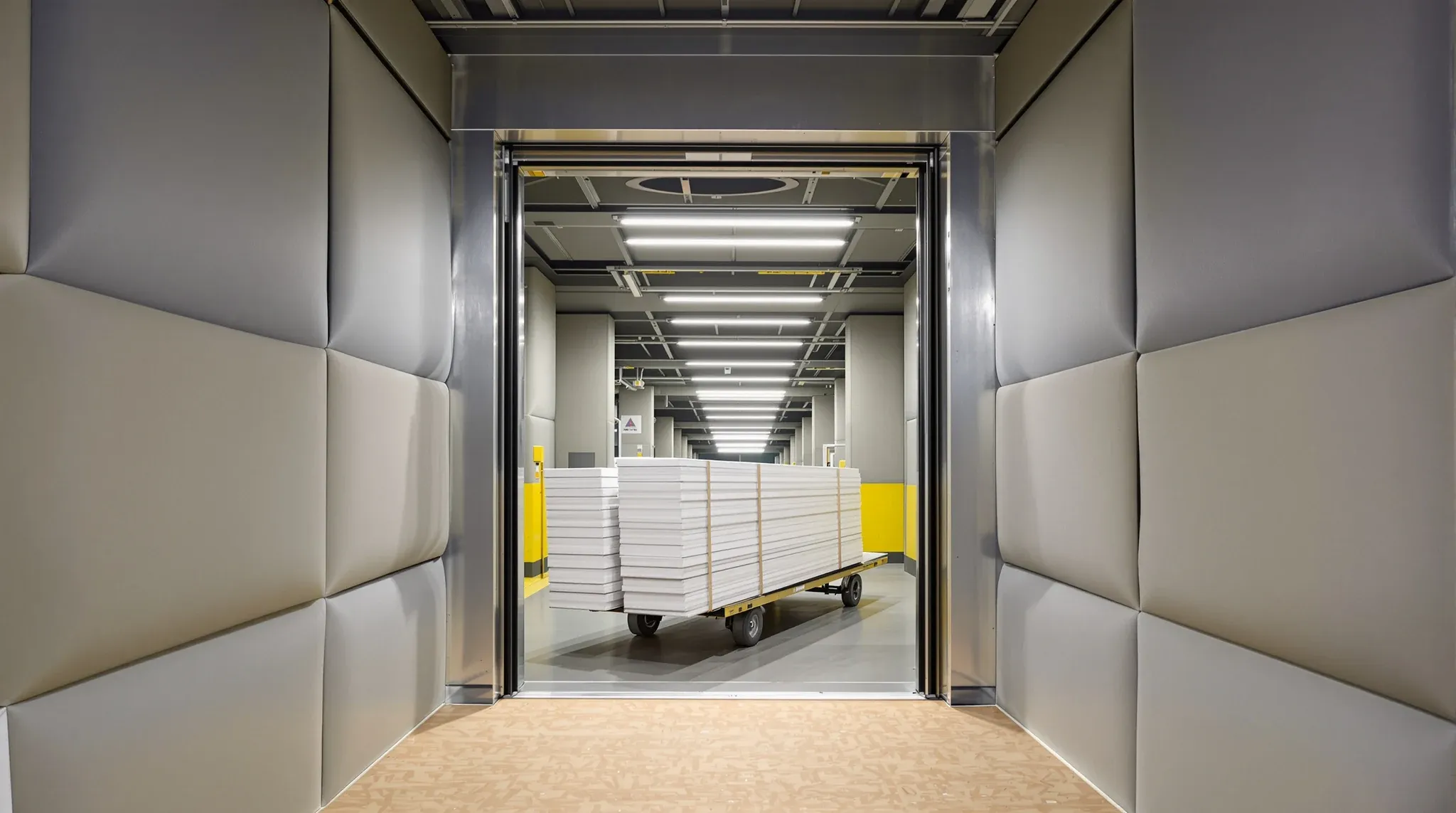
Goods lifts, where a building has one, change the picture substantially. A dedicated goods lift takes material handling off the passenger-lift bottleneck, carries larger loads, and runs outside the tenant-service schedule. Buildings with good goods-lift access are faster and cheaper to fit out for the same reason: a trade crew can keep working instead of waiting for the lift, and the lift is not a shared resource they are rationing across five other crews.
Tenants often assume a large building has good goods-lift access as a matter of course. That is not reliable. Some premium-grade buildings run a single shared goods lift for the whole tower, and the booking sheet is full from seven in the morning. Other mid-tier buildings have surprisingly capable back-of-house arrangements. The only way to know is to ask during site inspection, not after the programme starts.
Loading dock time windows are a programme constraint, not a logistics one
Most commercial buildings restrict when and for how long a vehicle can occupy the loading dock. A typical tenancy move-in window might be 30 to 45 minutes per vehicle, with bookings required a few days in advance and strict timing for arrivals and departures. Miss the window and the vehicle circles the block until the next one opens.
For a fit-out with multiple deliveries a day, that scheduling is not a background admin task. It is a real programme constraint that shapes when partitions, ceiling materials, lighting fixtures, joinery and demolition waste can actually move. A crew cannot install what has not been delivered, and material cannot be delivered outside its booked window. When the booking system is tight, the crew is idle for hours at a time.
This is where logistics and sequencing collide. The same dependency stack that runs through the correct order to build an office fit-out only holds together if material lands on the floor at the right time. A ceiling grid crew that cannot start because the tiles are still in a van waiting for a loading bay is burning paid hours against an expensive trade.
After-hours premiums: where the biggest cost spikes hide
Most constrained buildings solve their daytime bottlenecks by forcing some of the work into evenings and weekends. That is usually the only way to run noisy demolition, heavy material movement, or a large delivery without disrupting other tenants. And after-hours work carries a premium rate for every trade and usually for the building itself in the form of supervisor fees, security callouts, or dedicated lift operators.
Tenants who have not fit out a space before often think after-hours work is a rare exception. On a central city high rise with restricted business-hour access, it is closer to the norm. On a well-configured suburban building with a dedicated dock and goods lift, it might barely appear on the programme. The difference between those two extremes is often the single biggest variable in a fit-out cost comparison between buildings.
The premium is not just the hourly rate. After-hours work usually requires a supervisor on site, a building concierge or security officer to run the lift, and sometimes a dedicated fire warden if the panel is being touched. All three add lines that a tenant never sees on a standard daytime quote, and all three get charged by the hour regardless of how much actual trade work is happening in the same window.
The behaviour of a live building during fit-out is worth setting out early. Running noisy, dusty, or disruptive work inside an occupied tower is not the same as working on an empty floor, and the rules around working after hours in live office fitouts shape how much of the programme the trades can put into daytime at all. The answer drives cost more than any finish selection ever will.
The parts of the job tenants rarely see on the quote
Waste removal is the other half of the logistics equation and usually the hardest to schedule. Demolition and strip-out generate waste faster than lifts and dock windows can clear it, which means on-site storage, staging bins, and carefully timed pickups. A difficult loading dock pushes waste costs up the same way it pushes delivery costs up, because the crew is paying for hours of waiting around rather than paying for bin collection alone.
The coordination around waste removal and site logistics is where tenants often notice the gap between a team that has done a lot of building-constrained fit-outs and one that has not. A well-planned programme stages waste around dock availability rather than against it. A poorly planned one has skip bins sitting full in the back-of-house while the strip-out crew stands around.
Similar logic applies at the upstream end of the programme. When a building has tight dock rules, we typically lean harder on procurement scheduling so that material arrives in the right order for the available delivery windows, not whichever order is most convenient for the supplier.
What we ask before quoting a building-constrained fit-out
When a tenant engages us for a complete office fitouts programme in a building we have not worked in before, our first questions are nothing to do with layout or finishes. They are about dock booking rules, goods lift availability, peak-hour lift restrictions, tenant-service exclusions, noisy-work hours, after-hours supervisor costs, and back-of-house access from the dock to the tenancy floor.
We ask because the answers change the price. A building with a dedicated goods lift, a generous dock booking system, and flexible working hours can take a fit-out programme at standard rates. A building with a single shared lift, a tight dock window, and hard restrictions on daytime noise will push a meaningful share of the work into after-hours, and the quote has to reflect that before the tenant signs it. Discovering the constraint mid-programme is always the expensive version.
Tenants weighing two buildings at lease negotiation stage often have more room to influence these terms than they realise. The logistics conditions are partially negotiable with a building manager who wants to sign a new tenant, and a small concession on dock access or after-hours rules can be worth more on the fit-out cost than a month of free rent.
If you are comparing buildings, fitting out a constrained one, or trying to understand why a quote feels higher than the scope suggests, we can help you work through the logistics layer and show where the hidden hours are hiding.
📞 Call us on 1300 60 93 93