
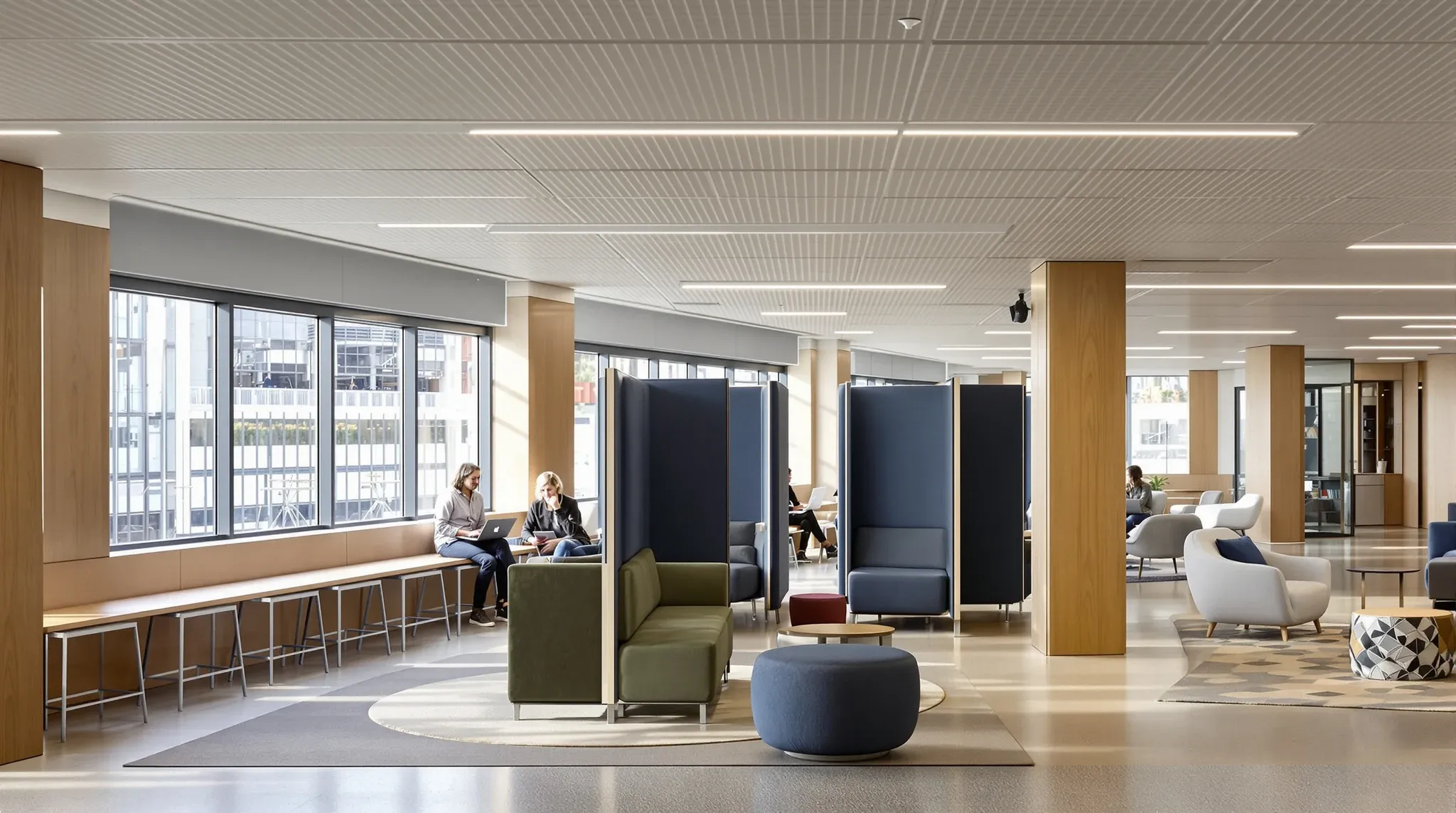
Activity-based working, usually shortened to ABW, allocates space by activity rather than by individual or team. Staff move between settings across the day depending on what they are doing: focused work in dedicated focus zones, collaborative work in collaboration spaces, meetings in appropriate-size rooms, casual interaction in breakout zones. No one has an assigned desk in the pure model; the settings are shared, and staff choose the one that fits the immediate activity. The strategy emerged from Northern Europe in the 1990s, became mainstream commercial office design through the 2000s and 2010s, and is now common enough that most tenants encountering the term have at least heard it discussed.
For fitout decisions, ABW is a specific allocation philosophy rather than a universal workplace truth. It suits certain operational patterns and produces strong outcomes there; it suits other patterns poorly and produces frustrated staff and underused workplaces when applied to the wrong situation. Tenants weighing whether to adopt ABW – or whether to abandon an existing implementation that is not delivering – usually benefit from a clear-eyed read on whether the operation actually fits the model before the fitout scope locks around it.
Where ABW Genuinely Suits
ABW suits operations where staff work patterns are genuinely varied across the day and across the week, where attendance patterns are hybrid (not everyone in the office every day, so desk-sharing is operationally feasible), where the work has a strong concept-and-execute rhythm (concentrated individual phases followed by collaborative phases, repeating across projects), and where the culture is mature enough that staff manage their own movement between settings without disruption.
Consulting firms with project-based work, technology companies with engineering teams that move between design and implementation phases, creative agencies with research-ideation-production cycles, and professional services firms with both client-facing and back-office work all fit the ABW pattern when the culture supports it. Designing an office for hybrid work shares much of the same logic – the pattern delivers strong outcomes when staff have the right setting for each activity, the floor utilisation runs higher than assigned-desking would deliver, and the workplace experience is varied rather than monotonous.
The strategy also suits tenants with constrained floor plates relative to headcount. Where the head office cannot accommodate full assigned-desking for the workforce, ABW with a desk ratio below 1:1 (typically 0.6 to 0.8 desks per FTE) allows the same floor to support more staff. The arithmetic only works if attendance patterns reliably support the lower ratio; if attendance unexpectedly spikes, the desk shortage becomes a daily friction.
Where ABW Does Not Suit
ABW does not suit operations with stable individual work patterns where staff do the same kind of work in the same way every day. A finance team that processes transactions, an analyst group that runs models, an admin function that handles routine workflows – each benefits from a stable workstation with the user’s specific setup. The variety ABW provides has no value because the user does not need variety; the cost of moving between settings each day is operational friction without operational benefit.
ABW does not suit operations with high attendance and 1:1 or close-to-1:1 desk needs. Where every staff member needs a desk every day, the shared-desking premise of ABW is undermined; the desks effectively become assigned regardless of the policy, with the official ABW framework becoming nominal rather than operational.
ABW does not suit cultures that depend on stable team neighbourhoods. Teams that build their working effectiveness through close proximity (everyone in earshot, easy informal communication, visible work in progress) lose that effectiveness when ABW disperses them across the floor each day. Some firms try team-neighbourhood ABW (the team sits in the same zone but rotates through specific desks within it); this hybrid sometimes works but undermines the desk-allocation efficiency that motivated ABW in the first place.
ABW does not suit certain neurodivergent staff or staff with specific accessibility needs. Predictability is important for many neurodivergent workers, and the daily-rotation premise of ABW imposes cognitive load that other arrangements do not. The cleaner pattern is to allocate stable workstations for staff who need them while running ABW for the rest of the floor; pure ABW that does not accommodate accessibility considerations creates real exclusion.
How Fitout Decisions Follow From The ABW Choice
An ABW fitout has different specification implications than an assigned-desk fitout. Desk count drops below 1:1, with the saved area redirected to the various work settings (focus zones, collaboration spaces, video booths, casual interaction zones). The room mix shifts toward smaller, more specialised settings rather than larger general-purpose meeting rooms. The supporting infrastructure for the various work types (acoustic provision for focus zones, AV for collaborative spaces, services for casual interaction) takes a bigger share of the spec. Phone booth and focus pod selection matters more in an ABW floor than in an assigned-desk floor, because the booths and pods carry the focus-and-call workload that assigned desks would otherwise absorb.
Storage provision shifts under ABW. Without assigned desks, staff cannot keep personal items at their workstation; the fitout has to provide alternative storage (lockers, day-use storage at each setting, larger team or department storage zones). The locker provision needs to be sized for actual demand (one per staff member who needs storage, accessible without disrupting other users), not as a token addition.
Technology infrastructure shifts. ABW depends on staff being able to work effectively from any setting, which requires consistent power and data provision across the floor, reliable wireless coverage, and devices that move with the user (laptops rather than desktops, mobile phones or softphones rather than fixed-line). The technology layer has to support the spatial mobility the strategy implies.
Cleaning and operational discipline shifts. Shared workstations need to be cleaned between users, with cleaning protocols that the operations team has to maintain. The settings that work well at handover degrade quickly if cleaning falls behind; staff abandon settings that have become tired or unclean, and the ABW allocation breaks down.
The Cultural Adoption Question
ABW depends on cultural adoption as much as on fitout provision. A workplace specified for ABW but staffed by people who continue to operate on assigned-desking patterns (claiming the same desk every day, leaving personal items overnight, treating shared spaces as personal) does not deliver ABW outcomes regardless of how well the fitout was designed.
The adoption pattern usually requires explicit cultural support: communication about the policy, examples of how staff are expected to move between settings, manager modelling of the behaviour, and operational tools that support the movement (booking systems for the bookable settings, clear protocols for clearing settings at end of use, etiquette guidelines for shared spaces).
Under-adopted ABW commonly comes from fitouts specified for the strategy but with cultural change management treated as a launch-day briefing rather than ongoing reinforcement. Staff revert to the most comfortable pattern available, which is usually assigned-desking despite the official policy; the ABW provisions become nominal, and the desk shortage that was supposed to deliver floor efficiency becomes daily friction.
Hybrid ABW Patterns That Often Work Better Than Pure ABW
Many tenancies that adopt ABW arrive at hybrid patterns that preserve some of the strategy’s benefits while addressing the practical limitations. Team-neighbourhood ABW assigns each team to a zone of the floor, with desks within the zone rotating between team members but the team’s location remaining stable. The pattern preserves team cohesion while delivering desk-allocation efficiency at the team level.
Activity-anchored ABW provides stable workstations for specific activities (focus work, video meetings, collaborative sessions) but does not require movement for the majority of routine work. Staff have a primary desk and move to specialised settings when the activity benefits from them, rather than rotating through different settings throughout the day.
Partial-ABW patterns provide stable workstations for staff who need them (those with stable individual work patterns, accessibility needs, or other reasons) while running ABW for the rest of the floor. The pattern accommodates the practical exceptions without abandoning the strategy.
The strongest implementations usually emerge from the operational pattern rather than from a policy decision. Tenants who let the workplace evolve toward the model that fits the work usually arrive at a hybrid that delivers strong outcomes; tenants who specify a particular model and try to drive operations to match often spend lease years adjusting.
The Fitout Cost Picture For ABW
ABW fitout cost can run higher per square metre than equivalent assigned-desk fitouts, despite the lower desk count, because the variety of work settings requires more specialised infrastructure. Focus pods, AV-enabled collaborative spaces, phone booths, casual interaction zones, and locker provision all add cost that simple desk-and-meeting-room layouts do not include.
The cost is often offset by floor efficiency. A 1,000-square-metre tenancy supporting 120 staff under ABW costs more per square metre than the same tenancy supporting 100 staff under assigned-desking, but the cost per FTE is usually similar or lower. Tenants weighing the strategies should compare per-FTE rather than per-square-metre cost.
The operational cost extends across the lease. Ongoing cleaning costs are higher for ABW because shared settings need more frequent cleaning. Furniture replacement cycles are shorter because shared desks see more wear than assigned ones. Technology costs include the mobile-device infrastructure that ABW requires. The total operating cost across the lease is a fair comparison to the upfront fitout cost difference.
Deciding Whether ABW Belongs In The Brief
The cleanest ABW brief identifies the operational pattern that justifies the strategy, the specific work types the floor has to support, the desk ratio that the attendance pattern actually supports, the room mix and supporting setting count, the cultural adoption approach, and the operational discipline that will maintain the strategy across the lease.
With those six elements clear, the fitout delivers an ABW workplace that operates as intended. Without them, the fitout produces an ABW-styled workplace that may or may not function as ABW depending on the cultural adoption that arrives after handover.
The decision about whether to adopt ABW at all is the foundational question. Tenants who arrive at ABW because consultants recommended it, because the previous tenant had it, or because it was the dominant trend at brief stage, often find the strategy does not fit the operation. Tenants who arrive at ABW because it genuinely matches the work patterns and the cultural readiness usually find it delivers value across the lease.
Happy to run the operational-fit conversation before the spec locks in either direction – the question is not whether ABW is good or bad in the abstract, but whether the specific operation fits the model and what the hybrid alternatives would deliver if it does not.
📞 Call us on 1300 60 93 93