
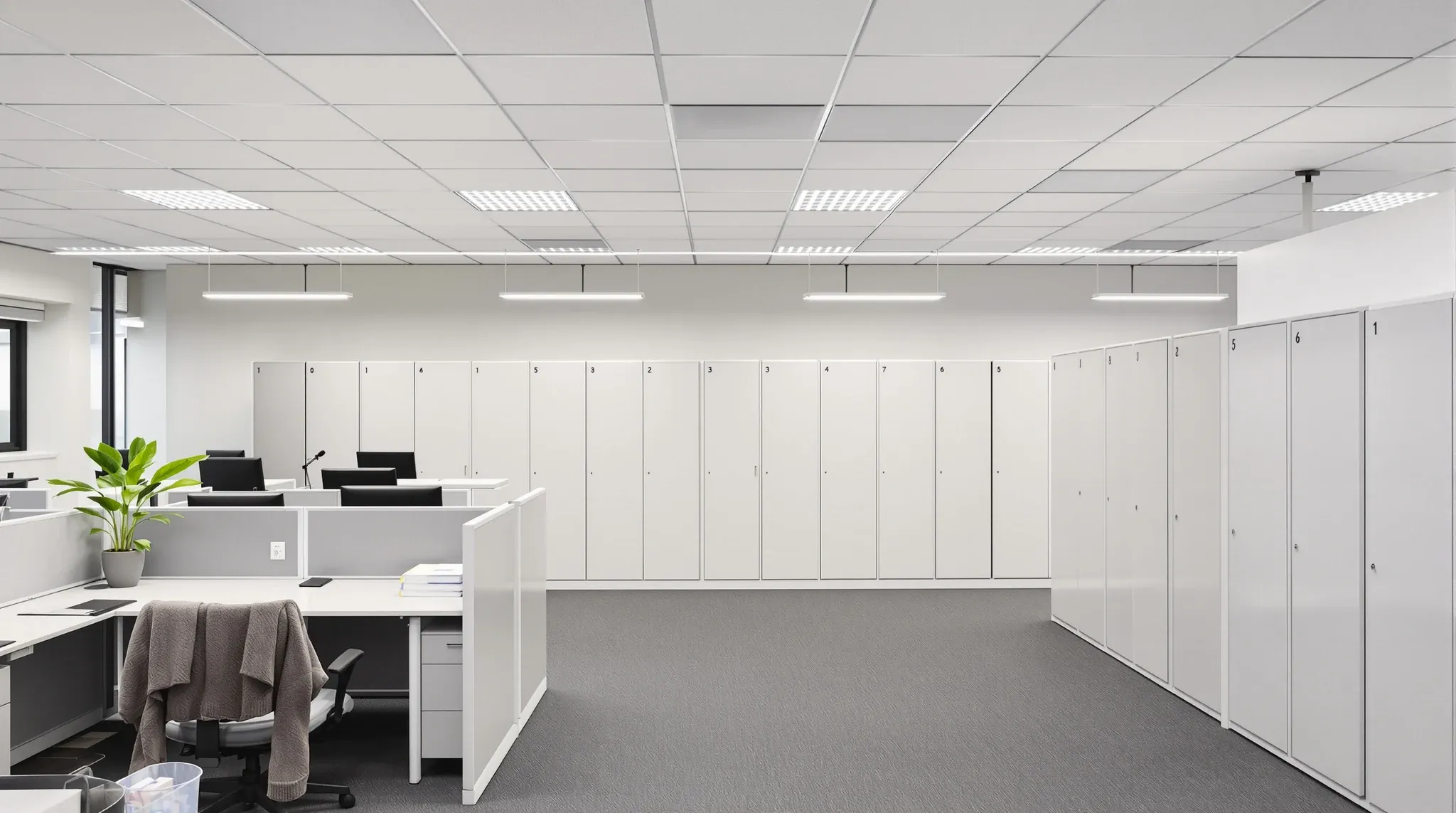
Activity-based working allocates space by the task being done rather than the person doing it. An assigned-desk layout allocates space by the person, full stop. Most Sydney commercial fitouts land somewhere between the two, and the commercial question tenants usually need to answer is not which model is better in the abstract, but which model suits the specific team, the specific floor, and the specific lease that has just been signed.
The short answer is that activity-based working tends to suit organisations with genuinely hybrid attendance patterns, mixed work modes across the day, and teams that do not need a fixed desk to function. Assigned desks tend to suit teams that are on-site most days, rely on personal setup (dual monitors, specialist kit, accessibility arrangements), or work in roles where confidentiality and constant access to local files matter. Almost every floor ends up with elements of both, and getting the ratio right is the decision that shapes the day-to-day experience of the space.
What Each Model Is, In A Commercial Fitout Sense
Activity-based working (ABW) treats the floor as a shared resource with a mix of settings: focus desks, collaboration tables, quiet rooms, phone booths, meeting rooms of different sizes, and social or touchdown spaces. Staff choose where to work based on what they are doing that hour, rather than returning to the same desk every day. Lockers, shared storage, and cloud-first tooling replace personal desk drawers and paper-heavy workstyles.
Assigned-desk layouts allocate a specific desk to a specific person for the length of their role. The desk is personalised, storage is local, monitors and accessories stay in place overnight, and the floor reads as teams owning their territory. Assigned desks can still sit inside open plan and can still include shared meeting rooms and collaboration space around them. The commitment is not to closed offices, it is to named seats.
The commercially interesting space between them is the hybrid. Many Sydney commercial offices now run assigned desks for the teams that genuinely need them (finance, legal, heads-down specialist roles) and ABW for the teams that do not (business development, consulting, mobile sales). The ratio is where the decision happens, not the model label.
When Activity-Based Working Is The Right Call
ABW tends to pay back in four conditions. The first is when attendance is genuinely hybrid at the team level, with most staff on-site two to three days a week rather than four or five. If everyone turns up every day, the theoretical desk-saving of ABW does not materialise, and the floor feels cramped at peak and sparse off-peak. ABW mathematics depend on attendance never hitting full capacity at once.
The second is when the work itself is genuinely variable across the day. A consulting, advisory, or business-development team that shifts between focus work, internal huddles, client calls, and pitch prep every couple of hours uses ABW settings well. The settings earn their floor area because people move between them.
The third is when the business is growing or contracting unpredictably and cannot commit floor area to fixed desks per role. ABW absorbs headcount changes more gracefully than an assigned layout, which has to be reshuffled every time a team changes size.
The fourth is when leadership genuinely supports the model. ABW fails reliably when senior staff keep the same desk every day while asking everyone else to rotate, which turns the whole system into a two-tier layout with extra furniture. If the leadership is not using the settings the same way as the rest of the floor, the numbers do not work and the culture does not either.
When Assigned Desks Remain The Better Answer
Assigned desks keep earning their place on floors where attendance is genuinely high and steady. Teams that are on-site four or five days a week do not save any floor area by rotating, and they usually lose productivity finding a suitable spot each morning. The ABW overhead (logins, locker access, setup time, lower ergonomic consistency) adds up.
Personal setup matters. Staff who rely on dual or triple monitors, specialist input devices, accessibility adjustments, or physical document workflows are poorly served by ABW settings that reset every morning. For those roles, assigned desks are not a preference, they are a functional requirement.
Confidentiality is another legitimate anchor. Finance, HR, legal, and certain operational roles deal with material that should not be left on a shared desk or stored in a locker between sessions. Assigned desks with local lockable storage solve that cleanly. Forcing those roles into ABW usually produces workarounds (staff staying at the same desk anyway, carrying sensitive material home in bags) that defeat the design.
Team identity is the softer but real factor. Some teams work better when they sit together in the same spot every day and develop the rhythms of a defined group. That is not nostalgia, it is how certain kinds of work actually improve. For those teams, assigned desks inside their own neighbourhood is the cleanest answer.
Understanding The Desk-To-Headcount Ratio
The ratio that separates ABW from assigned-desk layouts is desks per person. Pure assigned layouts plan one desk per full-time-equivalent, with some allowance for contractors and visitors. ABW layouts run below that, typically between 0.6 and 0.85 desks per FTE depending on attendance pattern, role mix, and how much collaboration space the floor carries.
The ratio chosen has real consequences. A 0.6 ratio on a team that quietly averages 80 per cent attendance produces a painful experience every Tuesday and Wednesday, when people drive in and find no desk. A 0.85 ratio on a team that genuinely averages 50 per cent attendance wastes floor area that could have been collaboration or amenity space.
Getting this right means measuring actual attendance, not policy attendance, over a reasonable sample. A team that has been told it must attend three days a week but averages 2.1 is planning against a number that is not real. Most Sydney offices landing new fitouts in 2026 benefit from six months of realistic attendance data before committing to a ratio, not a top-down target.
The Hybrid Model Most Offices Actually End Up With
In practice, the majority of mid-sized and large Sydney commercial fitouts land on a hybrid. Assigned desks for roughly half to two-thirds of the floor, ABW settings for the remainder, with a shared pool of meeting rooms, quiet rooms, booths, and collaboration tables that both populations use.
The hybrid works because it stops forcing one model on every team. The finance team can keep its assigned desks and secure storage. The client-facing consultants can rotate through ABW settings that suit their mobile days. Engineers can sit together in their own neighbourhood with assigned desks but share collaboration space with product and design. The floor carries the model each team actually uses.
The risk with the hybrid is zoning it badly. If the assigned-desk zone and the ABW zone share the same acoustic environment with no boundary, the rotating ABW population disrupts the static assigned one. A light acoustic boundary, a change in floor finish, or a run of tall storage between the two zones prevents the frictions that show up otherwise.
What Each Model Needs From The Fitout Itself
Pure ABW changes what the fitout has to deliver. Lockers replace desk storage and need to be sized, secure, and near the entries people use. Power and data need to support hot-desking, which usually means floor boxes, spine raceways, or dense workstation power to avoid cable chaos. Booking systems for rooms and desks are infrastructure, not an afterthought. Way-finding and mobile-first tooling become part of the design rather than optional extras.
Assigned desk layouts have a simpler brief, but the kit per desk tends to be heavier. Dual monitors, docking stations, local storage, personal ergonomic setup, and named chairs all add cost per seat compared with shared ABW stations. The fitout has to plan cable management around personalisation rather than around shared mobility.
Acoustic strategy differs as well. ABW floors rely more heavily on variety of settings (quiet rooms, focus booths, collaboration tables that are expected to be loud) and on ceiling absorption to let that variety coexist. Assigned-desk floors rely more on consistent background levels, because people stay put and cannot relocate if the neighbours get loud.
Cost And Long-Term Flexibility
An ABW fitout is usually slightly more expensive per square metre than an equivalent assigned-desk layout, because it carries more varied settings, more booking infrastructure, and more acoustic and wayfinding work. It saves money on total desks but spends part of that saving on everything around them. The breakeven depends on headcount, attendance pattern, and rent per square metre.
Over the life of a lease, ABW tends to absorb organisational change more easily. Headcount changes land in desk ratios rather than floor reshuffles. Assigned-desk layouts can absorb change, but each restructure usually triggers a small partition and furniture project to keep the layout coherent.
At lease end, both models face the same make good obligations. ABW does not reduce reinstatement scope, and assigned-desk layouts do not increase it in any meaningful way. The make good conversation is driven by the fitout that was installed, not the operating model that ran on top of it.
Choosing Between Them For A New Sydney Fitout
The decision frame that tends to work is to ask three questions in order. How many days per week does this team actually attend, measured rather than stated. What does each person need at the desk to do the work, particularly monitors, storage, and confidentiality. And how variable is the work across the day, week, and month.
Teams that average four or more attendance days, have personal setup requirements, or handle confidentiality-sensitive work should usually get assigned desks. Teams that average two or three days, work mobile-first, and move between activities across the day are reasonable candidates for ABW. Teams in the middle usually do best with assigned desks inside their neighbourhood and access to ABW settings around the floor for the moments that call for them.
We plan and deliver commercial office fitouts across Sydney and can help you work out the right mix of assigned desks and ABW settings for your team, based on how the work actually happens rather than a one-size-fits-all model. If the current layout is not fitting the business any more, we can help you reshape it inside the existing tenancy rather than starting over.
📞 Call us on 1300 60 93 93