
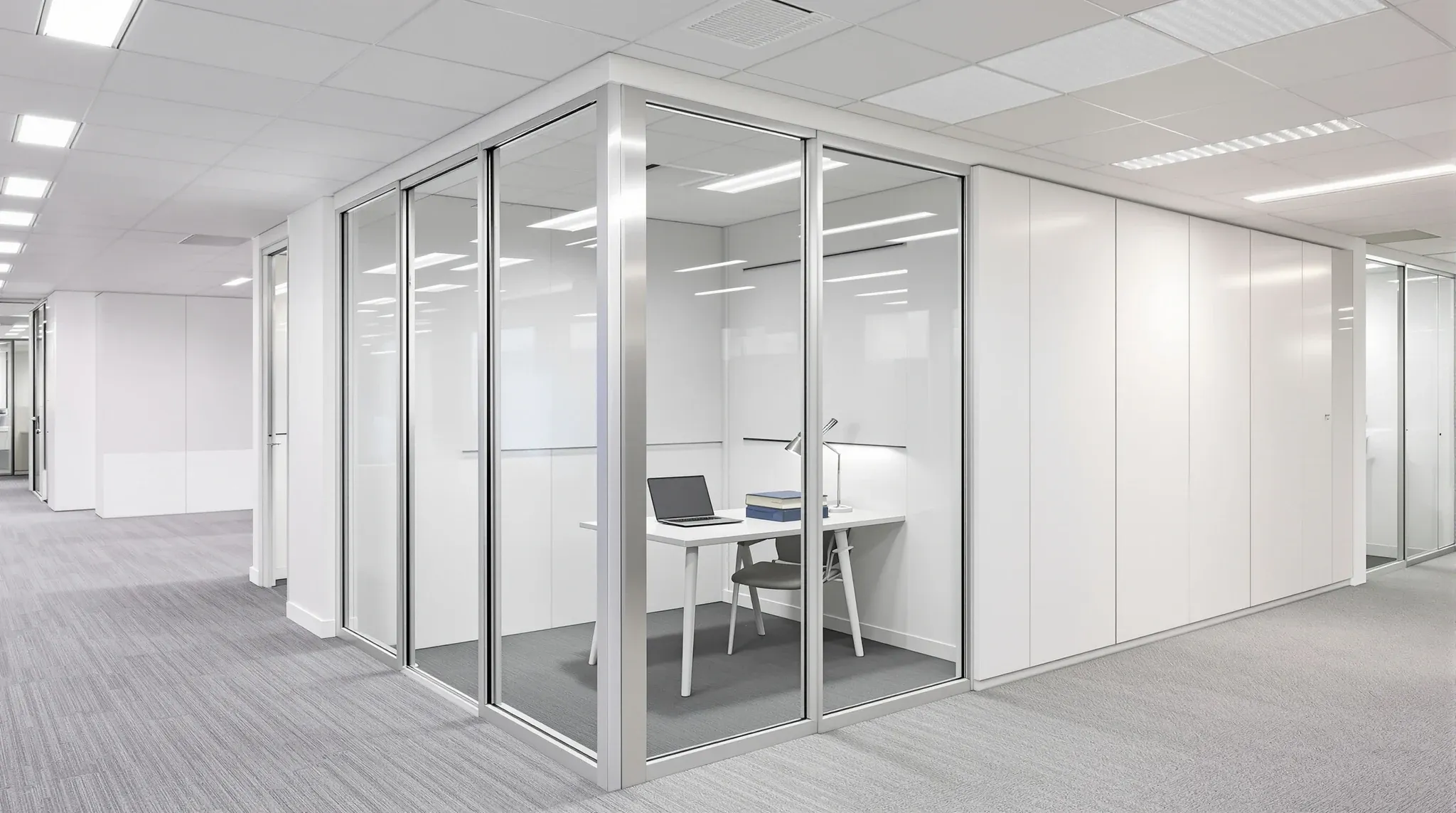
Glass offices are among the most coordination-intensive environments in commercial interiors. They look deceptively simple, a series of transparent walls with clean lines and minimal hardware, but their performance depends on the precise alignment of systems that are often designed, procured, and delivered by different parties. When those systems are managed by a single team with end-to-end responsibility, the outcome is reliably better. When they are fragmented, problems accumulate in the gaps between scopes.
This is not an abstract argument about project management philosophy. It is a practical observation about how glass offices succeed or fail, and it has measurable consequences for cost, programme, comfort, and long-term usability.
What Fragmented Delivery Actually Looks Like
In a fragmented delivery model, the glass partition supplier designs and installs the glass. A separate ceiling contractor handles the suspended ceiling. A mechanical contractor manages air-conditioning. An electrical contractor does the lighting. A fire services contractor handles detection and suppression. Each party works to their own scope, their own programme, and their own commercial incentive. Coordination between them is managed through meetings, emails, and shared drawings, often by a project manager who is not involved in the technical design of any individual element.
On paper, this can look like a well-organised project with clear responsibilities. In practice, each party optimises for their own scope. The glass supplier wants clean installation lines. The ceiling contractor wants a consistent grid. The mechanical contractor wants efficient duct runs. The fire contractor wants compliant sprinkler coverage. When these priorities conflict, the conflict lands in the space between scopes, where nobody has clear ownership and resolution depends on negotiation rather than design authority.
For glass offices, which are unusually sensitive to inter-trade conflicts, this model consistently underperforms. The problems are not dramatic failures. They are a series of minor compromises that add up to an office that falls short of what was expected.
Where the Gaps Between Trades Appear
The gaps in fragmented delivery tend to appear at interfaces rather than within individual scopes. Each contractor completes their work correctly against their own brief, but the combined result does not perform.
The ceiling grid meets the glass partition, but the junction was not designed for acoustic separation. Sound travels freely above the ceiling. The lighting layout is technically correct, but a fitting sits directly on the partition line, creating glare that makes the meeting room uncomfortable. The air-conditioning system was balanced for an open-plan zone, but two new glass rooms have changed the thermal load and the return air path. Each of these problems sits between two scopes, and in a fragmented model, resolving them requires retrospective coordination rather than proactive design.
Glass amplifies these interface problems because it conceals nothing. A solid wall hides a poor ceiling junction. Glass exposes it. A solid wall masks a lighting misalignment. Glass reflects it. A solid wall absorbs some acoustic energy at flanking paths. Glass transmits it. The margin for error that exists with conventional fitouts shrinks dramatically when the walls are transparent.
What Changes When One Team Owns the Whole Outcome
End-to-end delivery does not mean one person does everything. It means one team holds responsibility for how the glass, ceilings, services, fire strategy, lighting, and acoustics interact with each other. That team may include specialists in each discipline, but the design authority and coordination accountability sit in one place.
The practical difference is that interface decisions are resolved during the design phase rather than during construction. The ceiling strategy is developed alongside the glass layout, not before it. The mechanical design accounts for enclosed glass rooms from the outset, not as a late adjustment. The fire strategy reflects the actual room configuration at every stage, not a preliminary layout that has since changed. Lighting is positioned relative to glass lines, not relative to a ceiling grid that was finalised before partitions were considered.
This does not require more time or more cost. In many cases, it requires less of both, because the design coordination that prevents problems is cheaper than the construction variations that fix them. What it does require is a delivery team that understands the full system, not just the individual components.
Accountability and Problem Resolution
One of the most significant advantages of end-to-end delivery is how problems are handled when they arise. In a fragmented model, when something goes wrong at an interface, the first response is often to determine which party is responsible. The glass supplier says the ceiling is the issue. The ceiling contractor says the mechanical design is wrong. The mechanical contractor says the room layout changed after they designed the system. Each party has a defensible position, and the tenant pays for the time spent resolving the dispute.
In an end-to-end model, the same problem is diagnosed and resolved without that overhead. The team responsible for the outcome identifies the cause, determines the solution, and implements it. There is no commercial incentive to deflect responsibility because there is nobody to deflect it to. Problems are treated as coordination issues to be resolved, not claims to be managed.
This difference is particularly important in glass offices, where problems tend to involve multiple systems simultaneously. An acoustic complaint might involve the glass specification, the ceiling void treatment, the door seal, and the room adjacency. Resolving it requires someone who understands all four elements and has the authority to adjust any of them. In a fragmented model, that person often does not exist.
How Fragmented Projects Handle Change vs Integrated Ones
Change is unavoidable in fitout projects. Layouts evolve as the design develops. Client feedback adjusts room sizes, positions, or functions. Building conditions discovered during construction force adaptations. The difference between delivery models is how efficiently those changes are absorbed.
In a fragmented model, a change to one element triggers a chain of notifications, requotes, and rework across multiple parties. Moving a glass partition by one metre changes the ceiling grid alignment, the sprinkler coverage, the lighting layout, and potentially the air-conditioning zoning. Each of those changes requires a separate instruction to a separate contractor, each with its own cost implication and programme impact. The sequencing dependencies between trades mean that a change in one scope can delay several others.
In an end-to-end model, the same change is assessed holistically. The team knows which elements are affected, what the combined cost and programme impact is, and how to implement the change with the least disruption. The response time is faster, the cost is usually lower, and the coordination risk is managed internally rather than distributed across multiple commercial relationships.
The Programme Advantage of Integrated Delivery
Glass office fitouts are particularly sensitive to programme pressure because the installation sequence is tightly interdependent. Ceiling work must be substantially complete before glass can be installed in many systems. Services above the ceiling must be finished before tiles go in. Fire compliance must be verified at specific stages. Lighting must be coordinated with glass positions. Each of these dependencies creates a potential bottleneck.
In a fragmented model, programme coordination depends on external alignment between parties with different priorities and different commitments. A delay in one trade ripples through the others, and recovering lost time requires negotiation and acceleration that increases cost. In an end-to-end model, the programme is managed as a single sequence with internal flexibility. If one element runs slightly behind, the team can adjust the sequence internally without triggering a chain of claims and counter-claims.
For tenants in Sydney, where access windows, after-hours working restrictions, and sequencing constraints are common, this programme advantage is significant. The margin for error in a tightly programmed glass fitout is slim, and the delivery model determines how that margin is managed.
When Fragmented Delivery Can Still Work
End-to-end delivery is not the only viable approach for every glass project. Fragmented delivery can work when the scope is straightforward, the building conditions are well understood, the interfaces between trades are simple, and an experienced project manager provides the coordination that the delivery structure does not inherently include.
Simple glass additions to an existing office, where the ceiling, services, and fire strategy are already established and well documented, may not require the same level of integrated delivery as a full glass office fitout. Similarly, projects where the building is new and the base building documentation is comprehensive present fewer coordination risks.
The risk increases with complexity. Older buildings, limited services capacity, tight programmes, occupied offices, and high acoustic expectations all push the coordination requirements beyond what fragmented delivery reliably manages. In these conditions, the probability of interface failures rises, and the cost of resolving them retrospectively exceeds the cost of managing them through an integrated team.
Choosing the Right Delivery Structure
The delivery model is not usually the first decision tenants think about when planning a glass office. They think about glass type, room layouts, finishes, and budget. But the delivery structure shapes how all of those decisions interact, and it determines whether the assembled result performs as a system or falls short at the interfaces.
For tenants considering glass-heavy offices in complex or constrained buildings, end-to-end delivery offers a measurable advantage in coordination quality, problem resolution, programme control, and final performance. For simpler projects in straightforward conditions, the choice is less clear-cut and depends on the specific circumstances.
If you are weighing up how to structure delivery for a project involving glass partitions, whether as part of a complete office fitout or a standalone scope, we can help you assess which approach suits your building, brief, and programme.
📞 Call us on 1300 60 93 93