
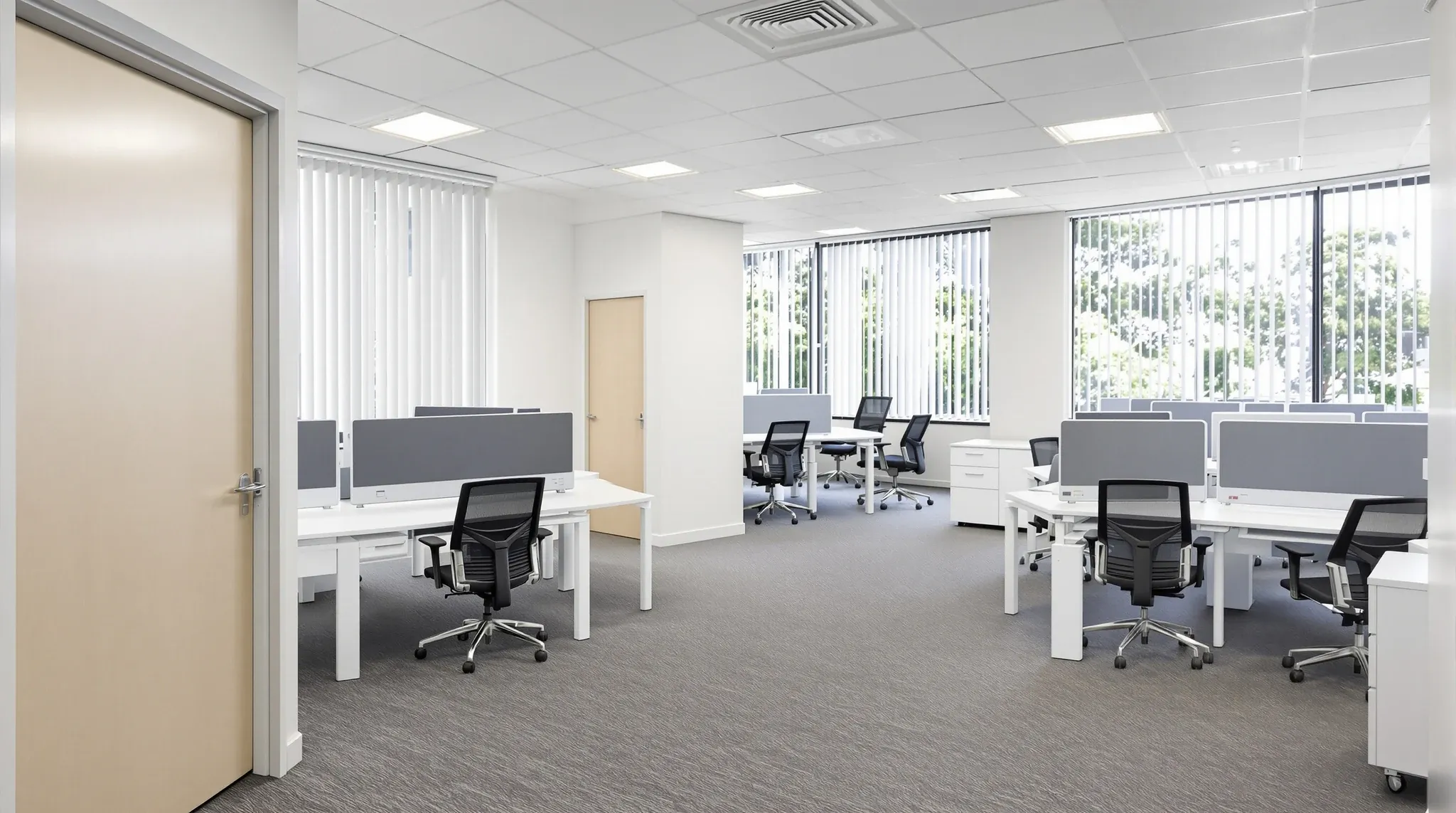
A spec suite makes sense when the lease is short, the team is small, the timing is urgent, and the brand does not need to be expressed through the space. A custom fitout makes sense when any of those conditions shift. Most tenants sit somewhere on that spectrum and the decision is really about where.
The confusion with this decision is that it looks like it is about cost, and it is not. The price difference between taking a pre-built suite from the landlord and commissioning a custom fitout is usually real, but it is almost never the variable that matters most. The real variable is whether the space you end up with actually supports how the business works, and the answer to that depends on lease length, team dynamics, and how much friction the office is allowed to create.
Defining The Spec Suite And Its Limitations
A spec suite is a tenancy the landlord has already fitted out to a marketable standard, typically in smaller floorplates across multi-tenant buildings. The landlord has selected the design, specified the finishes, installed the workstations, built the meeting rooms, fitted the tea point, and often included the furniture. The tenant signs a lease and moves in, usually within days or weeks rather than months.
What a spec suite is not is the same thing as a Cat A or Cat B handover. Cat A and Cat B describe the scope of the landlord’s base provision in a conventional fitout process. A spec suite is a completed, turnkey office product the landlord is selling as a ready-made offering. It is not a stage in a tenant’s own fitout journey. It is an alternative to having a fitout journey at all.
That distinction matters because the decisions a tenant has to make are genuinely different. Choosing Cat A versus Cat B is about who does what work in a tenant-led programme. Choosing a spec suite versus a custom fitout is about whether the tenant leads the fitout at all.
When A Spec Suite Is The Optimal Choice
Several scenarios make a spec suite the stronger option, and they cluster around lease length, team size, and the cost of delay.
Short leases often make the custom-fitout numbers hard to justify. A two- or three-year lease rarely gives enough amortisation runway to make the capital outlay of a custom fitout feel proportionate. A spec suite shifts that capital onto the landlord, and the tenant pays for it through rent rather than upfront. For a business that knows it will move again inside a few years, that trade is usually worth making.
Small teams often find spec suites scaled to their footprint. Most custom fitouts carry a fixed-cost floor regardless of size, and below around 150 to 200 square metres the fixed costs start to dominate. Spec suites are frequently built at exactly that footprint because that is where the landlord sees the clearest demand.
Fast occupation is the third clear case. When a business has to be in a new space within weeks rather than months, the custom-fitout timeline does not fit. Spec suites can be move-in ready on lease execution, and for a tenant whose existing lease is expiring or whose growth has outrun their current space, that timing alone is often decisive.
A brand that does not need spatial expression is the quietest of the four factors but it matters. Some businesses use the office as a functional tool rather than a brand statement. For those tenants, a well-specified spec suite works because the space is a container for work, not a representation of the business.
Value Proposition Of Custom Fitouts
The custom-fitout case is strongest when the conditions above reverse. A longer lease changes the amortisation calculation. A larger or scaling team changes the fixed-cost dynamic. A business that needs the office to express something about how it works, who it serves, or how its teams operate has reasons to spend capital that a spec suite cannot satisfy.
Operational specificity is usually the deciding factor in practice. Recruitment agencies need interview-room counts and sales-floor separation that no generic spec suite will have thought through. Law firms need client-meeting confidentiality and partner-office arrangements tuned to their actual practice groups. Medical and allied health suites need treatment rooms with specific plumbing, acoustic, and privacy requirements. In these cases, the cost of adapting a spec suite to fit usually approaches the cost of building a custom fitout from scratch, and the adapted result is almost always a compromise.
Scale matters too. Once a tenant is taking a full floor or multiple floors, the design logic shifts. The efficiency gains of a floorplate laid out for the tenant’s specific team structure compound over the lease. Spec suites rarely exist at that scale because landlords do not speculate on large floorplates without a committed tenant.
Brand and culture are legitimate reasons too, and they are often undersold. A business that wants its office to reflect how it works, what it values, and how it welcomes clients has to build that into the space. Paint and signage on a spec suite do not do the work. Layout, sightlines, material choices, and zoning do, and those are custom-fitout decisions.
The Overlooked Hybrid Fitout Strategy
There is a third option that sits between the two and does not get enough attention. Some landlords will agree to hand over a spec suite in shell condition, or in a partial fitout condition, and let the tenant complete the rest. In premium-grade buildings the landlord sometimes offers a Cat A+ arrangement where the base is fitted out but the tenant adds the distinguishing layer of workstations, partitions, and brand expression.
This works well when the tenant wants the speed and capital efficiency of a pre-built base but also wants to make the space its own above the line. It is not available in every building and not offered by every landlord, but it is worth asking about, particularly in newer CBD towers where spec provision is more flexible than the marketing suggests.
The risk with this hybrid option is that the tenant ends up paying for a base they would have specified differently and then paying again to modify the parts they care about. A fitout team can usually model both paths on the same brief and show a tenant whether the hybrid actually lands a better outcome or just adds another layer of negotiation.
Key Questions For Decisive Selection
The decision tends to clarify quickly when a tenant works through four questions honestly.
How long is the lease, really: not the headline term, but the period the business realistically plans to be in this space. If that horizon is under three years, the spec-suite case strengthens materially. If it is five years or longer, the custom-fitout case strengthens.
How specific is the operational brief: if the business has non-negotiable functional requirements that a generic spec suite will not satisfy, the custom route is usually the right call even on a shorter lease.
What is the cost of delay: some businesses can absorb a three-to-five-month fitout programme without meaningful disruption. Others cannot. If the cost of being in the wrong space is high enough, the spec suite earns its premium by removing the delay.
Does the space need to do brand or culture work: if yes, a spec suite will almost always feel borrowed. If no, it will feel adequate.
Most tenants who work through these four questions find that one answer dominates the rest, and the decision settles cleanly.
Identifying Scenarios With Marginal Differences
There are cases where the call is not obvious, and honesty about those cases matters more than pushing a tenant one way or the other. Mid-length leases, moderately specific operational requirements, and growing teams often sit in the grey zone. In those cases, the right answer is usually to model both options in detail, including the hybrid, rather than defaulting to whichever is cheaper on paper.
Spec-suite economics also depend on the specific building and landlord. Some spec suites are genuinely well-designed and reasonably priced relative to the custom alternative. Some are priced aggressively and designed in a way that will not survive heavy daily use by the tenant’s actual team. The spec-suite side of the decision is not uniform, and the tenant has to judge the specific product in front of them rather than the category as a whole.
The custom side has its own variation. A fitout team that scopes accurately, sequences realistically, and pushes back on a tenant’s early assumptions is not the same product as a team that agrees to everything and discovers the costs later. The custom case is only as strong as the team delivering it.
Strategies For Confident And Informed Decision Making
The strongest approach is to treat the decision as a shortlist exercise rather than a binary one. Most Sydney tenants can identify two or three spec suites worth considering and one or two fitout companies worth briefing. Running both conversations in parallel, rather than choosing a side and then searching for options, produces the clearest picture.
The parallel-track approach also reveals the hybrid option if it is available in the buildings on the shortlist. That discovery often shifts the decision in a useful direction, because the tenant sees three options rather than two and picks the one that fits rather than the one that looked cleaner at the start.
If you are weighing a spec suite against a custom fitout and want the real numbers on both, including the hybrid case where it exists in your shortlisted buildings, we can put the two paths side by side against your specific brief.
📞 Call us on 1300 60 93 93