
Most articles about staging an office fitout assume the decision has already been made, and walk you through how to keep working through the noise. The decision itself is the harder one. Before you stage anything, you have to decide whether your team is staying in the building during the works or moving out into swing space and letting the contractor have the floor. That choice shapes the cost, the timeline, the productivity loss, and the lease structure for the whole project. It is worth answering deliberately rather than by default.
The short answer is that staying in place suits projects that are smaller, slower, and tolerant of disruption, while a full decant suits projects that are larger, faster, and need the floor cleared to do good work. The longer answer is more useful, because the trade-offs are not always obvious until you cost both options against your specific business.
What each approach actually means
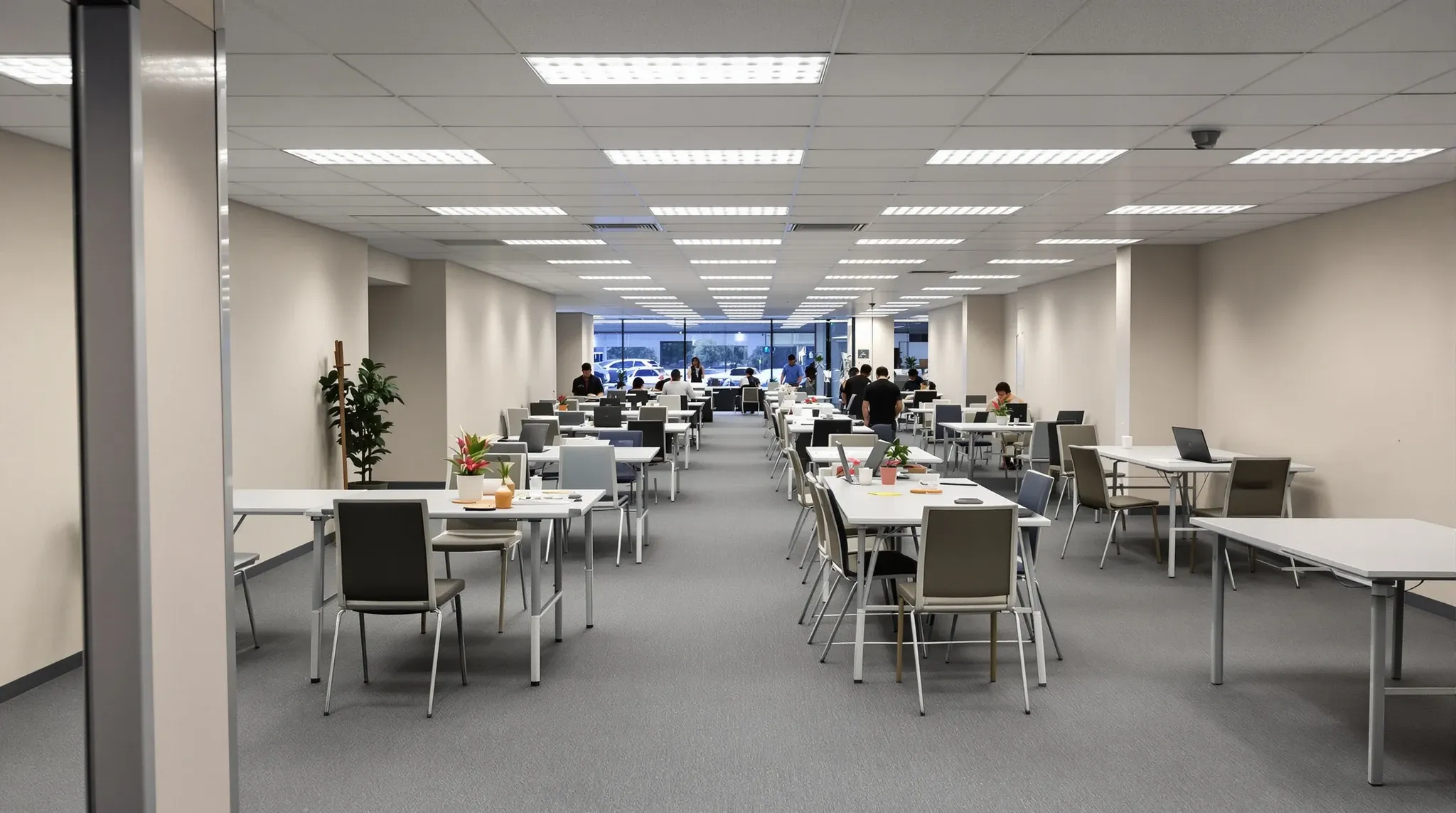
A staged in-place fitout means the team continues to work in the existing tenancy while the fitout is built around them in defined zones. The contractor might take a quarter of the floor at a time, complete the work, decant the team into the finished area, and move on to the next zone. The space remains occupied throughout. The team experiences the fitout as a series of disruptions rather than a clean before-and-after.
A decant fitout means the team relocates to alternative space for the duration of the works. The existing tenancy is handed over to the contractor as an empty floor, the fitout is built without occupant interruption, and the team moves back into the finished space at the end. The decant location might be a temporary tenancy taken specifically for the project, a sub-leased section of an adjacent floor, a coworking arrangement, or in some cases a partial work-from-home period if the business can absorb that.
The two approaches are not always presented as a choice. Some businesses default to staging because the idea of moving twice feels expensive, and some default to decanting because the idea of working through a fitout feels intolerable. Both defaults skip the calculation that should sit between them.
What changes the answer
Five things tend to drive this decision: the scale of the works, the speed required, the team’s tolerance for disruption, the availability and cost of swing space, and the lease structure that governs the existing tenancy.
Scale matters because some work simply cannot be done quietly in zones. A floor that needs new partition walls, ceiling rework, services rerouting, and acoustic upgrades cannot be staged into half-day windows around team meetings. The trades need continuous access to the area they are working in, and the noise, dust, and movement do not stop at a temporary partition. A full strip-out and rebuild is almost always faster and cleaner if the floor is empty.
Speed matters because staged works run at maybe 60 per cent of the pace of an empty-floor build, sometimes slower. Every trade has to clean up at the end of each shift, every zone change adds setup time, and every coordination question with the team adds delay. If the project has a hard end date driven by a lease event, a funding milestone, or an operational deadline, staging can simply fail to land on time.
Disruption tolerance is a real cost that businesses often refuse to put a number on. A team that loses two hours of focus a day for ten weeks is losing meaningful output. The cost of that productivity hit can easily exceed the cost of a swing space lease, but it is harder to see because it does not show up as an invoice. The honest version of the calculation includes both numbers, not just the visible ones.
When staying in place is the better call
Staged in-place works best when the scope is genuinely modest, the project can absorb a slower pace, the team can tolerate the disruption, and the cost of swing space is high relative to the value of the works.
Common examples include partition reconfiguration on part of a floor, a kitchen or breakout refresh that affects a single zone, an acoustic upgrade in a specific area, or a phased fitout that intentionally treats one zone as a pilot before extending. In these cases the works are small enough that the contractor can carve out the affected area, the noise and dust can be contained to a defined zone with adequate hoarding and dust control, and the rest of the team can keep working without significant interference.
Staging also wins when the existing tenancy has no realistic swing-space option, when the team is already partly remote and the in-office headcount is low, or when the fitout is being delivered incrementally over a longer programme by design. In all of these cases the cost and disruption of moving twice would clearly outweigh the cost of working through.
The honest test is whether the in-place version of the project can actually be delivered to the same standard as the decanted version. If the answer is no, staging is the wrong call regardless of how convenient it feels.
When decanting is the better call
Decanting wins when the works are large enough that staging would either compromise the build quality or extend the timeline unacceptably. The clearest signal is when the design touches the ceiling, the services, or the acoustic envelope of more than one zone. Once trades need access to the slab, the void, or the perimeter, the work cannot reasonably happen around an occupied team.
Decanting also wins when speed is the binding constraint. A six-week empty-floor build is often equivalent to a twelve-week staged build, and the difference matters when the project has a hard end date. It is the faster path to a finished space, and the rent on swing space for six weeks is a smaller number than the operational cost of a project that overruns.
The other case for decanting is when the existing tenancy is genuinely awful to work in once the fitout starts. Older buildings with poor acoustic separation, exposed services, or limited containment options sometimes cannot be staged cleanly even for modest works. The dust travels, the noise carries, and the team ends up working in conditions that damage productivity and morale. A short decant in those conditions is usually cheaper and kinder than insisting on staging.
Costing both options honestly
The reason this decision is often made on instinct is that the cost comparison looks lopsided at first glance. Staging looks cheap because there is no swing space rent line. Decanting looks expensive because the swing space rent is visible. The full comparison is more complicated than that.
A staged in-place project carries hidden costs that do not appear on the contractor invoice. The fitout takes longer and costs more in trade time because of the zone changes, the cleanups, the coordination, and the slower pace. Productivity loss across the team for the duration is a real number, even if it is hard to measure precisely. The risk of overrun is higher because every staged project has more variables, and overrun cost compounds. The fitout quality is sometimes lower because the trades cannot work as cleanly as they would on an empty floor.
A decant carries visible costs but fewer hidden ones. There is the swing space rent for the period, the cost of moving twice, any temporary IT and AV setup, and the lease overlap if the timing is uncertain. Against that, the project itself runs faster and cleaner, the team works in stable conditions throughout, and the final handover is the only transition.
When tenants compare both numbers honestly, the gap is usually smaller than it looks. For larger projects the decant often comes out cheaper in total. For smaller projects the staged option usually wins. The middle ground is where the decision is genuinely close, and where it is worth modelling rather than guessing.
Lease structure and the timing question
Lease overlap is where decanting most commonly trips up. The cleanest decant runs from a known start date in the existing tenancy to a known end date and then into the finished space. Real timelines are messier. The contractor needs more time than expected, the swing space lease needs to extend, the move-back gets pushed, and the costs accumulate.
The tenants who avoid this build a buffer into the swing space lease term from the start, agree on a contractor programme with named milestones rather than a single end date, and confirm with the building owner what flexibility exists if the move-back date moves. None of these are unusual asks, but they are easier to negotiate at the planning stage than after a slip has happened.
Staging has the opposite trap. The programme drifts because each zone takes longer than planned, the project runs into the next quarter, and the team’s tolerance for living through the works runs out before the works finish. The fix there is to set a realistic programme at the start and accept that staged projects move more slowly than empty-floor projects.
The decision worth making early
Decant or stage is the kind of decision that gets harder the longer it is left. Made early, it shapes the design, the contractor selection, the lease conversation, and the budget in coherent ways. Made late, it forces compromises on whichever option is left.
The tenants who handle this well usually answer it before the design phase, not after. They have a rough scope, an honest read on disruption tolerance, a sense of what swing space is actually available in their area, and a real number on what each option costs. That is enough to choose between them with confidence rather than by default.
If you are weighing up a decant against a staged in-place fitout for an upcoming office project and want a straight read on what each approach would cost and how it would run, we can help.
📞 Call us on 1300 60 93 93