
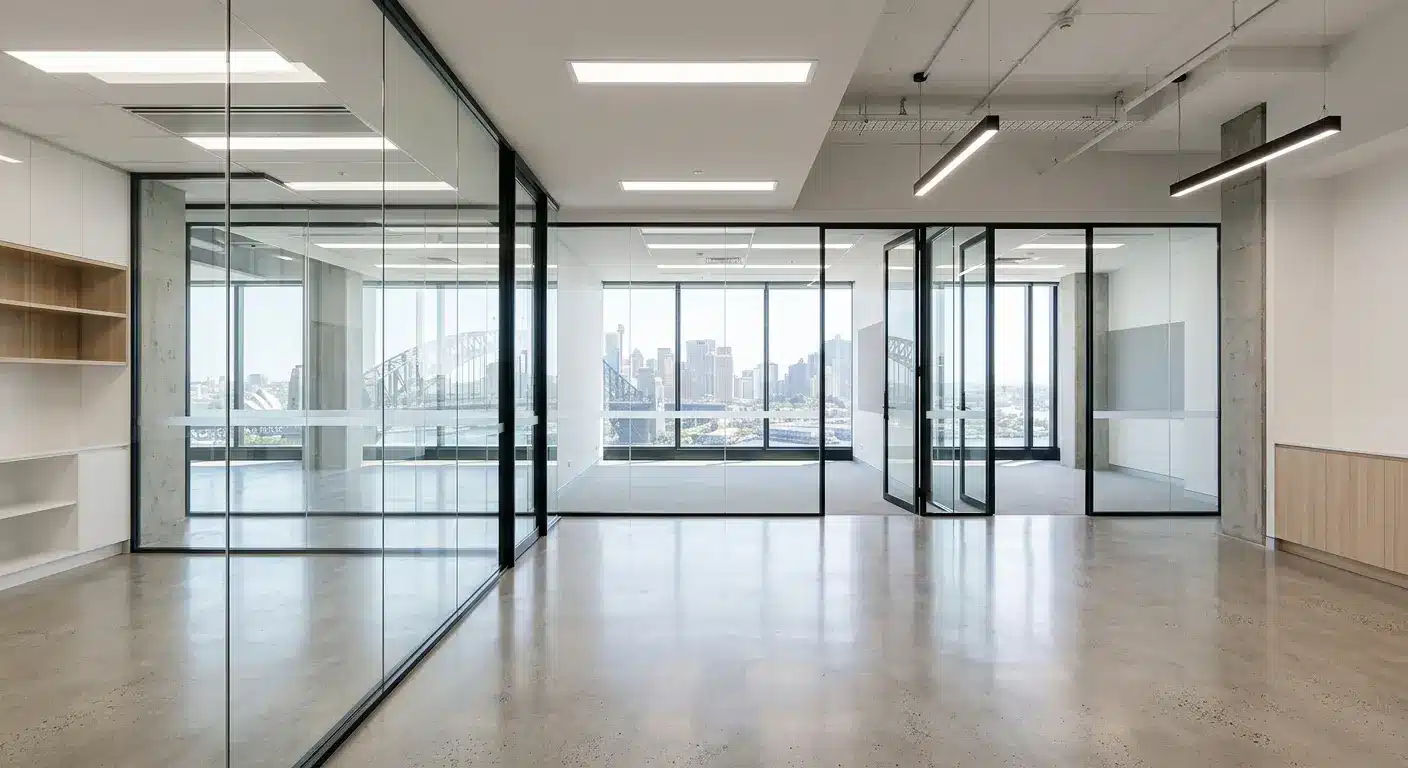
Make good is not one scope. The same lease clause produces a very different schedule of works depending on whether the tenant is leaving the tenancy entirely or staying put under a renewed lease. Most tenants think of make good as the thing they do when they move out. Tenants who renew often discover, partway through the renewal conversation, that there is a make-good obligation in their direction too, and that it looks structurally different from the one they would have faced on exit.
The choice between relocation make good and in-place make good is rarely framed as a choice. It is usually a consequence of whether the tenant is staying or going. But the consequences of that consequence shape the scope, the cost, the programme, and the negotiating position with the landlord in ways worth knowing before either path is locked in.
What Each Path Actually Means
Relocation make good is the scope of works needed to hand a tenancy back to the landlord at the end of a lease where the tenant is moving out. The work is done to a defined exit condition, typically agreed in the lease and refined through a terminal dilapidation schedule. The tenant pays for the works, the tenancy is handed back vacant, and the bond or bank guarantee is released against final landlord sign-off.
In-place make good is the scope of works agreed where a tenant renews and stays in the tenancy under a new lease. The work brings the tenancy up to a defined condition that the new lease will treat as the commencement baseline, while the tenant continues to occupy the space. The structure of the obligation is different, and so is the practical scope.
The clause in the original lease can read identically in either case. What differs is how it gets executed when the lease term ends.
Scope Difference: What Gets Done In Each
The most obvious difference is partition demolition. Relocation make good typically removes tenant-installed partitions, glass, and joinery, restoring the floor to base building condition or the agreed exit state. In-place make good rarely removes partitions, because the tenant continues to use the same floor plan and demolishing the existing layout would interrupt the business.
What gets done instead in the in-place version is reinstatement of finishes, refresh of any items that have aged through the lease, and addressing the specific items the dilapidation schedule lists as required to bring the tenancy to the renewed-lease commencement standard. The dilapidation schedule is the document that resolves these, and the version produced for an in-place renewal typically reads thinner than the equivalent terminal schedule.
Ceiling reinstatement, partition removal, services strip-out, and floor finish restoration are the four big items in a typical Sydney terminal make good. None of them usually appears in an in-place version unless specific items in the tenancy are genuinely in poor condition or the renewal landlord has a particular reason to scope them.
Cost Difference And Why The Comparison Misleads
On a straight per-square-metre basis, an in-place make good lands meaningfully cheaper than a relocation make good. The scope is narrower, the demolition is largely absent, and the works run alongside continued occupation rather than against an empty tenancy.
That comparison misleads in two directions. First, the tenant doing in-place make good is also paying for a new lease and possibly fitout adjustments to refresh the space they continue to use. The total spend in the renewal scenario can be higher than the relocation scenario even where the make-good slice is smaller. Second, the in-place tenant carries the make-good obligation forward into the renewed lease. The relocation tenant is done.
The comparison that matters is total occupancy cost across the lease cycle, not the cost of the make-good line item. Either path can be the right one depending on the broader commercial picture; the make-good cost alone is not the determining factor.
Programme Difference: Empty Vs Occupied
Relocation make good runs against an empty tenancy. The tenant has moved out, the floor is clear, trades have full access, after-hours rules and lift restrictions are easier to negotiate because the floor is not occupied by anyone else. Programmes are usually two to five weeks for a typical Sydney office tenancy, depending on size and scope.
In-place make good runs against a working tenancy. The tenant is still operating from the floor, trades have to work around the business, dust and noise have to be contained, and most of the works run after hours or in defined zones during business hours. Programmes stretch. A scope that would take three weeks against an empty tenancy might take six weeks against an occupied one, and the trade cost reflects that.
This is one of the more practical reasons in-place make good lists short. Where the work would require taking the tenancy out of operation, the scope tends to get negotiated down to what can be done with the floor still occupied, with the rest accepted as fair-condition continuation.
Landlord Position In Each Scenario
The landlord’s commercial position is different in each path, and that shapes how the schedule reads.
For a relocation make good, the landlord is preparing the tenancy for re-leasing. The schedule will scope toward returning the floor to a state ready for a new tenant, which can mean wider scope than the lease strictly requires. Temporary make good between tenants covers the middle ground where landlords sometimes accept reduced scope in exchange for the floor being marketable as-is.
For an in-place make good, the landlord is keeping the same tenant. The scope incentive is different. The landlord wants the tenancy in defensible condition for the renewed lease term but is not preparing it for marketing. Schedules in renewal scenarios tend to focus on specific items that have deteriorated noticeably during the prior term, rather than a wholesale return to commencement condition.
This difference is worth using during the renewal negotiation. A tenant who recognises that the in-place schedule has less commercial pressure behind it usually negotiates a tighter scope than they would face on exit.
Documentation Difference: What Sets The Baseline
For relocation make good, the original lease commencement condition report sets the baseline. The terminal schedule scopes against it, the works are done against the schedule, and the final inspection signs off against the same baseline.
For in-place make good, the question of baseline gets more nuanced. The renewed lease typically establishes a new commencement condition, and the in-place make-good works are the bridge between the prior lease’s exit condition and the renewed lease’s commencement condition. A fresh photographic condition report at renewal is worth running for the same reasons one was useful at original commencement. It locks in the baseline for the new term.
Skipping this step at renewal is a common mistake. Tenants who renew without resetting the condition documentation end up with a make-good obligation at the end of the renewed lease that argues against a baseline twelve or fifteen years out of date.
When The Decision Is Genuinely A Choice
Sometimes a tenant is at a renewal point and the lease offers both options: stay under a renewal, or go and do relocation make good. The choice is mostly a business decision about the space, the location, the rent, and the operations. The make-good comparison influences it at the margin.
The margin runs in favour of staying when the existing fitout still works, the partition layout still suits, the make-good obligation on exit would be substantial, and the renewal rent is acceptable. It runs in favour of leaving when the existing fitout is dated, the operations have outgrown the layout, and the relocation make good is a known, finite cost compared to continuing to pay rent on a space that needs significant adjustment.
The make-good comparison is rarely the deciding factor. It is often the factor that changes the rank order between two close-run business cases.
What Tenants Should Confirm Either Way
Whichever path the tenant ends up on, three things are worth confirming early. The version of the dilapidation schedule that applies to the chosen path, because relocation and in-place schedules read differently and the wrong version can produce a wider scope than the lease supports. The condition baseline being used, particularly at renewal where a fresh report is often appropriate. And the programme and access arrangements with the landlord and building manager, because the practical execution differs noticeably between the two scenarios.
If we can help work through the make-good scope on a Sydney commercial lease where relocation or renewal is on the table, scope the works under either path so the trade input is comparable, or negotiate the schedule down to what the lease genuinely supports, this is the kind of defit and make good work we walk tenants through regularly.
📞 Call us on 1300 60 93 93