
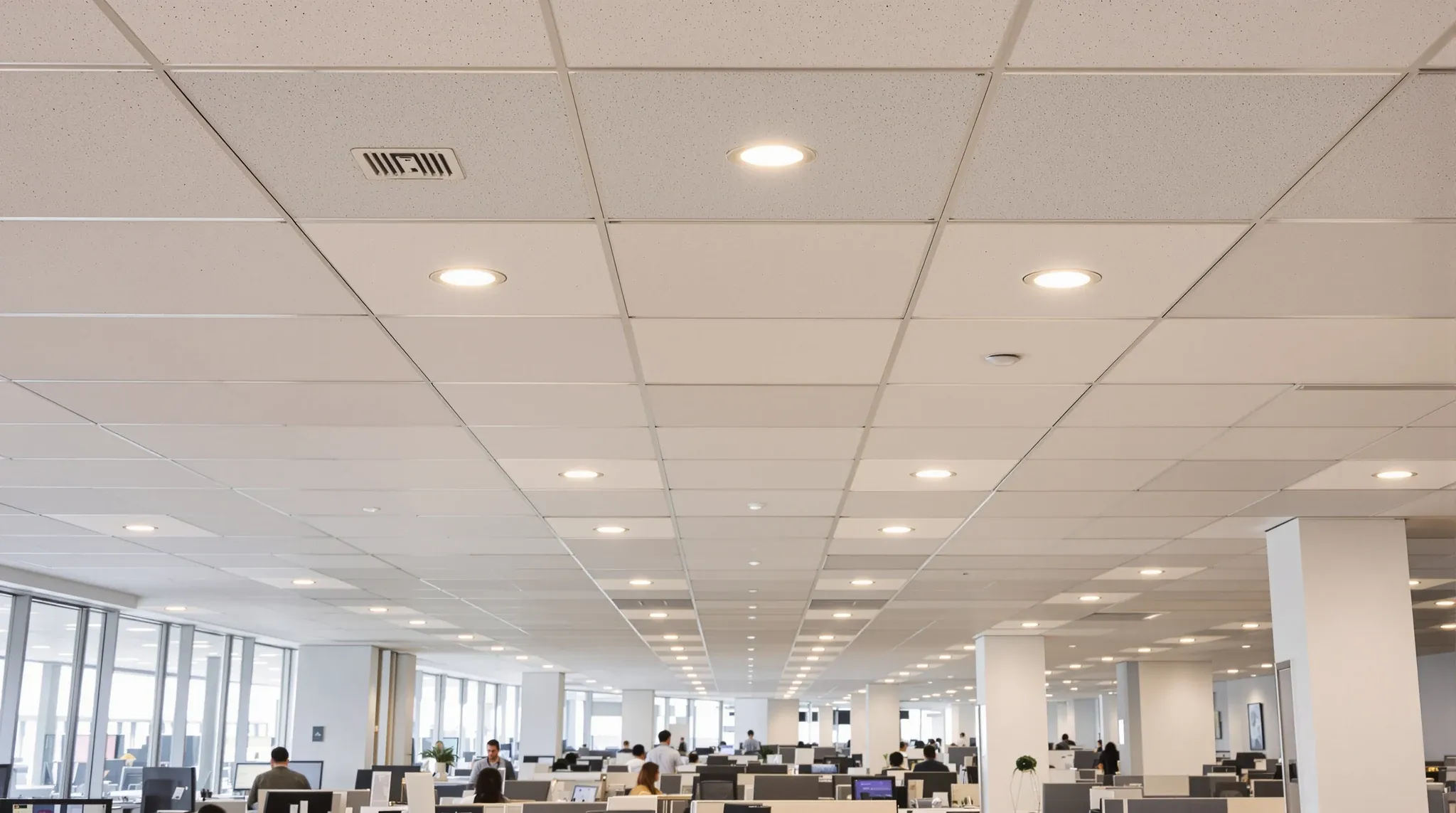
Lighting is the make good scope item that surprises tenants most often. The partitions come out, the walls get patched, the carpet gets replaced, and by that point the lighting scope is usually the only thing standing between the tenant and the landlord’s sign-off inspection. That is also the point where the scope is most expensive to fix, because the electrical trade is back on site for the second or third time, the ceiling has already been reinstated, and any change to fitting locations means lifting tiles that have just been set clean.
A deliberate reading of the lighting clause at lease end, done six months before handback rather than six weeks before, is how tenants avoid the scramble. What the clause actually says, what the base-building condition actually was, and what has been changed during the tenant’s occupation are three separate conversations, and all three of them affect what has to come out and what has to go back.
Base-Building Lighting Versus Tenant-Added Lighting
The starting point for any lighting reinstatement scope is the base-building specification the tenancy was handed over under. In most Sydney commercial leases, the landlord provides a baseline lighting solution at lease commencement, typically a grid-integrated recessed LED or fluorescent fitting at a nominated density. The fitting type, wattage, colour temperature and circuiting are recorded in the original handover documentation or lease schedule.
Tenant-added lighting sits on top of that baseline. Feature pendants, downlights in feature ceilings, track lighting in reception areas, linear LED integrated into joinery, under-shelf lighting, signage illumination, and accent lighting in meeting rooms are all routine tenant additions to a commercial fitout. Each of them was added after the landlord’s baseline was in place, and each of them has a lease-end obligation attached.
The reinstatement logic is usually straightforward in theory. Tenant-added fittings come out. Base-building fittings stay. Where tenant work changed the baseline, the baseline has to be restored. The complication sits in the middle case, which is more common than either of the clean ones; tenants frequently removed or disabled base-building fittings during their fitout, relocated them, or replaced them with upgraded products, and the record of what happened is often thin by the time make good is being planned.
Reading the original condition report, the approved fitout drawings, and the as-built electrical plan side by side is usually the only way to separate these three categories cleanly. Tenants who did not retain those documents at the start of the lease often find themselves paying for reinstatement work that was arguably the landlord’s responsibility, because the evidence to push back is not there. The obligations at lease end usually point back to documents the tenant should have secured at the start.
Feature Lighting and How Each Category Reinstates
Within tenant-added lighting, the removal and reinstatement work varies sharply by category. Pendants suspended from ceiling hooks or track are the cleanest to remove; the cable drops out, the hook is made good, the ceiling tile or plasterboard patch is repaired, and the work is usually a one-day electrical visit.
Track lighting is moderately more involved because the track itself is fixed to the ceiling or a bulkhead and needs removal plus surface repair. The fittings on the track come off with the track. The electrical termination at the track head needs to be capped or made safe, and if the track was circuited separately from the base building, the circuit may need to be decommissioned back at the distribution board.
Linear LED integrated into joinery, bulkheads, or ceiling slots is the expensive category. The fittings themselves are typically not removable as discrete objects; they were built into the joinery or ceiling work. Removing them usually means removing the host structure, and reinstating the base-building ceiling or wall finish where the host structure was. A tenant who installed a continuous LED strip along a 15-metre corridor soffit is looking at both the removal of the strip and the reinstatement of a plain soffit, and the cost of the second part is usually larger than the cost of the first.
Under-shelf and in-joinery lighting usually leaves the building with the joinery itself at make good, which simplifies the electrical scope at the fitting but not at the termination point on the wall or ceiling.
Signage illumination and backlit features are a specific sub-category. Even when the signage is removed, the illumination cabling and the wall cut-outs that housed the fitting typically remain and need to be closed off. If the signage wall was plasterboard and the illumination required a local transformer or driver hidden in the wall, the tenant’s make good scope has to include removing the driver and closing the access panel cleanly.
Emergency and Exit Light Implications
Emergency lighting and exit signage are almost always base-building responsibility, but tenant fitouts commonly modify the positions of both during the original fitout. Meeting rooms get emergency lights re-placed to match the new room layout, exit signs get moved to match new door positions, and illuminated path-of-travel signs get added or removed depending on layout changes.
At make good, any modification to the emergency or exit lighting layout has to be reversed or signed off by a licensed electrical contractor as compliant with the current configuration. This is a non-negotiable requirement at the handback inspection, because emergency and exit lighting is tied to the building’s fire compliance certificate and the landlord cannot accept handback without confirmation that the layout still works.
The practical difficulty is that reversing a multi-year fitout’s emergency lighting changes is rarely tidy. Original positions may now sit inside new partition walls. Cables may have been re-routed through joinery that is being removed. Exit signs may have been replaced with updated product that the landlord’s base-building standard does not match. Each of these requires a specific solution, and the electrical contractor managing the make good needs to be briefed to identify these points early rather than late.
A pre-inspection walkthrough with a qualified electrician, done three or four weeks before the intended handback date, is the common-sense defence against late surprises. The electrician’s report then becomes a scope document for the remaining work rather than a punch list found at the landlord’s inspection. What a make good scope typically covers extends beyond the obvious partition and paint items into this emergency-lighting layer that is often forgotten.
Electrical Certification at Handover
The paperwork at handback is often where make good scopes derail, even when the physical work was done correctly. Any alteration to the electrical installation during the tenancy, including lighting changes, generates a trail of Certificates of Electrical Safety and compliance documentation that the landlord can ask to see.
For lighting reinstatement specifically, the tenant usually needs a final Certificate of Electrical Safety confirming that the installation at handback is safe, compliant, and matches the as-built drawing the landlord is accepting. If the make good work is being done by the same contractor who did the original fitout, the paperwork is usually straightforward. If it is being done by a different electrician working off incomplete documentation, the certification can lag, and a delayed certificate is a delayed handback.
The landlord’s building manager may also require a confirmation that all removed fittings have been disconnected at the source rather than simply disconnected at the fitting. A cable hanging live behind a ceiling tile at handback is a genuine safety issue and a certificate-blocker. Any tenant scoping lighting reinstatement should ask the electrician whether the termination plan goes back to the distribution board, not just to the wall.
Cost Ranges and Timing Tenants Underestimate
Lighting reinstatement is consistently one of the underestimated cost categories in make good budgeting. A tenant who treats it as a minor line item, lumped in with “general electrical”, frequently finds it landing at several thousand dollars more than the budget carried.
The underestimation has a few common sources. The first is assuming that tenant-added feature fittings can be removed without ceiling or wall damage; in practice they rarely can, and the repair work is a real cost. The second is forgetting the reinstatement of base-building fittings in positions that were changed during the tenant’s occupation. The third is treating the emergency and exit lighting scope as if it were part of the landlord’s responsibility when the tenancy has demonstrably altered it.
Timing is the other underestimated variable. Lighting reinstatement is one of the last scopes to finish, because it has to follow the ceiling reinstatement, the painting, and the partition removal. Any delay in those earlier scopes compresses the electrical window, and a compressed window forces premium pricing and weekend work. Tenants who build the lighting scope into the programme from the start, not as a catch-up at the end, generally land inside their budget. Tenants who leave it to the end find that the window is too small for the work and either pay a premium or miss the handback date.
Scoping Lighting Line by Line Instead of Bulk Provisional Sum
The practical advice that saves tenants the most at make good is to insist on a line-by-line lighting reinstatement schedule rather than accepting a bulk provisional sum from the make good contractor. A provisional sum looks like a simple solution at tender stage but hides the detail that makes the scope either straightforward or expensive.
A line-by-line schedule identifies every tenant-added fitting by location, lists its removal cost, lists the reinstatement cost of the base-building fitting if applicable, and flags any surface repair required at the host structure. Specific line items for emergency and exit lighting restoration, for any cable termination work at the distribution board, and for the Certificate of Electrical Safety sit alongside.
This schedule becomes the basis for the tender. The tenant can price it, the landlord can review it, and the electrician quoting it can identify ahead of time which items need specialist attention. More importantly, it produces a defensible record of what was agreed at the start, which protects the tenant if the landlord’s inspection identifies additional scope at handback.
Provisional sums are the tool of the ill-prepared make good. Line-by-line schedules are the tool of the make good that finishes on time and within budget.
If you are planning the make good at the end of your lease and want the lighting scope identified line by line before you commit to a contractor, we can walk the tenancy with the electrical trade and produce the schedule that actually maps what comes out and what goes back. It is a conversation that fits naturally inside a broader defit and make good scope.
📞 Call us on 1300 60 93 93