
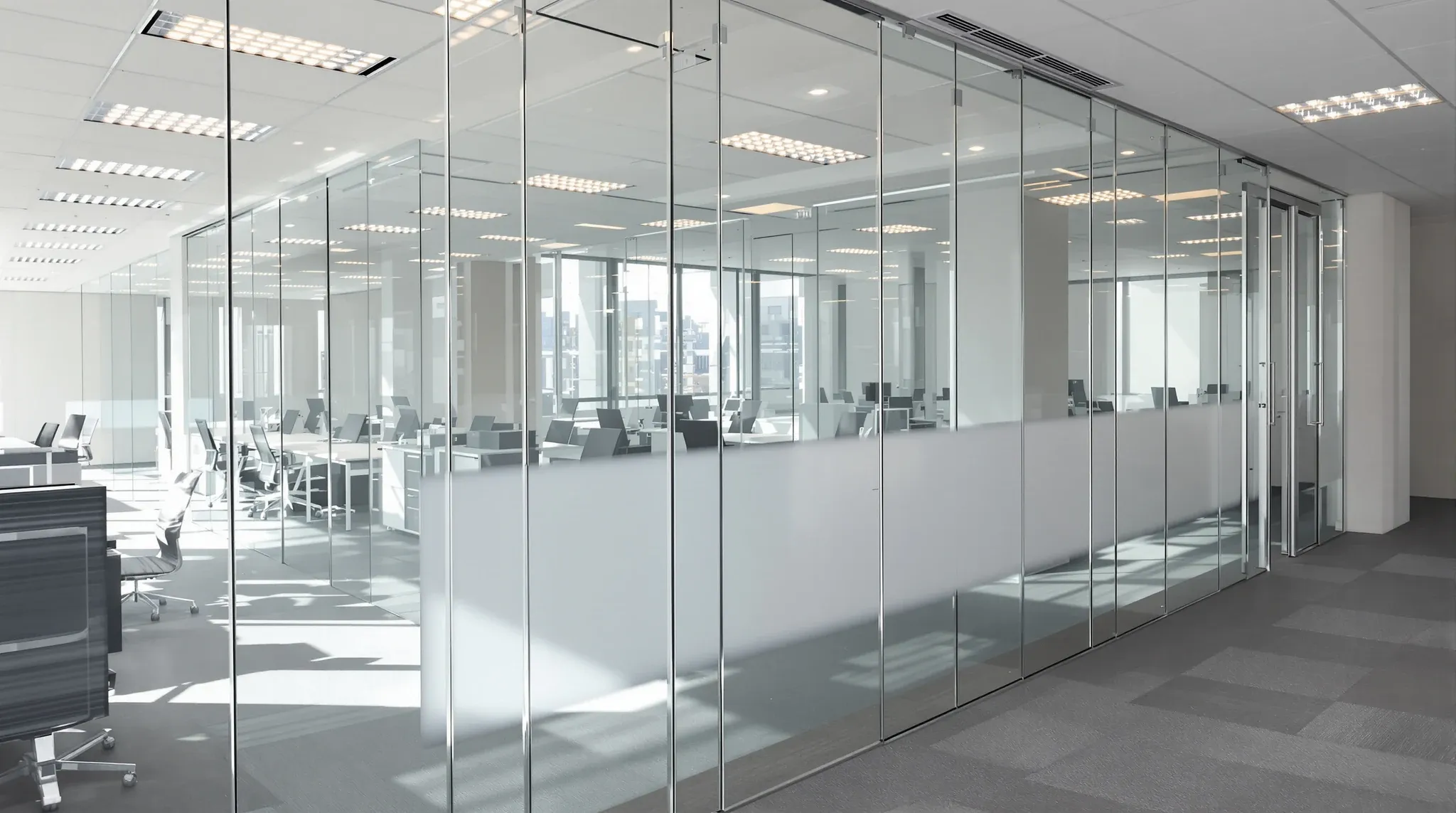
The decision between repairing and replacing damaged glass office partitions usually comes down to four things: what the damage actually is, whether the partition is still safe and compliant, how much of the room has to come out of use to do the work, and how much of the lease term is left. Most damage to glass office partitions is repairable. The cases where replacement is the only sensible call have a recognisable pattern, and getting clear on which case is in front of you is the difference between a half-day fix and a full-room program.
The starting point is rarely “is this fixable” in isolation. The more useful question is “what is the cheapest path to a partition that performs the same as the day it was installed”. Sometimes that is a polish-out and a hardware tighten. Sometimes that is a panel replacement with the framing left in place. Sometimes the framing has been knocked out of square and replacing the glass alone leaves the problem behind. Each of these has a different cost, downtime, and outcome.
What is repairable on a glass office partition
Surface damage on the glass face is generally repairable. Minor scratches that have not penetrated the surface treatment can be polished out by a glass restoration specialist, with the panel left in place. Light chips on the edges of standard toughened glass, away from the corner load points, can sometimes be smoothed and sealed without affecting the panel’s safety rating, though the cosmetic result varies.
Hardware faults are the most common repair category. Hinges, pivots, locks, closers, and handles wear over a lease’s life and can be replaced individually without touching the glass. A door that has dropped on its pivot, a closer that no longer holds the door closed, a lock that stopped engaging, all of these are hardware swaps. Most are achievable in a single visit by a partition or glazing trade.
Seal and gasket failures are repairable when the failure is in the seal itself rather than in the framing. Door drop seals, perimeter gaskets, and acoustic seals can be replaced without removing the glass panel. Where the seal failure has let water or contamination into a double-glazed unit, the issue moves into replacement territory because the glass unit itself has degraded.
Framing finish damage, including paint chips, scratches on aluminium framing, or dents in the framing channel, can usually be repaired with touch-up or section replacement. The decision is cosmetic. If the framing’s structural function is intact, the fix is paint and patch.
What usually means replacement
Cracks that run across the glass face, regardless of length, indicate the panel’s structural integrity has been compromised. Toughened glass that has cracked has lost its rated strength and should be replaced rather than treated. Partial replacement of one panel in a partition run is a workshop-and-install job, but the cost is meaningfully lower than reconfiguring the surrounding partition.
Edge breakage on a panel, particularly at corner loads or where the panel meets framing, usually requires panel replacement. Toughened glass is sensitive to edge damage, and a panel with edge chipping that has propagated has effectively lost the load path it was designed for. Continuing to use the panel risks a sudden full-panel failure.
Failed double-glazed units, where moisture has entered the cavity between the two glass layers and the seal has perished, are not repairable. The unit has to be replaced. The framing usually stays in place; only the glass unit is swapped. Cost varies with the panel size and the lead time on the replacement unit, but the framing and hardware remain unchanged.
Frame distortion from impact damage, such as a heavy collision with a door or framing element, often takes the framing out of square. A panel can be replaced into a distorted frame, but the glass will sit under stress and the door will not close cleanly. The cleaner answer is to address the framing before the panel goes back in, which usually means a section of frame is replaced as well.
The safety and compliance test
Before either path, a partition with damage that could affect occupant safety needs an immediate assessment. Glass that has cracked but not separated, particularly in toughened panels at door positions, is at risk of sudden full-panel failure. The room is usually taken out of use until the panel is either confirmed safe by a glazier or replaced.
Safety glass standards apply to office partitions in occupant zones. A repaired panel has to remain compliant with those standards, which means a polish-out on a chip is fine but a structural repair on a crack is not. The replacement path is the only compliant outcome where structural integrity has been compromised.
Where the partition forms part of a fire compartment or has a specified acoustic rating, repairs that affect the rating require recertification. A repair that maintains the rating may be acceptable; a repair that does not has to be replaced or upgraded to maintain the original specification.
Cost differences between repair and replacement
Hardware repairs typically run a few hundred dollars per door, depending on the part. Surface polish-out on glass costs in the low hundreds per panel for minor scratches. Seal and gasket replacement is a similar order of magnitude.
Single-panel replacement, including the panel, hardware reinstallation, and out-of-hours access, usually sits in the low thousands per panel for a standard toughened glass installation, with double-glazed and laminated panels priced higher because of the unit cost. Frame section replacement is on top of that.
Full-room partition replacement, where the framing and panels all come out, is in the same band as new installation. For a tenant approaching lease end with significant damage, this can sometimes coincide with the make-good obligation and become part of the defit scope rather than a separate cost.
The pattern that justifies replacement on cost is repeat repair. A partition that has needed three or four repair visits in a year, where the pattern points at a fundamental issue with the original installation or a change in usage, is usually cheaper to replace than to keep repairing.
Downtime and access considerations
Repair work generally happens within business hours, with the affected room briefly out of use for the visit. Hardware swaps are 30 minutes to two hours per door. Surface polish-out is similar. Seal replacement is room-out-of-use for a half day.
Single-panel replacement is more involved. The panel has to be removed without damage to the surrounding panels, the new panel has to be brought to site (often involving lift bookings and after-hours access in CBD buildings), and the install has to allow setting and curing time for the seals. A single-panel job is usually a half-day to full-day program with after-hours access if the room is in active use.
Full-room replacement runs across a weekend or several evenings. The room is fully out of use for the duration, and the program has to align with building access rules. Tenants who need replacements in active offices usually stage them outside business hours regardless of the cost premium, because daytime work disrupts the neighbouring zones.
Lease-term considerations
The remaining lease term changes the maths. With five years left, the cost of replacement is amortised across the time the new partition is in service, which usually justifies replacement on a partition with persistent issues. With twelve months left, the calculation is different. A partition that gets the tenant through to lease end at minimal cost may be the right answer even if it would normally be replaced.
The make-good clause matters here. If the partition has to be removed at lease end regardless, and the make-good takes the room back to a base condition that does not require the partition to be in working order on the day before handback, repair to a “functioning until lease end” standard may be the commercial answer. If the partition has to be left in usable condition for the next tenant or for the landlord’s marketing, the standard is higher.
Tenants in the last 18 months of a lease often defer all but safety-critical repairs and roll the partition into the lease-end works. Tenants with three or more years left typically benefit from replacing damaged partitions to standard, because the partition is going to be in their workplace for long enough that the experience cost of a sub-par fix outweighs the saving.
Hardware and framing decisions inside a replacement
Where a panel replacement is happening, there are decisions to make on the surrounding hardware and framing. If the existing hardware is mid-life and functional, leaving it in place is usually right. If the hardware was already failing, replacing it during the panel swap saves a separate visit later. The marginal cost of new hardware while the panel is out is much lower than coming back to do it.
If the framing system has been discontinued or the manufacturer no longer supports the spare-parts chain, the calculus shifts toward replacement of the framing as well. This is an issue that surfaces on partitions installed eight to ten years ago, where the original system has been superseded. A panel-only replacement on an unsupported framing system can lock the tenant into ongoing supply problems.
Where the original installation used custom panel sizes, the replacement panel has to be manufactured to match. Lead times of three to six weeks are common for non-standard sizes, which has to be factored into the program. Standard panel sizes are usually held in stock or available within a week.
Getting an honest assessment
The first step on any partition damage is a site walk with a glazing or partition specialist. The assessment should cover the safety status, whether the damage is repairable, what the repair would involve, what the alternative replacement scope looks like, and what the cost and downtime difference is between the two paths. Decisions made on photographs alone tend to either over-scope (replace what could have been repaired) or under-scope (repair what really needed replacement).
If you have a damaged glass partition and want a clear read on whether repair or replacement is the right path, we work across the full range of glass partition repair and replacement in Sydney commercial offices, and can come on site to assess against your specific tenancy and lease position before any work is committed.
📞 Call us on 1300 60 93 93