
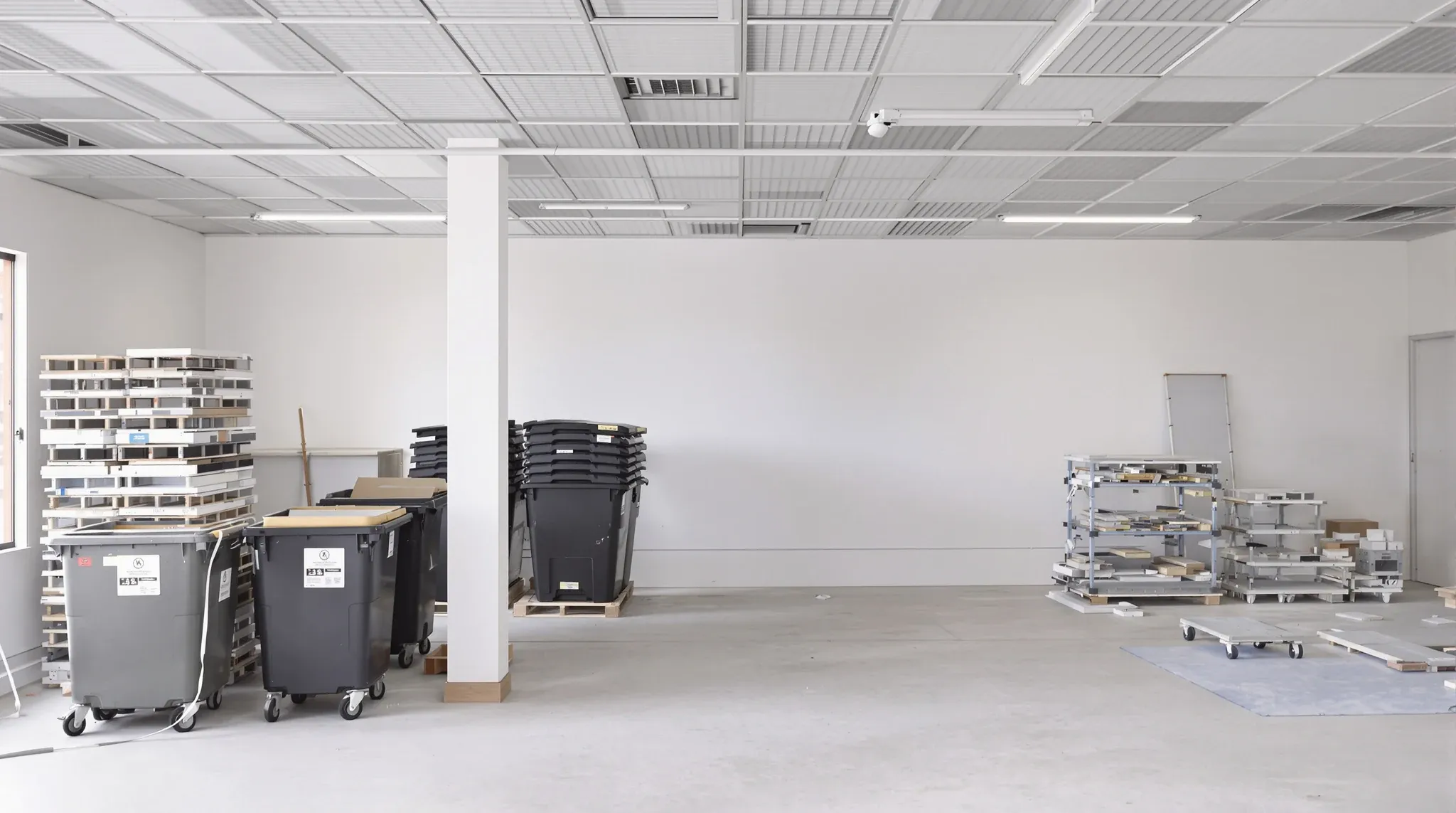
An office strip-out is a demolition job that produces sorted materials rather than rubble. A typical floor gives up plasterboard, steel studs and track, ceiling grid and tile, glazing and aluminium frames, carpet tile, data and power cabling, and a quantity of doors, hardware and joinery, and each of those has a different destination once it leaves the building. What drives the build is that the separation has to happen on the floor as the fitout comes apart, because a mixed skip cannot be unmixed at the tip and everything in it goes to landfill.
When we price a strip-out, the waste plan sits beside the labour. It sets how many bins are on the dock, which materials travel in cages instead of skips, which trades pull their own material and how the dock time is used. The choices are made before the first wall comes down, and they are the difference between a floor that recovers most of its material and one that sends the lot to landfill and pays the levy on all of it.
Separation Starts as the Fitout Comes Apart
The order of removal decides how clean each stream is. We strip ceilings before walls, because the tile and grid come out clean when the partitions are still standing to work off, and the plasterboard is easier to keep whole when nothing is falling onto it from above. Carpet tile comes up last so that the floor stays protected while heavier material is moving across it, and cabling is pulled from the ceiling space before the grid is dropped so it does not end up tangled through the tile stack.
Each material goes into its own pile or cage at the point it is removed. A wall is de-sheeted first so the plasterboard comes off in large clean pieces, then the studs and track are unscrewed and bundled, then the insulation, if there is any, is bagged separately. Mixing those three for a moment on the floor costs more than the time saved, because someone has to pull them apart again before the bins can be filled.
The set-out for the piles is part of the floor plan for the strip-out. Heavy streams sit closest to the goods lift, glass is stacked upright on A-frames away from the traffic path, and the cages for scrap metal sit where they can be wheeled straight to the dock.
Plasterboard Only Recycles When It Is Clean
Plasterboard is the largest stream by volume on most floors and the one where the recycling decision is made on the floor, not at the recycler. Regyp, the largest plasterboard recycler in the country, accepts plasterboard and cornice from the major manufacturers and processes it back into gypsum and paper, but the material has to arrive clean with low levels of contamination. Nails, screws, timber, steel, plastic and insulation in the load are the contaminants that turn a recyclable bin into a landfill bin.
That is why de-sheeting is done as a separate step rather than pulling walls down whole. The sheets come off with the screws backed out or the sheet snapped away from the fixings, and the loose screws are swept before the board is stacked. Where a wall has had timber blocking, tile adhesive, wet-area lining or a laminate finish glued to it, that board is kept out of the gypsum pile and goes with the general stream.
We size the plasterboard bin against the linear metres of wall on the drawings and the number of layers on each face, so the recycling bin is not full by the second day. Foil-backed and fire-rated boards are queried with the recycler before the job starts rather than assumed, because the acceptance criteria are set by the recycler and change between sites.
Studs, Track, Grid and Cable Leave as Scrap Metal
The metal on a floor is the stream that most reliably avoids landfill. Steel studs and track, the main tees and cross tees of a suspended ceiling, hanger wire, aluminium partition framing and door frames, and the copper in data and power cabling all go to a scrap metal merchant, and a merchant will usually pay for it rather than charge for it, provided it is separated.
Separation here means keeping steel, aluminium and copper apart. Steel studs go in one cage, aluminium framing in another, and cabling in a third once the connectors and any plastic trunking are cut off. Ceiling grid is a mixed product, with steel tees and sometimes an aluminium capping, and it is bundled flat and strapped so it packs into a cage rather than filling a skip with air.
Cabling is the item most often left behind. Data cable abandoned above a ceiling is a common find in a strip-out, and most landlords now ask for redundant cabling to be removed back to the comms room as part of the handover, so we pull it as its own task with the ceiling open.
Ceiling Tiles, Carpet Tiles and Glass Depend on the Supplier
These three streams are where recovery is decided by who made the product and whether a take-back exists, so the work starts with a phone call rather than a bin. For carpet tile, Interface runs a ReEntry programme in which the manufacturer assesses the used tiles and directs them to reuse through charities and social enterprises, to recycling, or to recovery where neither is possible. Other manufacturers have their own arrangements or none, and the tile has to be identified from the backing before the floor is lifted.
Carpet tile that is going back to a manufacturer is lifted whole, kept dry and stacked on pallets, not thrown into a skip. Tile that has been glued down with a full-spread adhesive rather than a tackifier rarely comes up whole and generally goes to landfill, so we check the adhesive at the walk-through and price the two outcomes differently.
Mineral fibre ceiling tile is the harder case. We ask the tile manufacturer whether a take-back applies before the ceiling comes down, and where one does not, the tile goes with the general stream and the grid is separated out as scrap. Glass is similar: toughened and laminated panels are stacked on A-frames and offered to a glass recycler, and whether the recycler accepts laminated glass or only clear toughened panels is confirmed with them, not assumed. The aluminium frames and channel the glass sat in are always scrap, whatever happens to the panels themselves.
Demountable Systems Are Worth More Whole Than Broken
Demountable partitions, glazed office fronts, doors and hardware are the items where reuse beats recycling, and the decision to keep them whole has to be made before the crew starts. A glazed system that is dismantled panel by panel, with the channel, gaskets and fixings kept together, can go back into another tenancy, and the conditions that make reusing glass partitions after lease expiry work are set by the system, its age and where it is going next.
The same applies to solid demountable walls and to solid core doors with their frames and hardware. Within a single tenancy, moving a system rather than replacing it is usually the cheaper outcome, and the trade-offs in partition relocation versus replacement are the same trade-offs that decide whether a system is worth carrying out of the building whole. Where the tenant has no use for it, a reuse outlet or a salvage buyer can take doors, glazing and hardware, and that is a pathway the Better Buildings Partnership guidelines name alongside recycling.
Careful dismantling costs more labour than demolition. A glazed front that would take a crew an hour to break down for scrap takes half a day to remove intact, so the reuse decision is priced as its own line and only made where there is somewhere for the material to go. Items nobody has claimed by the time the strip-out starts are treated as waste, because a pile of unclaimed doors on a stripped floor blocks the make good behind it.
Bins, Cages and the Dock Set the Pace
The waste has to leave the building through the same goods lift and dock as everything else, and the building's rules on bins, hours and lift bookings decide how fast a strip-out moves. How those rules differ between towers, low-rise buildings and heritage stock is its own subject, covered in waste removal and site logistics, and the waste plan for a strip-out is written against the specific building.
On the floor, separated material moves in wheeled cages and on pallets rather than in bulk bags where the lift allows it, because a cage can be tipped straight into the right bin on the dock without re-handling. A dock with room for one skip means one stream at a time, so the strip-out is sequenced so that the plasterboard bin is filled and swapped before the general bin arrives, and the metal cages go out to the merchant on a separate truck. A dock with room for three bins lets the streams run in parallel and the programme shortens.
Where the building allows no bin on the dock at all, the material goes out in caged trucks during a booked window and the cost moves from the bin hire to the labour hours waiting on the lift. That is the same mechanism by which lift access and loading docks affect every trade on a fitout, and it applies with more force to a strip-out because the volume leaving the floor is greater than the volume that came in.
The Levy Makes Separation Pay for Itself
The NSW waste levy applies to waste received at landfill in the metropolitan levy area, which takes in the Sydney metropolitan area along with the Illawarra, Hunter and several surrounding local government areas. From 1 July 2026 the rate is published by the NSW EPA at $180.20 per tonne, and that figure is charged on every tonne that goes to landfill regardless of what it is.
That is the arithmetic behind the sorting. A mixed skip of plasterboard, grid and carpet is charged at the levy on its full weight, while the same material separated into a gypsum load, a metal cage and a manufacturer take-back attracts the levy only on the fraction that could not be recovered. On a large floor the plasterboard alone runs to many tonnes, and the levy on that stream is often larger than the labour cost of de-sheeting cleanly. The levy is indexed annually, which is why we set the waste plan before pricing the labour rather than after.
The Records That Come Back with the Floor
Landlords, their building managers and any rating tool the building is targeting increasingly ask for evidence of what happened to the material rather than a statement that it was removed. The Better Buildings Partnership, whose members include several of the large Sydney office owners along with the City of Sydney, publishes stripout waste guidelines that set a minimum resource recovery target of 60 percent for office strip-out and refurbishment, report that an average of 21 percent of fitout waste across Sydney is diverted from landfill, and provide template contract clauses that some landlords now write into their strip-out requirements.
What the paperwork consists of is straightforward. Each bin or truckload that leaves the floor generates a weighbridge docket at the facility it goes to, and the docket records the weight and the material type. A recycler's docket shows the load was received as plasterboard or scrap, a landfill docket shows the tonnage that was not recovered, and a manufacturer take-back issues its own receipt. We collect those as the job runs and hand them back with the make good as a single waste report that lists each stream, its weight and where it went.
That report is what a landlord's team reads against their own diversion target, and it is what a Green Star Interiors submission draws on if the incoming tenant is pursuing a rating, since the BBP guidelines are aligned with that tool. Where the defit and make good scope includes reinstating ceilings and services after the strip-out, the report also records which base building material was kept and reinstated rather than replaced.
We sequence a strip-out so the plasterboard, metal, glass, carpet tile and cabling come apart into separate streams on the floor, and we hand the landlord a weighbridge-backed waste report with the make good.
📞 Call us on 1300 60 93 93