
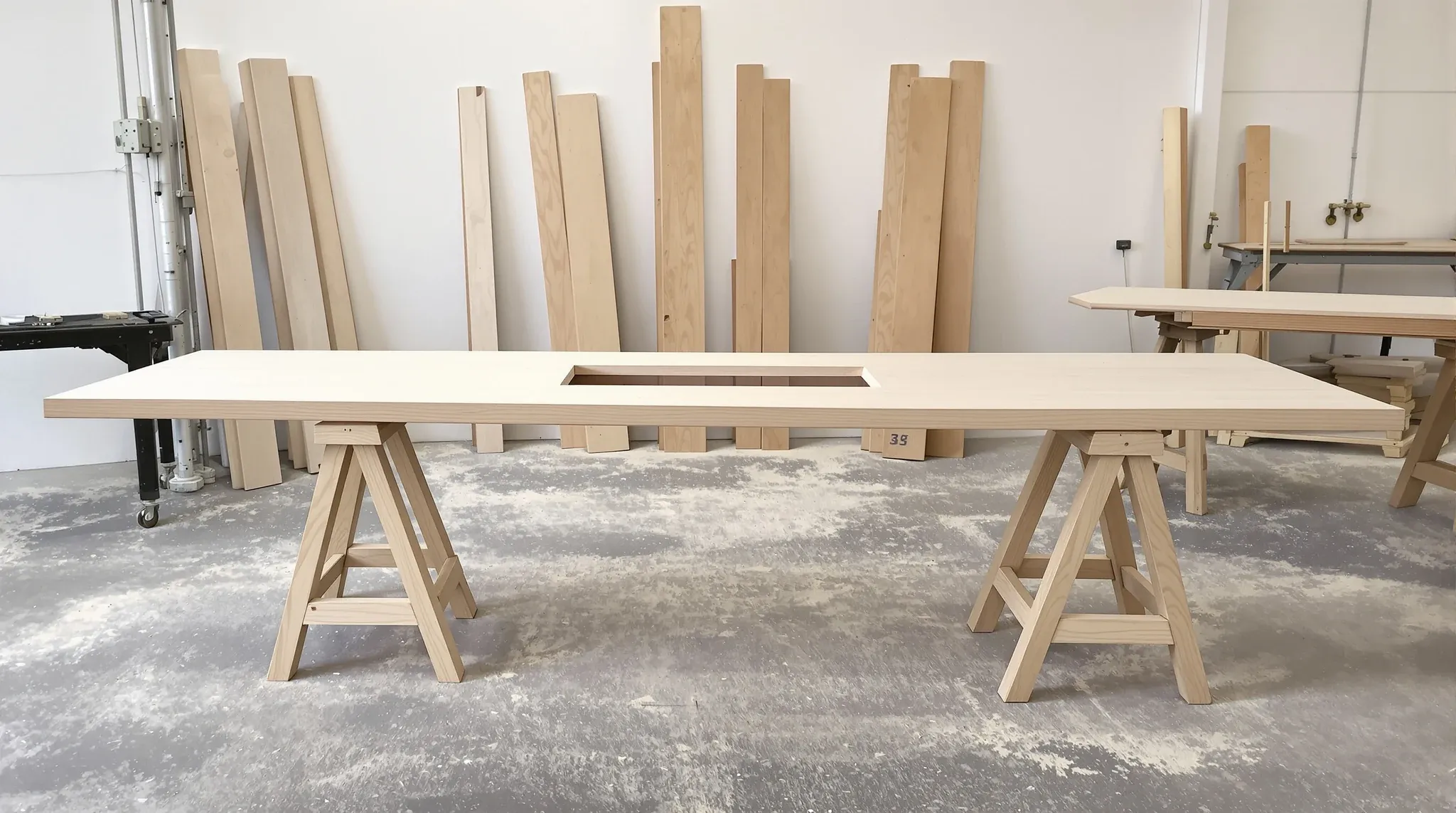
Most office furniture comes from a catalogue. Desks, chairs, meeting tables, and storage units are selected from manufacturer ranges, ordered in standard sizes, and delivered ready to assemble. For the majority of office requirements, this approach works well. But there are situations where no standard product fits the space, the function, or the design intent, and where a purpose-designed, purpose-built piece of furniture is the only solution that works.
Custom office furniture design and manufacture sits between off-the-shelf purchasing and built-in joinery. Unlike joinery, which is fixed to the building, custom furniture is freestanding and can be moved or removed without damaging the tenancy. Unlike catalogue furniture, it is designed from scratch to meet a specific brief, built to exact dimensions, and finished to a standard that off-the-shelf products rarely match.
When Custom Furniture Is the Right Answer
Custom furniture makes sense when the requirement falls outside what standard products can deliver. The most common triggers are unusual dimensions, specific functional requirements, a design aesthetic that standard ranges do not offer, or a combination of features that no single off-the-shelf product provides.
A meeting table that needs to seat fourteen people in a room with an unusual aspect ratio is a typical example. Standard meeting tables come in set sizes, and fitting the maximum seating capacity into a non-standard room often means the table is either too narrow, too short, or the wrong shape. A custom table designed to the exact room dimensions, with cable management integrated into the top surface and power outlets at each seating position, solves the problem completely.
Brand and design coherence is another driver. Businesses that invest in a distinctive office aesthetic sometimes find that standard furniture disrupts the design language of the space. When the reception desk, joinery, and partitions are all carefully designed to work together, a catalogue meeting table or breakout bench that does not match the material palette or design language can undermine the visual coherence of the fitout. Custom furniture designed as part of the same palette ensures everything in the space feels like it belongs together.
What Custom Furniture Design Involves
The design process for custom furniture starts with a brief that defines the functional requirements, the spatial constraints, the material preferences, and the budget. The designer translates this brief into concept drawings, then develops the design through to detailed production drawings that the manufacturing workshop uses to fabricate the piece.
The level of design development depends on the complexity of the item. A simple custom desk with specific dimensions may require only basic drawings showing overall size, material specification, and leg detail. A complex boardroom table with integrated AV technology, cable management, and a mixed-material construction requires detailed drawings showing every component, every joint, and every service connection.
Material sampling happens during the design phase. The client sees and approves actual material samples, edge profiles, and finish options before fabrication begins. This approval step is critical because the appearance of materials varies significantly between small swatch samples and full-sized panels, and colours can look different under office lighting than they do in a showroom. Custom furniture manufacturers typically provide larger sample panels or finish mockups for complex items to ensure the client is confident in the selection before production starts.
Manufacturing Process and Quality Control
Custom office furniture is manufactured in a workshop environment using a combination of CNC machining, traditional cabinetmaking techniques, and specialist finishing processes. CNC machining provides precise cutting and shaping of panel materials, while hand finishing delivers the detailed work on edges, joints, and surface treatments that gives custom furniture its distinctive quality.
Quality control in custom furniture manufacturing happens at several stages. Material is inspected on delivery for consistency and defects. Machined components are checked against the production drawings for dimensional accuracy. Assembly is inspected for joint quality, alignment, and finish consistency. And the completed piece is pre-finished and inspected before dispatch, including surface quality, hardware operation, and overall appearance.
The difference between well-manufactured custom furniture and a poorly executed custom piece is often in the details that only become apparent over time. Drawer runners that operate smoothly after years of use rather than binding after months. Edge treatments that resist chipping under daily contact. Surface finishes that maintain their appearance under cleaning chemicals and UV exposure. These details are a function of material selection, manufacturing precision, and the quality standards of the workshop producing the furniture. Strategy and substance matter more than surface style in custom furniture just as they do in the broader fitout.
Common Custom Furniture Items in Office Fitouts
The items most frequently designed and manufactured as custom pieces in commercial offices include boardroom and meeting tables, executive desks with integrated storage, reception area seating and tables, breakout area tables and benches, collaborative work surfaces, and display or credenza units for client-facing spaces.
Boardroom tables are the most common custom furniture item because the room dimensions, seating requirements, and AV integration needs are rarely standard. A boardroom table that serves twelve people in a specific room, with power and data ports at each seat position, a concealed AV connection hub at the centre, and a surface material that matches the rest of the fitout’s design language, is almost always a custom piece.
Collaborative work surfaces for open-plan environments are another growing category. These are large shared tables or benching systems that accommodate multiple users, often with integrated power, USB charging, and data connectivity. Standard desking systems provide this functionality, but custom versions can be designed to fit irregular floorplates, wrap around columns, or integrate with custom joinery elements like storage walls or planter boxes. The result is a work environment that feels purposefully designed rather than assembled from disconnected components.
Materials and Finishes for Custom Furniture
Custom furniture opens up a wider material palette than off-the-shelf products, because the design is not constrained by the materials that a particular manufacturer stocks. Common materials include natural and reconstituted timber veneers, high-pressure laminates in premium textures, solid timber for structural elements and legs, powder-coated or brushed metal for frames and bases, reconstituted stone and solid surface for countertops, and commercial-grade upholstery fabrics for seating elements.
The material selection should balance aesthetics with commercial durability. A boardroom table surface that looks stunning in timber veneer but marks easily with coffee rings and pen scratches will become a source of frustration within months. Specifying a lacquer finish with adequate hardness, or choosing a veneer with a protective clear coat, maintains the appearance without sacrificing the material choice. Similarly, upholstery fabrics for custom seating should carry a commercial abrasion rating that matches the expected use intensity, not just a residential rating that sounds adequate on paper.
Sustainability in material selection is increasingly relevant. Recycled content in substrates, FSC-certified timber veneers, low-VOC adhesives and finishes, and manufacturers with environmental management systems all contribute to a more sustainable custom furniture outcome. For businesses that have committed to environmental targets or green building credentials, the material supply chain for custom furniture is worth specifying deliberately rather than leaving to the manufacturer’s default choices. Sustainable fitout choices extend beyond structural elements to every piece of furniture in the space.
Lead Times and Budget Considerations
Custom furniture takes longer to deliver than off-the-shelf products because it must be designed, approved, manufactured, and finished before it arrives on site. Typical lead times range from four to eight weeks after design approval, depending on complexity, material availability, and the workshop’s production schedule. Complex items with imported materials or specialist finishes may take longer.
The cost of custom furniture is higher than equivalent off-the-shelf items because it includes design fees, one-off manufacturing setup, and often premium materials that are not available in standard product ranges. The premium varies significantly depending on the item’s complexity and material specification. A simple custom table in standard laminate may cost thirty to fifty per cent more than a comparable catalogue product. A complex boardroom table with integrated technology and premium materials may cost several times more.
The budget conversation should start with the brief, not the price. Defining what the furniture needs to do, what it needs to look like, and how long it needs to last allows the manufacturer to present options at different price points. Often, the design intent can be achieved at a lower cost by substituting a premium material with a visually similar but more cost-effective alternative, or by simplifying a construction detail that adds cost without adding visible quality. A good custom furniture manufacturer will offer these options without being asked, because they understand that the goal is to deliver the brief within the budget, not to maximise the specification.
Integrating Custom Furniture with the Fitout Programme
Custom furniture needs to be designed and ordered early enough in the fitout programme to arrive on site when the space is ready to receive it. This typically means the design should be finalised and production drawings approved before the construction phase of the fitout begins, so that fabrication runs in parallel with the build rather than sequentially after it.
Delivery and installation coordination matters because custom furniture pieces are often large, heavy, and difficult to manoeuvre through standard doorways and corridors. The fitout team should confirm that delivery access is adequate before the furniture is manufactured in a configuration that cannot fit through the available openings. A boardroom table that needs to be delivered in sections and assembled on site requires a different manufacturing approach than one delivered as a single piece.
The installation sequence within the fitout programme places furniture delivery and installation after painting, flooring, and joinery are complete. Custom furniture arrives alongside or shortly after loose furniture delivery, and should be positioned and connected before final cleaning and handover. Power and data connections for custom furniture with integrated technology need to be coordinated with the electrical and data cabling scope to ensure the right connections are available at the right locations when the furniture arrives.
If you need custom furniture designed and manufactured for your office, whether it is a single boardroom table or a full suite of purpose-built pieces, Complete Office Fitouts can coordinate the design, manufacture, and installation as part of your fitout programme.
Call us on 1300 60 93 93