
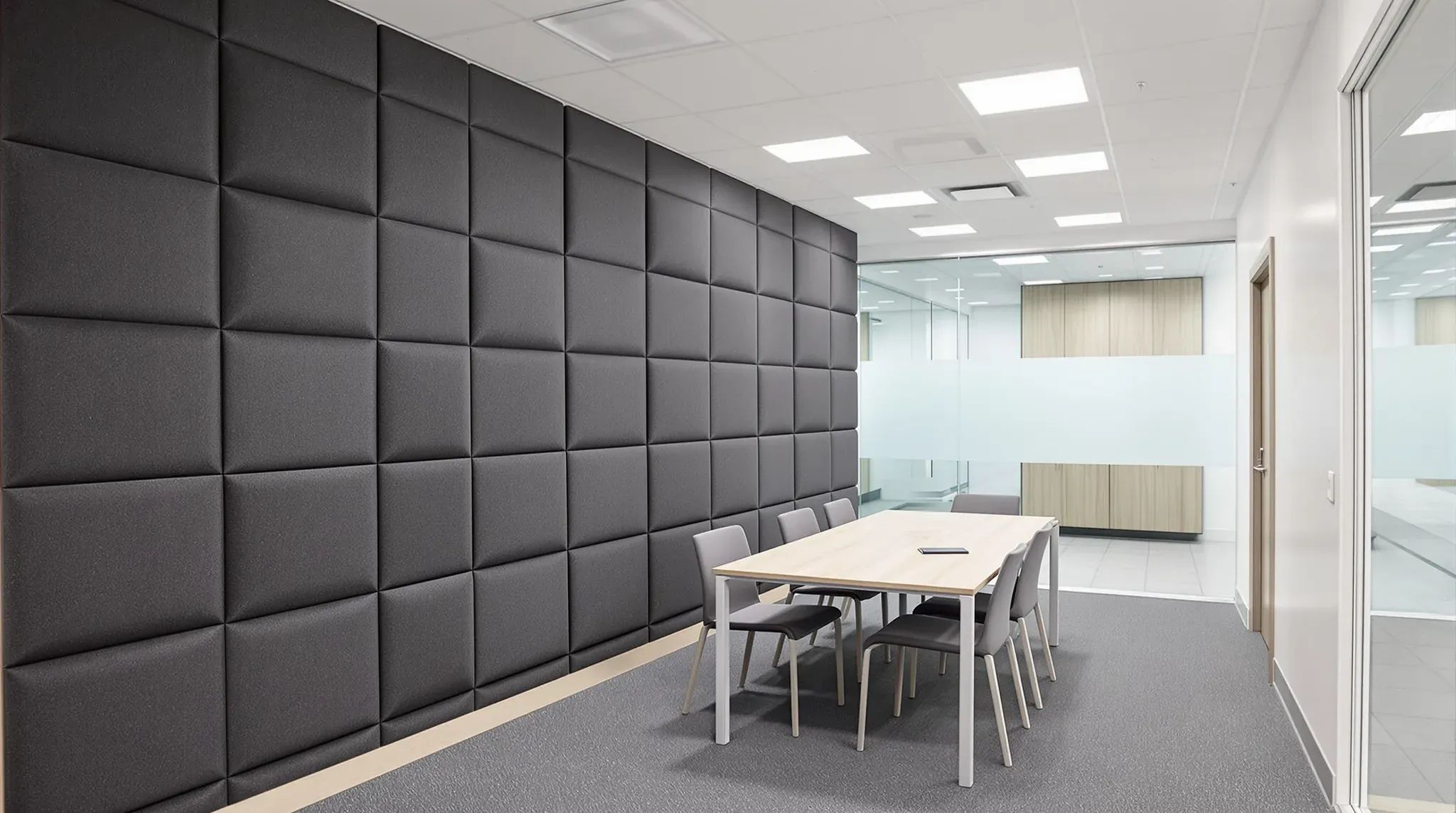
An acoustic wall panel is a sound-absorbing panel fixed to the wall of an office. It soaks up the sound of voices that would otherwise bounce off hard walls, so speech in the room sounds clearer and echo dies away sooner. A panel does not stop sound travelling through the wall into the next room.
Office acoustic panels usually work alongside an acoustic ceiling. The ceiling absorbs the sound that rises to it, and the panels absorb sound travelling between the walls. Office panels are usually fabric-wrapped or made of polyester felt. We can install them in a new fitout or on the walls of an office already in use.
Echo in the Room or Voices from Next Door
The right fix depends on which problem the room has. Echo is sound reflecting around inside the room, which blurs speech and makes a room feel loud even when people talk normally. A conversation heard from the next room is a different problem. That sound is passing through the wall, over the top of it or around the door.
Wall panels reduce echo. They should not be treated as soundproofing, since a panel adds little to the sound the wall itself blocks.
Keeping a conversation inside a room depends on how the room is built. Insulated plasterboard partitions built up to the concrete slab stop more sound than walls that end at the ceiling. Where a wall stops at the ceiling, a sound barrier in the space above closes the path over the top. Gaps around the door let conversation out, so the door takes acoustic seals on every edge.
Many rooms need both fixes. A boardroom with walls built to the slab can still echo, because its glass and painted plasterboard reflect voices back into the room.
Where Acoustic Wall Panels Go
Panels work best on the walls that voices strike, at the height of people's heads when they are seated and standing. The usual places in an office are:
- Meeting rooms with a glass front, where the panels go on the solid walls.
- Boardrooms and rooms used for video calls, where echo makes speech harder to follow for the people joining remotely.
- Open plan areas, where panels on end walls and columns add to the ceiling's absorption.
- Breakout areas and kitchens, where hard benches, splashbacks and floors reflect the noise of a busy room.
A glass front facing a bare plasterboard wall can send speech back and forth between the two in a rapid series of repeats. This is called flutter echo. A row of panels on the plasterboard wall breaks up that reflection, and the glass stays clear.
In open plan, the ceiling does most of the absorbing. Desk screens stop short of the ceiling, so speech spreads across the desks unless the ceiling soaks it up.
The amount of wall to cover depends on the size of the room, the ceiling above it and how many other hard surfaces it has. In a fitout designed with an acoustic consultant, the consultant's design sets the panel area for each room. A meeting room often has panels across at least one wall.
How Wall Panels Work with the Acoustic Ceiling
Echo fades more evenly when the absorbing surfaces are spread around the room. A meeting room with good ceiling tiles can still ring between two hard walls, because sound travelling across the room keeps reflecting until a wall absorbs it. A carpeted floor helps, but it does not absorb enough on its own. Many meeting rooms and boardrooms need an absorbent ceiling and wall panels together to bring the echo down.
Wall panels can also replace the ceiling as the main absorber. A flush plasterboard ceiling reflects most of the sound that reaches it, so in a room with one, the wall panels carry most of the absorption. Under an exposed ceiling, where the concrete slab stays visible, wall panels can work with acoustic rafts hung from the slab.
Fabric-Wrapped or Polyester Felt Panels
The two main kinds of panel differ in what they are made of, how they are fixed and how they look:
| Fabric-wrapped panel | Polyester felt panel | |
|---|---|---|
| What it is | A glass wool or mineral fibre core wrapped in fabric | A semi-rigid sheet of compressed polyester felt |
| Usual fixing | Clips or aluminium rails screwed to the wall | Adhesive on the painted wall |
| Finish | The colour and texture of the chosen fabric | The felt's own colour, cut into shapes or printed with a pattern |
| Also suits | Walls that get knocked, with an impact-resistant fabric face | Pinboards, since pins push straight into the felt |
A thicker panel absorbs more sound, especially the lower part of the voice. The same panel also absorbs more when it is fixed with an air gap behind it.
Absorption is often quoted as a single rating averaged across several pitches. A high average can hide weak absorption of lower voices, and that leaves a room sounding boomy. Panels are best compared on their absorption across the whole range of speech.
Where a timber finish is wanted, a timber slat wall over an absorbent backing is another way to add absorption to a wall.
Fixing, Removal and Fire Ratings
The fixing method decides what happens when the panels come off. Glued panels are meant to stay, including panels pressed onto spiked clips with adhesive. Removing them can damage both the panel and the wall. Interlocking clips, and some rail systems, let a panel lift off the wall and leave only screw holes to fill.
At a make good when the lease ends, the plasterboard behind glued panels usually needs patching and repainting. Panels on interlocking clips can come down whole and be refitted in new premises.
Under the National Construction Code, wall and ceiling linings in commercial buildings need a fire hazard group number. The group a wall needs depends on the building's class, where the wall is and whether the building has sprinklers. Acoustic wall panels count as part of the wall lining. We check each panel's fire test results against the wall it will cover, and the certifier usually confirms the choice.
Installing Panels in a New or Existing Office
In a new fitout, the panel positions go on the drawings with the room layout. Setting them out early keeps screens, whiteboards and power points clear of the panel areas. Screens and whiteboards also need backing inside the wall, which goes in before the plasterboard is fixed.
The panels go on after the final coat of paint. Each panel is cut around the power points and switches on its wall, and those outlets are usually brought forward to sit on the panel face.
Adding panels to existing walls is one way to reduce echo in an office without rebuilding a wall or ceiling. In an office already in use, we can work one room at a time, so the other rooms stay available.
We can measure each room, confirm which walls need panels and quote fabric-wrapped or felt panels to suit how the room is used.
📞 Call us on 1300 60 93 93