
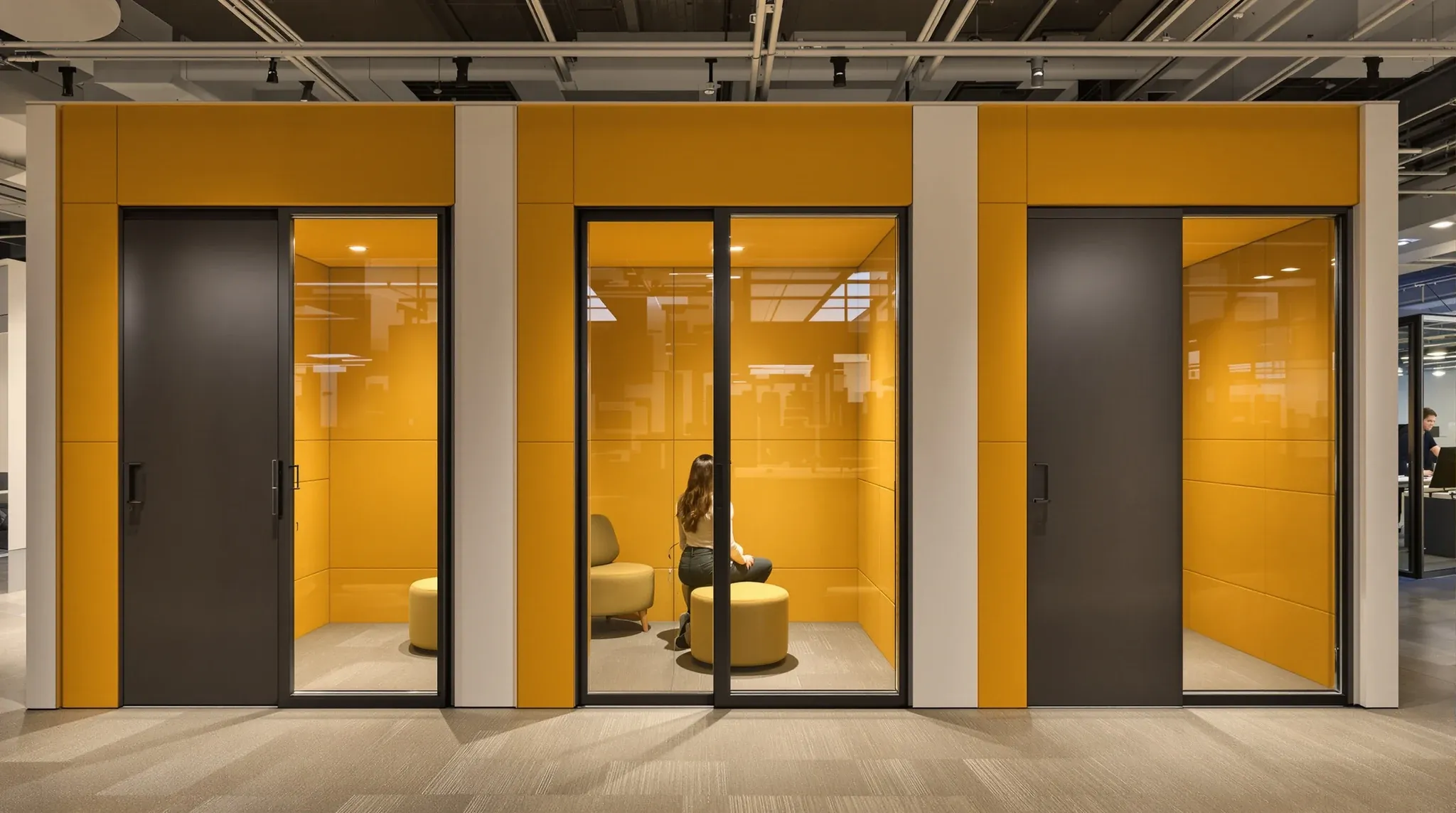
Phone calls are one of the most common sources of acoustic conflict in commercial offices, and the partition system used to enclose call spaces has a direct effect on whether calls are private, productive, and non-disruptive to the surrounding workspace. The proliferation of video calls, client consultations, and conference calls means that more office time than ever is spent on the phone, and the partition choice for call-heavy spaces has become one of the most practically important decisions in office fitout planning.
Different partition types perform differently against phone call noise because the acoustic characteristics of speech, particularly its frequency range and directness, interact with partition materials in predictable ways. Understanding these interactions helps in selecting the right partition for spaces where phone use is frequent, prolonged, or confidential.
Why Phone Calls Create a Specific Acoustic Challenge
Phone call acoustics differ from general office noise in several ways that affect partition selection. Phone conversations involve speech at conversational volume directed toward a single point, typically a handset, headset, or laptop microphone. This speech is sustained, coherent, and intelligible, which makes it significantly more distracting to nearby workers than the diffuse, variable noise of general office activity.
The human brain is particularly attuned to intelligible speech, which means that even low-level speech transmitted through a partition is more distracting than equivalent-level mechanical or ambient noise. A quiet hum from an air conditioning unit at 45 decibels is less disruptive than speech from an adjacent phone call at 45 decibels, because the brain processes the speech content involuntarily and struggles to filter it out.
This means the acoustic requirement for phone call partitions is not just about reducing the volume of transmitted sound. It is about reducing the intelligibility of the transmitted speech. A partition that reduces the volume but leaves the words comprehensible is only marginally better than no partition at all in terms of distraction. Effective phone call partitions need to reduce the transmitted speech to a level where individual words cannot be distinguished by listeners on the other side.
Glass Partitions and Phone Call Privacy
Standard single glazed glass partitions provide limited acoustic separation for phone calls. A typical 10mm toughened glass partition reduces sound by approximately 28 to 32 decibels, which in most office environments leaves phone conversations partially audible from the other side of the glass. The words may not be fully intelligible at normal conversation volume, but the rhythm and tone of the conversation are clearly discernible, which many people find distracting.
Glass partition performance can be improved by using thicker glass, laminated glass, or double glazed configurations, each of which adds mass or damping that reduces speech transmission further. However, even with these upgrades, glass partitions rarely match the speech privacy performance of well-built plasterboard walls because the fundamental mass and damping characteristics of glass are less effective against the frequency range of human speech than the combination of plasterboard, insulation, and air cavity that a solid wall provides.
For offices where phone calls happen in glass-enclosed rooms and the surrounding environment is relatively quiet, the acoustic limitation of glass becomes more apparent because the low background noise provides less masking of the transmitted speech. In noisier environments, such as open plan offices with moderate ambient activity, the background noise partially masks the speech that passes through the glass, making it less intelligible and less distracting.
Plasterboard Partitions and Phone Call Privacy
Plasterboard partitions are significantly more effective at containing phone call noise than glass partitions, primarily because of their greater mass and the acoustic insulation that can be placed within the wall cavity. A standard plasterboard partition with a single layer of board on each side of a 64mm steel stud typically achieves a sound reduction of 35 to 40 decibels, and the reduction is particularly effective in the speech frequency range of 250 to 4,000 Hz.
Adding acoustic insulation within the cavity improves the performance further, typically by 3 to 5 decibels, and using double layers of plasterboard on one or both sides can push the performance to 45 to 50 decibels or beyond. At these levels, phone conversations on one side of the wall are essentially inaudible on the other side under normal office conditions.
The practical consideration with plasterboard for phone rooms is that the wall is only as effective as its weakest element. A plasterboard wall with excellent acoustic mass is undermined by a lightweight door, a gap under the door frame, or services penetrations that create sound paths through the wall. Services penetrations in plasterboard partitions are a common source of acoustic leakage that compromises the performance of an otherwise well-built wall.
Purpose-Built Phone Pods and Booths
Freestanding phone pods and acoustic booths have become a common solution for phone call privacy in open plan offices. These prefabricated units provide an enclosed space for calls without requiring permanent partition construction, and they can be positioned anywhere on the floor plate without modification to the building fabric.
The acoustic performance of phone pods varies widely by manufacturer and specification. Entry-level pods provide modest sound reduction that is adequate for short calls in moderately noisy offices. Higher-specification pods use multi-layer panel construction, acoustic seals, and ventilation systems designed to minimise sound transmission, achieving performance levels comparable to well-built plasterboard rooms.
The advantages of phone pods include their portability, their independence from the building structure, and their availability in a range of sizes from single-person booths to four-person meeting pods. The disadvantages include their cost, which on a per-unit basis can exceed the cost of building a plasterboard room of similar size, and their ventilation limitations, which can make pods uncomfortable for extended use, particularly in warmer climates. Understanding when temporary solutions outperform permanent ones helps tenants decide whether pods or built partitions are the better investment for their specific call volume and office layout.
The Role of Background Noise in Call Privacy
The effectiveness of any partition for phone call privacy depends not just on the partition’s acoustic performance but on the background noise level in the space outside the room. Background noise acts as a masking signal that covers the residual speech that passes through the partition, making it less intelligible and less distracting.
In offices with moderate ambient noise levels of 40 to 45 decibels, a partition with relatively modest acoustic performance may provide adequate speech privacy because the background noise masks the transmitted speech. In very quiet offices with ambient levels below 35 decibels, the same partition may feel inadequate because the transmitted speech is clearly audible against the silent background.
Sound masking systems, which introduce a controlled level of broadband noise into the office through ceiling-mounted speakers, can supplement partition performance by raising the background noise level to a point where transmitted speech is effectively masked. These systems are particularly effective in offices with glass partitions, where the acoustic performance of the glass alone may not be sufficient for speech privacy but the combination of glass plus masking achieves an acceptable result at a lower cost than upgrading the glass specification.
Layout Strategies for Call-Heavy Offices
The partition type matters, but so does where call spaces are positioned within the office layout. Placing phone rooms and call pods in the quietest part of the office, away from the main social zones and high-traffic corridors, reduces the acoustic challenge that the partition needs to overcome. A phone room positioned near the server room or a quiet internal zone faces a lower noise differential across its walls than one positioned adjacent to the kitchen or the open plan desks, which means the partition specification can be lighter without compromising privacy.
Clustering call spaces together rather than distributing them across the floor also has acoustic advantages. When multiple phone rooms share a common wall, the occupants of adjacent rooms are both speaking and therefore generating their own masking noise. This mutual masking effect means that the partition between two phone rooms does not need to achieve the same level of sound reduction as a partition between a phone room and a silent workspace.
The distance between call spaces and focused work areas is another layout variable that affects the partition requirement. Sound intensity decreases with distance, and a phone room positioned three or four metres from the nearest workstation requires less partition performance than one positioned immediately adjacent. Where the floor plan allows, using circulation space, storage, or utility zones as buffer zones between call spaces and work areas can reduce the partition specification needed while still achieving acceptable privacy.
Choosing the Right Partition for Your Call Environment
The right partition choice for phone call spaces depends on the volume and duration of calls, the sensitivity of the conversations, and the ambient noise conditions in the surrounding office. Offices where calls are brief, non-confidential, and taken in a moderately noisy open plan environment may be well served by glass-enclosed phone rooms or basic phone pods that provide visual separation and moderate acoustic reduction.
Offices where calls are frequent, prolonged, and involve confidential or commercially sensitive content need partitions that deliver higher speech privacy. Plasterboard partitions with acoustic insulation and solid doors are the most reliable option for these applications, and the investment in higher acoustic performance is justified by the sensitivity of the conversations and the productivity cost of inadequate privacy.
For offices that need both visual openness and acoustic privacy for calls, a hybrid approach often works best. Glass partitions provide the transparency and light that the office needs for its general character, while dedicated plasterboard-enclosed call rooms at strategic locations provide the acoustic performance that sensitive conversations require. This combination addresses both needs without forcing the entire office to compromise on either visual openness or acoustic performance. Choosing partitions based on use rather than preference produces the best outcomes for call-heavy offices.
If your office handles a high volume of phone calls and the current partition setup is not providing the privacy or concentration your team needs, Complete Office Fitouts can assess the acoustic conditions and recommend partition solutions that match the way your team actually uses the phone.
Call us on 1300 60 93 93