
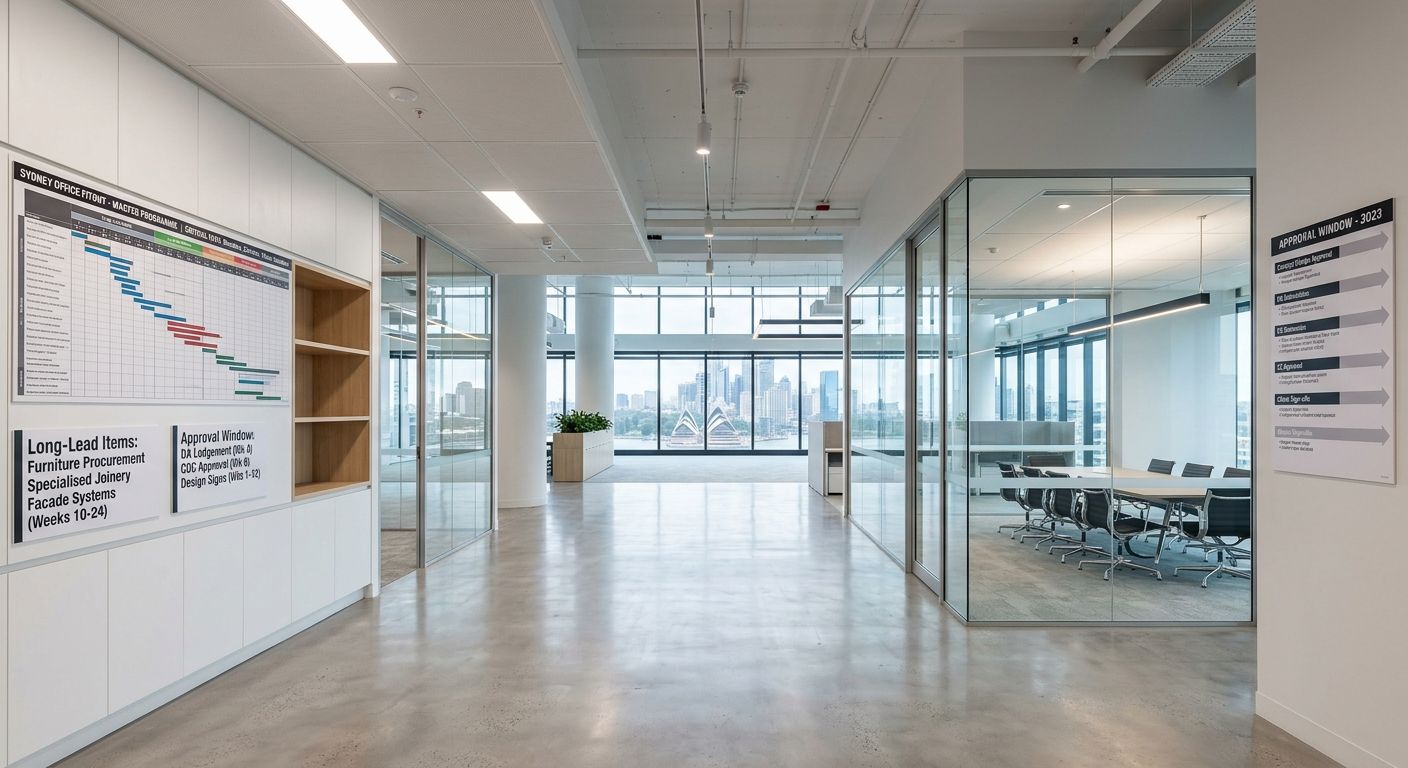
The programme on a Sydney commercial office fitout is rarely the document that causes the project to slip, but it is almost always the document that exposes the slip first. A client-side project manager’s job is to keep that programme honest: built backwards from the move-in date, sequenced through the dependencies that actually constrain delivery, with the long-lead items and the landlord approval window flagged as the early-resolution items they really are. The fitout team will have its own programme, and a good one will be detailed and realistic. The PM’s programme is a different document. It tracks the dependencies that sit outside the fitout team’s control, ties them to the fitout milestones, and identifies where the programme is genuinely fragile rather than just busy.
The pattern across most Sydney commercial fitouts in the eight-to-twelve-week range is that the critical path runs through three areas: long-lead procurement (joinery, glazing, custom ceiling work, sometimes loose furniture), the landlord approval window, and the services interfaces with the building. These three areas are usually where time gets lost, and they are usually identifiable from the first programme draft if the PM has the right inputs. The work below is what the PM’s programme view should cover, where to expect the dependencies to bite, and how to use the document to surface decisions early rather than discover them late.
Typical Sydney Commercial Fitout Program Structure
A standard medium-scope fitout in a Sydney CBD building runs in the eight-to-fourteen-week range from contract award to practical completion, depending on scope, building rules and any landlord-side approvals. The programme has predictable phases: design finalisation and tender close, contract and procurement, demolition and services strip-out, services rough-in and partition framing, ceiling and services finalisation, finishes and joinery, commissioning and defects, then handover and occupation. Each phase has fixed minimums, and each phase has dependencies on the phase that follows.
The fitout contractor will produce the construction programme. The PM’s programme overlays the wider project: the design and approvals work that runs ahead of construction, the procurement of items that will not arrive in time on a standard order, the building’s approval and access arrangements, the tenant’s own readiness work (IT, furniture, communications), and the post-handover phase including defects management. The fitout contractor’s programme is the inner programme. The PM’s programme is the outer one, and it is usually where the project lives or dies.
Pre-Drawing Long Lead Order Requirements
The single biggest cause of avoidable slip on Sydney commercial fitouts is long-lead procurement that is committed too late. Custom joinery in the six-to-eight-week lead time range. Frameless glazing systems with specific profiles. Operable wall partitions for boardrooms. Specialist ceiling tiles or feature ceiling elements. Some lighting and AV with stretched supply chains. Loose furniture if it is part of the contract. Each of these has a normal supply window that is longer than the build-from-strip-out programme that contains it.
The PM’s programme should identify these items in the first draft, not the third. Each item gets an order-by date that is keyed to the latest moment it can be ordered without slipping the construction critical path. That date is usually weeks before the design is fully signed off, which means the design work has to identify the long-lead items early enough that they can be specified to a level that lets them be ordered. The pattern that fails is the one where the design is finished neatly at the end of the design phase and the long-lead items are ordered as part of the procurement phase that follows. By that point the construction programme is already a week or two short on those items and there is nowhere obvious to make it back.
Landlord Approval Windows On The Critical Path
Most Sydney CBD landlords require submission and approval of fitout drawings before site works begin, with a formal approval window that varies between buildings. Two weeks is not unusual. Four to six weeks happens. Some heritage or premium-grade buildings take longer when the design touches the base building envelope, services, or anything visible from outside the tenancy. The approval is rarely a refusal. It is far more often a sequence of comments, queries, and conditions that have to be cleared before construction can mobilise.
From a programme perspective, this means the design has to be substantially complete materially earlier than the construction start date. The PM’s programme should show landlord approval as a discrete activity with a realistic duration, with the design freeze date keyed to the start of that window rather than the start of construction. Where the design is still moving inside the approval window, every change reopens the conversation with the landlord and resets the approval clock to some degree. The most disciplined PMs treat the landlord submission as a one-shot delivery, not a rolling negotiation, and that discipline is set in the programme rather than in the approval phase itself.
Managing Cascading Trade Interface Risks
Inside the construction programme, the trade interfaces are where most slip happens once the build is under way. Services rough-in has to finish before the partitions can be lined and closed up. The ceiling grid has to be installed in a sequence that lets the services finalisation happen above it. Joinery delivery has to land after the partitions are finished and the floor is laid, but before the painting finishes. Each trade depends on the previous trade leaving the area in a fit state to receive it. Each trade also has its own crew availability, which is rarely fully exclusive to the project.
The PM’s view of these interfaces should not duplicate the contractor’s coordination role. The contractor owns the daily coordination. What the PM should track is the milestone interfaces where a slip in one trade has consequences for the others: services rough-in completion, ceiling closure, partition closure, finishes start, joinery delivery, commissioning start. When one of these milestones moves, the PM’s programme should immediately show the downstream impact, and the conversation with the contractor should be about how to recover rather than whether the slip matters.
Programming Backwards From Move In Dates
Most fitout programmes are built forwards from the contract award date, which is the wrong direction for a programme that has to land on a fixed move-in. The PM’s view should be built backwards from the move-in date, with handover scheduled at least one week before, commissioning and defects a week or two before that, finishes and joinery earlier still, and so on back to the design freeze and approval submission. The forward-built programme tells you when the project will finish if everything runs to plan. The backwards-built programme tells you when each milestone has to happen for the move-in to hold.
When those two views give the same dates, the project is in good shape. When they diverge, the difference is the warning. A backwards-built programme that says design freeze had to happen three weeks ago is the cleanest possible signal that the project is in trouble, and it surfaces the problem in time to make the decisions that recover the position. A forwards-built programme that lands two weeks late at handover surfaces the same problem too late to do anything about it.
Strategic Allocation Of Program Contingency
Every fitout programme needs contingency, but most contingency is hidden or applied wrongly. Spread evenly across activities, contingency disappears into the ordinary slippage of busy trades and never shows up when the project actually needs it. Concentrated at the end of the programme as float before move-in, contingency creates a soft handover window that gets eaten by late finishes work and leaves nothing for genuine problems.
The cleaner pattern is to identify the activities most likely to cause real slip and to hold contingency against those specifically. Long-lead procurement, landlord approval, services commissioning, and the defects window are usually the right places. Two or three days of explicit contingency on each, transparent in the programme, gives the PM something to draw down when the specific risk materialises. Hidden contingency that is not visible in the programme is not contingency. It is a buffer the contractor can absorb without anyone noticing, which means it does not protect the move-in date.
Identifying Unready Briefs Through Scheduling
Programmes often surface a problem with the brief before they surface a problem with the build. If the design freeze date keeps moving because the business cannot settle on the layout, the meeting room mix, the joinery specification, or the AV scope, the programme is showing that the brief is still in motion. No amount of construction effort recovers from that. The right intervention is back at the brief, with the business making the calls that have been deferred.
The PM’s programme is one of the few documents that can make this visible to the business in a way that lands. “We are three days into the design freeze week and the AV scope is not signed off” is a sharper statement than “we are still working on the AV scope”. The programme converts the ambiguity into a missed milestone, and missed milestones force conversations that open-ended decisions do not. A PM who uses the programme to surface those conversations early is doing the part of the job that fitout contractors usually cannot do, and it is often the part that has the largest effect on whether the project lands cleanly.
Final Phase Handover Commissioning And Defects
The last two weeks of the programme are where most project handovers fail to land cleanly. Commissioning of mechanical and electrical systems takes time the programme often does not allow. The defects walk produces items that have to be rectified before practical completion. The fire and life safety certifications have to align with the building’s approval process. The cleaner expects a handover-ready space, not a partially-finished one. None of these are afterthoughts, but they often appear in the programme as a single “handover” activity rather than the layered sequence they actually are.
The PM’s programme should break the last two weeks into specific activities with realistic durations. Commissioning starts when services are finalised, runs in parallel with finishing trades, and produces a snag list that has to be worked through. The defects walk is best run a week before practical completion, not on the day, with rectifications scheduled into the remaining time. Handover documentation, certificates, warranties, and the operations and maintenance manuals all have to land before the tenant can take occupation cleanly. None of this is unusual. It just has to be in the programme as the work it actually is, not as a single line that absorbs whatever time is left.
If you are managing a Sydney commercial office fitout from the client side and want a contractor whose programme integrates cleanly with yours rather than running alongside it, we can walk through the long-lead items, the landlord approval window, and the trade interfaces with you, and price the work against a programme that lands honestly on the move-in date.
📞 Call us on 1300 60 93 93