
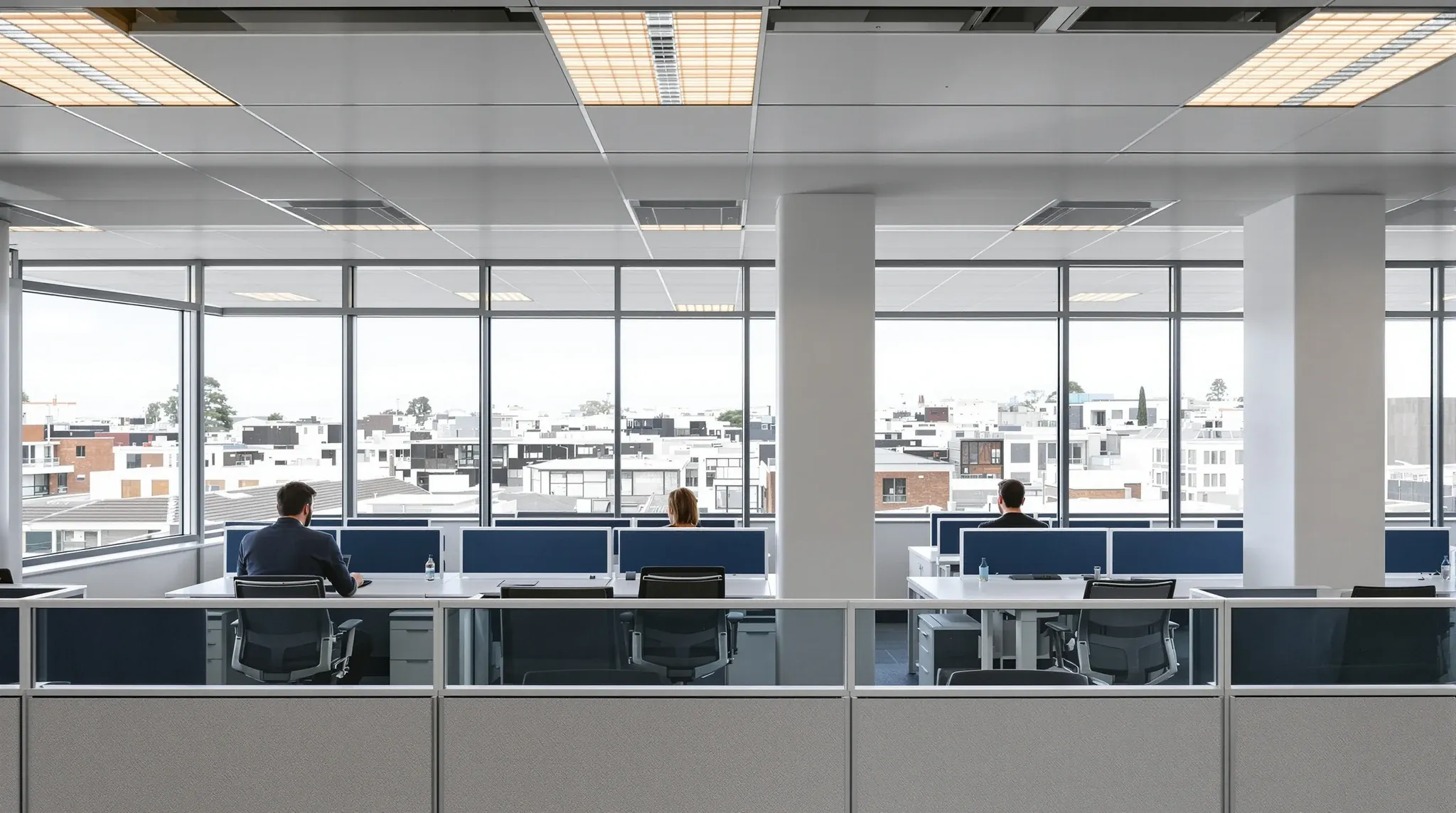
Office fitout in Newcastle runs on a different commercial logic than office fitout in Sydney, despite using the same construction trades, partition systems, and fitout disciplines. The Newcastle commercial market sits 160 kilometres north of Sydney CBD and operates as its own economy: heritage stock alongside new development, a meaningful concentration of professional services and government tenants, a redeveloping CBD around Honeysuckle and the foreshore, and a workforce that mixes long-tenure locals with newer arrivals from Sydney and from interstate. The fitout brief that works in Newcastle has to reflect that local context rather than treat the market as a smaller version of Sydney.
The differences from Sydney CBD show up in the building stock, the lease terms typical of the local market, the Newcastle City Council approval pathways, the trades and material logistics, and the workplace culture of Newcastle’s commercial tenants. A Sydney-based fitout brief dropped into Newcastle without adjustment usually misses on at least two of those, with the result being a fitout that works technically but does not quite fit the city it sits in.
The Newcastle Commercial Office Stock
Newcastle’s commercial office market clusters around three precincts: the traditional CBD around Hunter Street and Watt Street, the redeveloped Honeysuckle precinct along the foreshore, and a smaller cluster around the new University of Newcastle CBD campus at NewSpace. Each precinct has its own commercial character and its own fitout implications.
The traditional CBD includes heritage-listed and contributory buildings, mid-grade commercial stock from the 1960s through 1990s, and selective newer redevelopment. The heritage stock is the part that most often shapes fitout decisions. Newcastle’s central CBD has a relatively high concentration of character buildings (sandstone facades, traditional commercial architecture, sometimes with internal heritage controls), and tenants in these buildings work within constraints around facade modification, internal partition placement against heritage walls, and services routing through original building fabric. Fitouts in heritage or converted buildings follow methods that transfer cleanly between Newcastle and Sydney heritage stock.
The Honeysuckle precinct is newer, with A-grade buildings developed from the 2000s onward. The structural and services capacity in these buildings supports modern fitout demand cleanly; tenants face fewer base-building constraints and the brief can focus on workplace strategy rather than on working around building limitations. Honeysuckle is also where most of Newcastle’s larger corporate and government tenancies sit, with longer lease terms and more sophisticated fitout requirements.
The NewSpace area and the surrounding inner-CBD redevelopment are still finding their character. Newer stock is mixed with refurbished older buildings, and tenant profile ranges from education-adjacent to creative to professional services. Fitout briefs here vary widely.
Lease Terms In The Newcastle Market
Newcastle commercial leases follow the same structural form as Sydney leases but with different commercial weighting. Lease terms are sometimes shorter than equivalent Sydney terms for smaller tenancies (3 to 5 year primary terms common for SME tenants), with longer terms (7 to 10 years) common for larger corporate and government tenancies in A-grade Honeysuckle stock. Make-good clauses are typically standard commercial make-good with full reinstatement.
The shorter typical term in some Newcastle tenancies changes the fitout calculus from a comparable Sydney tenancy. A 5-year term amortises the fitout investment across less time, which justifies lighter fitout build-ups and a stronger weighting toward demountable or reversible partition systems. Where the lease end is closer, make-good cost has more weight in the original spec decision.
Landlord approval processes in Newcastle vary by building. A-grade Honeysuckle landlords typically have well-established alterations approval processes, similar to Sydney CBD A-grade. Mid-grade and heritage CBD buildings sometimes have less formalised processes, which can mean faster approval for straightforward scopes but less predictability for unusual work. Tenants should establish the building’s specific process early rather than assuming a Sydney commercial standard applies.
Newcastle City Council And Approval Pathways
Newcastle City Council handles planning and development consent for fitout work requiring council approval. Most commercial office fitouts inside existing tenancies do not require council DA, where the work is internal, non-structural, and within the building’s approved use. Where the fitout involves change of use, structural alterations, or external changes, the council pathway becomes relevant.
Heritage controls are more material in Newcastle than in many Sydney commercial precincts. The CBD heritage conservation area covers a meaningful share of the traditional commercial stock, with specific buildings individually listed. Tenants in heritage-controlled stock should confirm the building’s heritage status and the controls that apply before committing to fitout works that might affect protected fabric. Internal works are usually less constrained than external; partition placement against heritage walls and services penetrations through original fabric typically require specific approvals.
Approval timelines through Newcastle Council are generally workable but can run longer than Sydney commercial timelines during peak development periods. Tenants planning fitout with council-approval requirements should factor 6 to 10 weeks into the program for the approval cycle, with longer buffers for heritage-affected work. The pattern we see most often on Newcastle approvals is timeline underestimation; tenants budget the Sydney timeline and find the local pace runs slower in practice.
Trades, Materials, And The Sydney Logistics Relationship
Newcastle has a meaningful local trade pool capable of handling standard commercial fitout work. Partition systems, ceiling installations, finish trades, general electrical and mechanical work are all served by Newcastle-based or Hunter regional trades. Bespoke joinery, specialist glazing, custom AV integration, and premium finishes more often involve Sydney-based suppliers, with the work delivered via Sydney logistics or by Sydney trades travelling to site.
The distance (about 2 hours by road) is workable for project management and for trades travelling for specific tasks, but adds friction compared to a Sydney metropolitan project. Mobilisation premiums for Sydney trades travelling to Newcastle typically run 5 to 15 percent on affected labour, offset by materials cost similarity (most commercial fitout supplies cost the same in both markets through integrated supply chains).
The trade pool’s strength varies by discipline. Newcastle is well-served for standard commercial trades; the city has a long industrial and commercial construction history and the trade base reflects it. Specialist trades (medical fitout, lab installation, high-spec AV integration, premium custom joinery) more often involve Sydney engagement, with the trade-off being travel cost and coordination complexity.
The logistics consideration that matters most is access for material deliveries. Newcastle CBD buildings have varying lift access and loading-zone arrangements; A-grade Honeysuckle buildings are well-equipped, older CBD buildings sometimes have constrained access that limits material handling. The fitout program should confirm access conditions at the specific building before pricing.
Newcastle Workplace Culture And What It Implies For The Brief
Newcastle’s commercial workforce mixes long-tenure local staff with newer arrivals from Sydney, Melbourne, and interstate. The mix has implications for workplace strategy. Local staff with deep regional roots respond differently to workplace design than Sydney-CBD-style fitout templates assume; the brief that works in Newcastle often leans into local material references, regional identity, and a slightly less corporate-generic aesthetic than equivalent Sydney CBD work.
The pattern we see most often on successful Newcastle fitouts is briefs that explicitly resist the glossy A-grade Sydney CBD template. Local timber materials, references to the city’s industrial and maritime heritage where natural, and a slightly more grounded finish language than the Sydney equivalent tend to land better with both staff and clients. Pure Sydney-template fitouts sometimes read as imposed rather than locally fluent.
The workforce demographics also affect attendance patterns. Newcastle’s hybrid attendance is generally slightly higher than equivalent Sydney professional services, partly because the commute distances are shorter for most staff and partly because local culture supports stronger in-office norms. Fitouts that size for full-attendance occupancy work cleanly; fitouts that assume Sydney-style 60 percent attendance sometimes under-spec capacity for the actual Newcastle pattern.
The Professional Services Concentration
Newcastle’s commercial office demand is heavily weighted toward professional services (legal, accounting, consulting), government and government-adjacent tenants, healthcare and allied health, education-related organisations, and a growing tech and creative sector. The fitout briefs these tenants produce share characteristics: meeting room density for client-facing work, acoustic privacy for confidential conversations, considered reception experiences, and stable individual workstations rather than heavy hot-desking.
Government tenancies are a larger share of the Newcastle market than they would be in equivalent Sydney CBD blocks, and government fitout briefs typically require specific procurement compliance, accessibility provision, and finish specifications that match relevant agency standards. Tenants pricing fitout work for government or government-adjacent clients should confirm the brief’s procurement and compliance requirements early.
Healthcare and allied health fitouts in Newcastle follow Sydney medical fitout patterns with the same cost drivers (plumbing, finish specification, acoustic privacy, dedicated services). The local trade pool handles standard medical fitouts but specialised scopes (imaging, lead-lined rooms, surgical procedure infrastructure) typically involve Sydney-based specialists travelling for the project.
Working With A Sydney-Based Fitout Team On A Newcastle Project
A meaningful share of Newcastle commercial fitouts are delivered by Sydney-based teams working on Newcastle tenancies, with local trades subcontracted where appropriate. The model works because the fitout disciplines, contractor capabilities, and design language transfer cleanly, while the local logistics, council relationships, and building-specific knowledge can be brought in for the specific project.
The practical considerations on a Sydney-managed Newcastle project are travel time for site visits, a clear on-site contact during works, the contractor’s familiarity with the specific building, council approval lead times, and the local trade coordination. These are solvable through experienced project management, and the result for tenants is usually a delivered fitout at Sydney commercial-grade quality with the local building knowledge layered in.
Tenants choosing between a Sydney-based fitout team and a Newcastle-based team typically weigh the depth of fitout expertise (Sydney teams handle higher project volumes and broader specialist scopes) against the local familiarity (Newcastle teams often have closer council relationships and faster building-specific knowledge). For larger and more complex fitouts, the Sydney-based approach with local subcontracting tends to be the cleaner fit; for smaller and more straightforward scopes, the local team is often the right answer.
If you are scoping an office fitout in Newcastle, whether in heritage CBD stock, A-grade Honeysuckle, or newer redevelopment, we work across Newcastle tenancies from Sydney with established processes for the building access, council approval, and trade coordination that the Hunter commercial market requires. We can run through the brief on a complete office fitout basis against your specific building and lease position.
📞 Call us on 1300 60 93 93