
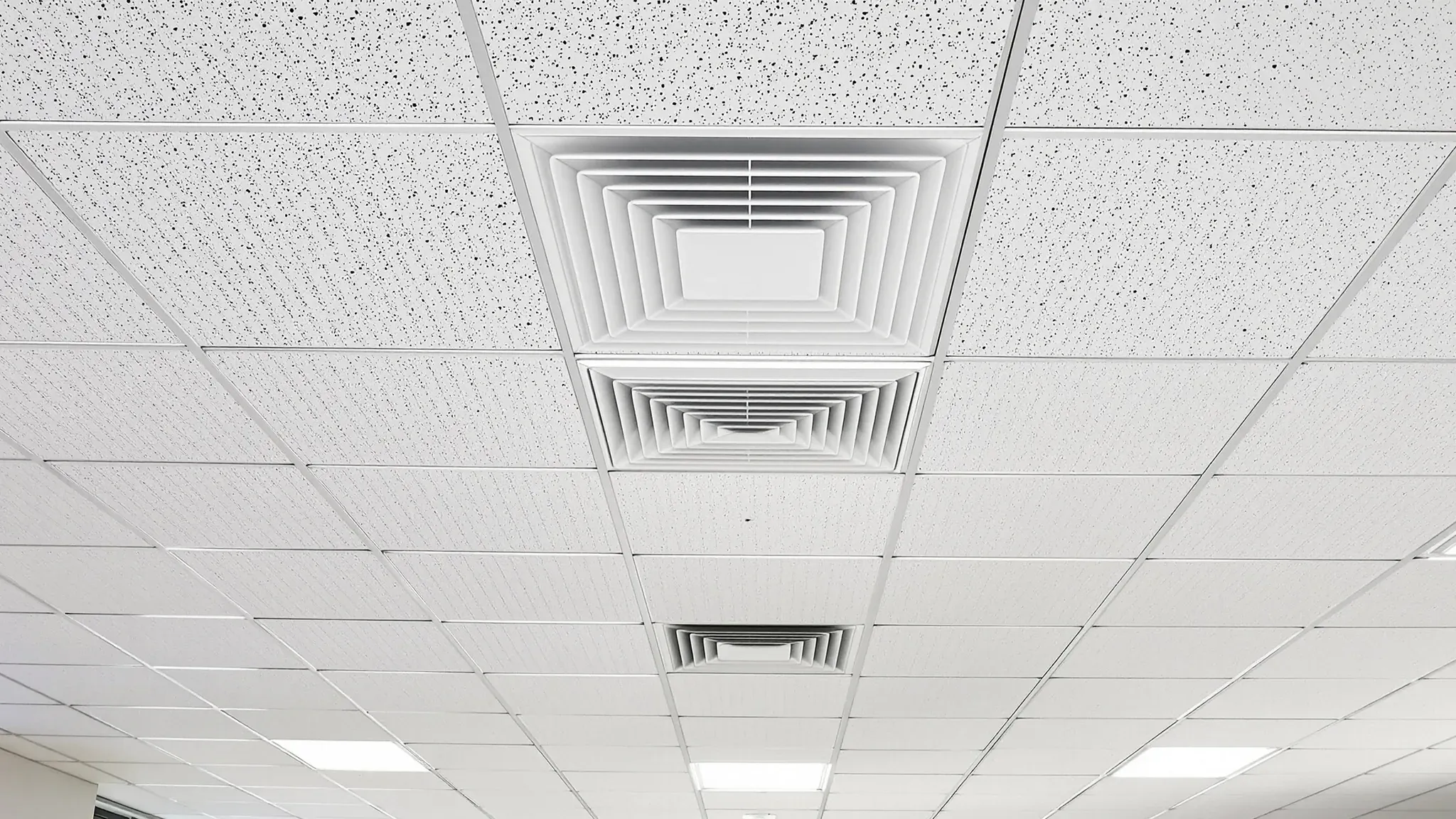
Repairing an office ceiling after a water leak is the work that replaces what the water has damaged and makes the ceiling match the rest of the room again. Wet tiles and soft plasterboard are usually replaced, while the metal grid and the steel ceiling frame can usually be kept. The repair starts once the leak has been fixed and the ceiling has dried.
We carry out suspended ceiling repairs and plasterboard ceiling repairs as separate jobs, without a wider fitout. A job can be a few tiles under an air conditioning unit or the ceiling of a whole room. How much of the ceiling can be kept depends on whether it is tiled or plasterboard, and on how long the water sat.
What Is Repaired and What Is Replaced
Tiles and plasterboard soak up water, so they are usually replaced once they are wet through. The metal grid and the steel ceiling frame are usually kept.
| Part of the ceiling | Usually kept or repaired | Usually replaced |
|---|---|---|
| Ceiling tiles | Dry, flat tiles with no marks | Wet, stained, sagging or soft tiles |
| Metal grid | Straight bars, cleaned and relevelled | Bent, buckled or rusted bars |
| Plasterboard | Firm, dry board with a stain, sealed and repainted | Soft, swollen or sagging board, or board with peeling paper |
| Steel ceiling frame and screws | Dry, straight channels | Rusted channels and screws |
Drying a sagged tile or a sagged section of plasterboard does not return it to its original shape.
The Order of a Ceiling Repair
A ceiling repair after a leak usually follows this order:
- The plumber, roofer or air conditioning contractor fixes the leak, because new tiles or paint under a live leak stain again.
- Wet tiles come down, and a sagging plasterboard ceiling is propped or taken down before it falls.
- Insulation is lifted off the ceiling so the tiles or board can dry.
- An electrician checks wet light fittings before they are switched back on.
- We repair the grid or ceiling frame, then replace the tiles or plasterboard.
- Plasterboard joints are filled and sanded, then the ceiling is sealed and painted.
Water can run along the top of the tiles or the board before it drips through. We lift the tiles around a stain to see how far the water travelled. On a plasterboard ceiling, we check the board on both sides of the stain for soft spots.
Where water has also reached the walls and floor, the repair becomes a wider reinstatement after a burst pipe, with partitions and floor finishes in the same programme.
Ceiling Tiles After a Leak
A tile that has been soaked is usually replaced rather than dried and put back. The brown mark left by a leak soaks into a mineral fibre tile rather than sitting on its face, so it rarely cleans off. A tile that stays damp can also grow mould, which is one more reason it is replaced.
Painting over a stain is possible, but the paint can reduce how much sound the tile absorbs and change how it behaves in a fire. Most office tiles are acoustic tiles, chosen to absorb sound, so we usually replace a stained tile instead.
Some tiles are made to hold their shape in damp conditions. Near an air conditioning unit, where condensation can form in the ceiling space, we can lay moisture-resistant ceiling tiles in place of the standard ones.
The Metal Grid Above the Tiles
The grid usually comes through a leak intact, but soaked tiles can bend it. Its short cross bars, called cross tees, are chosen to carry the weight of a dry tile. A tile full of water weighs more, and a row of soaked tiles can bend the tees under it or pull part of the grid out of level.
A bent tee can be unclipped and replaced without taking the rest of the grid down. The new tee has to match the old grid's profile and the width of its visible face, so it locks in and lines up with its neighbours. We then adjust the hangers that hold the grid from the slab above until the grid is level again.
Light water marks can be cleaned off the grid. A tee with rust showing through its painted face is replaced.
Repairing a Plasterboard Ceiling
A plasterboard ceiling soaked across a large area usually needs replacing. After a smaller leak, the damaged section can usually be cut out and replaced, and the rest of the ceiling kept.
Wet plasterboard cannot be judged until it is dry. We check how firm the board is, and whether its screws still hold, once the moisture has gone.
Once the ceiling is dry, firm board with only a stain is sealed with a stain-blocking sealer before it is repainted. Without the sealer, the brown mark can bleed through the new paint.
In most offices, the plasterboard is screwed to light steel channels hung from the slab. We cut the damaged board back to the nearest channels, so the new piece has framing to screw to along every edge. The new piece matches the old board's thickness and type. Its joints are then taped, filled and sanded flush with the ceiling around it.
A ceiling built to resist fire or to reduce sound is usually repaired with the same board and joint details as the original. A different board can change how the ceiling performs.
We usually repaint the whole ceiling of the room, or up to a corner or a change in ceiling height. New paint on a patch can show a different colour and sheen from the old paint around it.
Perforated plasterboard is an acoustic ceiling board with rows of holes and a fabric backing that absorbs sound. Its hole pattern runs unbroken across the joints, so a repair usually replaces whole boards. Each new board is fixed with the exact joint gap its pattern needs, which keeps the holes in line with the old boards. The paint is rolled on rather than sprayed. Spray paint can clog the fabric behind the holes and reduce how much sound the ceiling absorbs.
Matching New Tiles to an Old Ceiling
The wet tile that comes down is the best guide to its replacement. Its size, edge profile, thickness and face pattern narrow down which office ceiling tile it is. Some tiles also carry the maker's markings on the back. Where a tile is no longer made, a manufacturer can often suggest the closest current tile from a sample or photographs.
The right tile can still look whiter than tiles that have aged in place. The difference shows most where a few new tiles sit in the middle of a large open ceiling. Instead of replacing tiles one by one, we can retile the whole room or corridor. The undamaged old tiles from that room then become spares for the rest of the office.
We can inspect the ceiling once the leak is fixed, quote the tiles, grid or plasterboard that need replacing, and repair the ceiling to match the room.
📞 Call us on 1300 60 93 93