
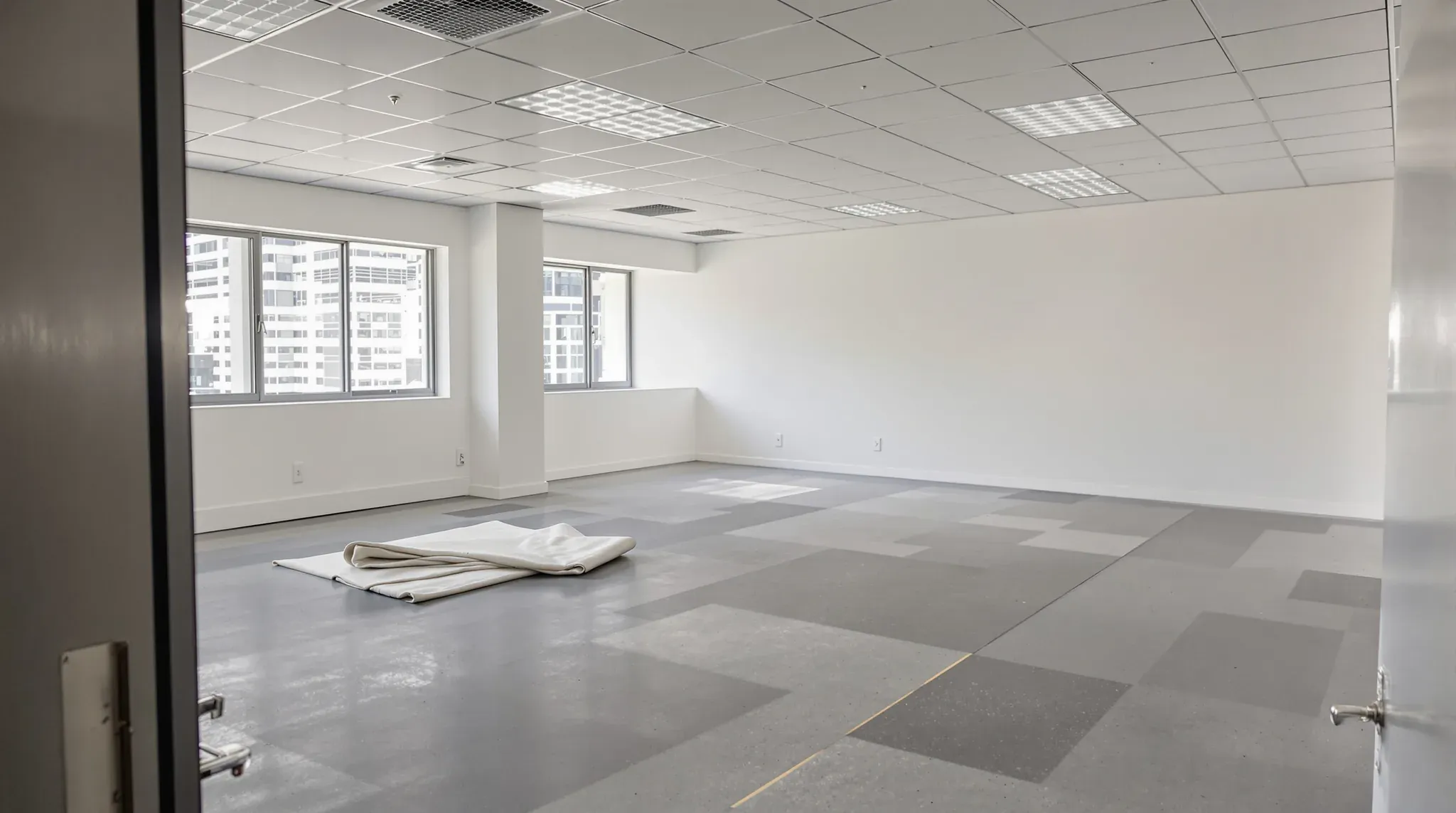
A final strip out is the removal of a business's fitout when the business closes rather than moves. With no new premises to take anything to, the business first sells, gives away or recycles its furniture, equipment and stock. Then the services are disconnected and the fitout is stripped out as the lease's make good clause lists. The empty tenancy is repaired and handed back with the keys.
Defit is another name for a strip out. A make good adds the repairs and repainting the lease asks for. We quote a closing business's defit and make good after reading the lease and walking through every room. The same steps apply whether the business is an office, a shop or a clinic.
The Order of a Final Strip Out
A final strip out usually runs in this order:
- The business clears its furniture, equipment, stock and files.
- Equipment that a buyer will collect is disconnected from the power, water or gas.
- The tenant's power circuits, data cabling and security equipment are disconnected.
- The fitout items the lease lists are stripped out and sorted for recycling.
- The floor, walls and ceiling are patched, repainted and cleaned.
- The landlord or property manager inspects the tenancy, and the keys go back.
The strip out starts once the contents have gone. Anything still in the tenancy at that point comes out with the fitout and usually leaves as waste.
Clearing Furniture, Equipment and Stock
A business that moves takes its desks, computers and kitchen appliances to the new premises. A closing business has to find each of those items a buyer, a new home or a recycler before the strip out starts.
Office furniture can be sold to second-hand dealers or given away. Rented equipment, such as a printer or a water cooler, goes back to the company that supplies it. Stock, files and personal belongings leave with the business and its staff.
Computers, monitors, printers and TVs can go to a drop-off point in the National Television and Computer Recycling Scheme. Drop-off through the scheme is free for households and small businesses. Larger businesses, and collections from the premises, may be charged.
Equipment a Buyer Collects
Equipment connected to the building's services has to be disconnected before a buyer can take it away. Examples include a gas cooktop or oven, a dishwasher, a boiling water tap, a plumbed coffee machine and any appliance wired straight into the power.
In NSW, disconnecting a gas appliance from its gas pipework is gasfitting work, and gasfitting and plumbing work need a licence. A gas fitter disconnects each gas appliance and caps the pipe. A plumber shuts off the water to each plumbed appliance and seals the open end. Hardwired equipment is isolated at the switchboard before an electrician disconnects it.
Screens, whiteboards and shelving fixed to the walls are unbolted and taken down. We fill each bolt hole and repaint any wall that stays.
A closing cafe or restaurant also has a kitchen exhaust hood and a grease trap. In a cafe or restaurant make good, each is either removed or left working for the next food tenant, as the lease lists.
What the Lease Asks to Be Removed
The lease's make good clause, and any schedule attached to it, lists what the tenant removes and what is repaired. These lists commonly include the tenant's partitions and glass offices, kitchen joinery, signage, data cabling and floor coverings. Patching and repainting are usually listed too. Some leases also ask for particular items to stay, such as a kitchen or meeting rooms the landlord wants for the next tenant.
A closing business may leave behind items that a moving business would take with it. Examples are a server rack, a safe bolted to the floor or a storage cage fixed to the concrete. Each is either cleared before the strip out or removed with the fitout. The anchor holes they leave in the concrete floor are filled and levelled with the other floor repairs.
Disconnecting the Business's Services
Each service the business added is disconnected before the walls and ceilings around it come out. An electrician disconnects the business's circuits at the tenant's switchboard and makes the cable ends safe. Where the lease lists it, the tenant's data and power cabling is pulled out back to the riser, the shaft where the building's cables pass between levels.
Pipework the business added for water or gas is cut back and capped at the point the lease names. The business's card readers, cameras, alarm sensors and alarm panel are removed by the security installer, together with their cables.
Where the business has its own electricity account, the account stays open until the keys are handed back. Closing an account usually brings a final meter reading and, in some states, a disconnection. The strip out needs lights and power for its tools until the last day.
Recycling the Fitout
Much of a fitout can be recycled when its materials are kept apart as it comes out. Steel studs, ceiling grid and aluminium partition frames leave as scrap metal. Clean plasterboard can go to a recycler, and some carpet tiles and ceiling tiles can go back to the companies that made them.
We sort fitout waste at strip out into separate bins or cages as each room comes apart. Plasterboard mixed with screws, timber or insulation is usually no longer clean enough to recycle. Waste that cannot be recycled goes to a facility that can lawfully accept that type of waste.
Signage and Handing Back the Keys
The business's name comes off the shopfront, the entry door, any glass and the directory board in the building's lobby. Removing signage leaves screw holes in walls and adhesive on glass. We fill and repaint the walls and clean the glass.
The tenancy is ready to hand back once it is empty, repaired, repainted and cleaned. The landlord or property manager walks through it and compares it with the make good clause and any condition report written when the business moved in.
Storerooms, cupboards and the comms room that held the network equipment are checked for anything left behind before the keys go back. The business then returns every key and access card, along with fobs, car park remotes and any keys copied during the lease.
We can walk through your tenancy and quote the strip out, then start once the furniture and equipment have gone.
📞 Call us on 1300 60 93 93