
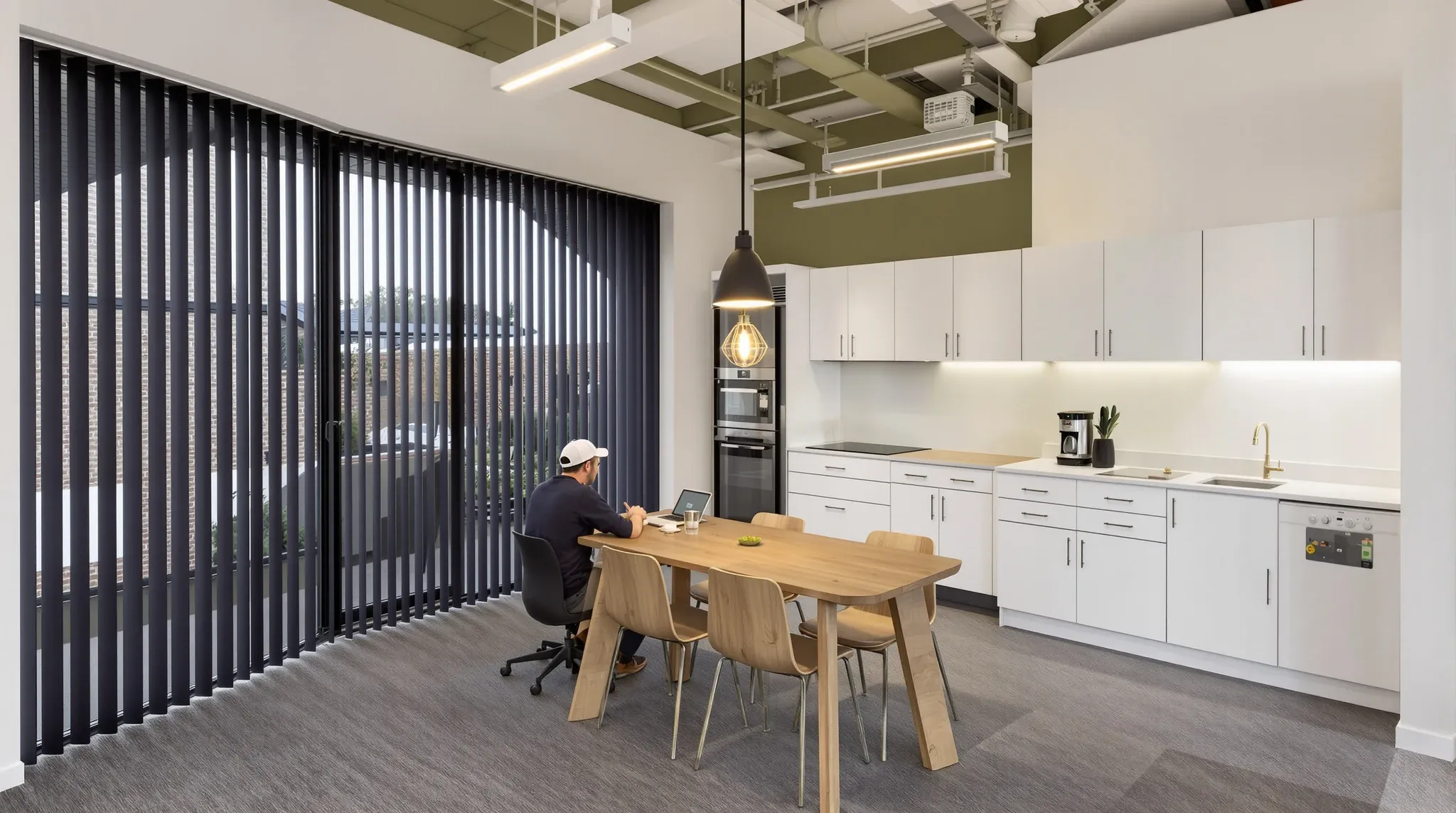
Founder-led businesses approach office fitouts differently from corporate tenants, and understanding that difference is the starting point for getting the project right. When the person making the fitout decisions is also the person who built the business, the financial risk is personal, the timeline is driven by operational need rather than corporate process, and the design priorities reflect a direct connection between the workspace and the way the business functions day to day.
Founders typically operate with less buffer between the fitout budget and the business’s cash flow. They tend to make decisions faster than committees but are more personally invested in the outcome. They are often planning for growth but uncertain about the pace and shape that growth will take. These characteristics mean that a fitout for a founder-led business needs to be practical, budget-conscious, and flexible enough to accommodate change without requiring a complete refit within a few years.
How Founder-Led Businesses Think About Fitout Differently
In a corporate environment, the fitout budget is typically approved through a procurement process, managed by a project team, and absorbed into the broader capital expenditure programme. The decision-makers are often several steps removed from the daily operations of the space they are creating. In a founder-led business, the person writing the cheque is usually the person who will sit in the office every day.
That direct connection between investment and experience changes the way decisions are made. Founders tend to weigh practical performance over aesthetic trends. They are less likely to over-invest in finishes that do not serve a functional purpose and more likely to prioritise the elements that directly affect their team’s productivity and the client experience. They also tend to make decisions quickly once they are satisfied with the reasoning, which can accelerate the fitout process considerably if the information is presented clearly and the options are well defined.
The downside of founder-driven decision-making is that it can sometimes compress the design phase too aggressively. A desire to move fast can lead to decisions being made before all the options are properly evaluated, which creates change orders during construction that cost more than the time they were intended to save. Reducing fitout risk without overspending is particularly relevant for founders, because the cost of rework falls directly on the business rather than being absorbed by a corporate contingency fund.
Budget Sensitivity and Where to Invest
Founders are typically spending their own money or money the business has earned, which creates a different relationship with the budget than a corporate tenant managing an allocated capital amount. Every dollar spent on the fitout is a dollar not available for hiring, marketing, inventory, or other growth investments. That context means the fitout budget needs to be optimised rather than just managed.
The most effective approach for founder-led businesses is to invest heavily in the elements that directly affect daily operations and client perception while specifying more modestly in areas that do not. Good partitioning, proper electrical and data infrastructure, functional meeting rooms, and a well-considered reception area are worth investing in because they affect the business every day. Premium flooring in a back-of-house corridor, designer light fittings in the utility room, and custom joinery in the print area are places where standard specifications deliver adequate results at lower cost.
The cheapest quote is often the riskiest for founder-led businesses, because the consequences of poor quality, missed timelines, and incomplete scope fall directly on the owner rather than being diffused across a corporate structure. The lowest price typically reflects omissions in scope, lower-quality materials, or compressed timelines that create risk. A middle-ground approach that prioritises reliability and completeness tends to deliver better value over the life of the tenancy.
Growth Planning Without Overcommitting
One of the most challenging aspects of a fitout for a founder-led business is planning for growth when the trajectory is uncertain. Founders typically know they want to grow but cannot predict whether the team will double in six months or remain stable for two years. Building for the maximum growth scenario wastes money on space that may sit empty. Building only for today’s headcount creates a problem the moment a new hire is needed.
A practical approach is to design the layout so that it can accommodate modest growth through simple adjustments rather than requiring construction work. Workstation areas that can add desks without moving walls, meeting rooms that can double as temporary offices, and storage areas that can be converted to workspace if needed all provide growth capacity without requiring upfront construction for space that may not be occupied for years.
Avoiding the need to rebuild every year is a particular priority for founders, because the disruption of construction in a working office is more acutely felt in a small business than in a large one. A well-planned fitout that anticipates a reasonable growth range can typically accommodate two to three years of expansion before major modifications are needed, which aligns well with most commercial lease review cycles.
The Founder as Decision-Maker and Primary Stakeholder
In a founder-led fitout, the decision-maker is also the primary stakeholder, which simplifies the approval process but creates its own challenges. Founders often have strong views about how their workspace should look and feel, and those views are informed by years of working in the business rather than by design expertise. The fitout team needs to respect that experience while also providing the technical guidance that ensures the founder’s vision translates into a functional and compliant space.
Communication is typically more direct in a founder-led project than in a corporate one. Decisions can be made in a single conversation rather than requiring committee approval, which keeps the project moving but also means that decisions need to be well-supported with clear information. Presenting options with their cost implications, performance trade-offs, and timeline impacts allows the founder to make informed choices quickly without feeling rushed or uninformed.
The emotional investment that founders bring to the fitout is also worth acknowledging. For many founders, the office represents a milestone in the business’s development. Moving from a shared workspace or a home office into a dedicated tenancy is a significant step, and the fitout is the physical expression of that progress. A fitout team that understands that context delivers a better experience than one that treats the project as purely transactional.
Lease Alignment and Fitout Scope
Founder-led businesses are often on shorter leases than corporate tenants, which affects both the fitout scope and the investment calculation. A three-year lease justifies a different level of fitout investment than a seven-year lease, because the amortisation period for the fitout cost is shorter and the make good liability at lease end comes around sooner.
The fitout scope should be calibrated to the lease term. On a shorter lease, it makes sense to keep the fitout lighter and more reversible, using approaches that deliver good daily performance without creating an expensive make good obligation at lease end. On a longer lease, a more substantial fitout with higher-quality finishes and more permanent construction can be justified because the investment is spread over more years of use.
A complete fitout for a founder-led business on a five-year lease might include standard plasterboard partitioning, a well-designed reception area, functional meeting rooms, and good electrical and data infrastructure, all specified to a standard that performs well for the lease term without over-investing in materials or finishes that will be stripped out at lease end.
Client Presentation and Team Culture
The workspace in a founder-led business often needs to serve double duty as both a productive working environment and a space where clients form impressions about the business. The reception area, the meeting rooms, and the general state of the office all influence how clients perceive the business’s competence and professionalism. Founders who meet clients in their office understand this intuitively, which is why many invest more heavily in the client-facing areas than in the back-of-house zones.
The workspace also plays a direct role in team culture. In a founder-led business, the team is typically small enough that the physical environment affects everyone’s daily experience. A well-designed workspace that feels comfortable, functional, and reflective of the business’s values helps attract and retain the people the business depends on. Conversely, a cramped, poorly lit, or neglected office sends a message about the founder’s priorities that can undermine morale and recruitment.
Getting the balance right between client presentation, team comfort, and budget discipline is the core challenge of a founder-led fitout. The businesses that get it right tend to invest in a coherent, well-planned space that prioritises the areas that matter most and accepts standard finishes where they are adequate. The result is a workspace that feels professional and purposeful without spending more than the business can justify.
Working with a Fitout Team That Understands Founder Priorities
Founder-led businesses benefit most from fitout teams that understand the specific pressures and priorities of owner-operated companies. The budget is real, not theoretical. The timeline is driven by operational need, not a project management schedule. The decisions need to be practical and commercially grounded rather than design-led or trend-driven.
A practical fitout roadmap for small business owners provides a useful framework for founders approaching their first significant fitout. The key steps involve establishing the budget realistically, briefing the fitout team thoroughly, reviewing options with clear cost and performance information, and allowing adequate time for design and construction phases without compressing them to the point where quality suffers.
The fitout for a founder-led business does not need to be modest or uninspiring. Many of the most effective office environments are created by founders who invest thoughtfully in the elements that matter most to their team and their clients while being disciplined about where the budget goes. The result is a workspace that reflects the founder’s values, supports the team’s work, and presents the business to clients with confidence.
If you are building or growing a business and need a workspace that works as hard as you do, Complete Office Fitouts can help with the planning, budgeting, and delivery.
Call us on 1300 60 93 93